Open post

“The Titanic Was Also A Vessel of Hope”: David Vartanian

"The Titanic Was Also a Vessel of Hope": David Vartanian

David Vartanian (who Armenian name was Davit) was 21 years old when his family implored him to leave them—and his new wife—behind in Armenia.

He had just married his sweetheart, Mary, in 1911.

David was a Christian, and the Armenian populace was suffering more each day, persecuted and abused by the hand of the Ottoman Empire. Additionally, there was a rumor that the Turks were beginning to draft able-bodied young men from the villages, sending them to the front lines without any weapons.

So local families collaborated to save their sons.

David Vartarian’s salvation was the kindness of his Turkish neighbors, who gave David their dead son’s papers, so that he would be permitted to leave the country.

And so David banded together with four other young men from the village. They set their course on foot for a seven-day trek to the Black Sea, where they then sailed for Marseilles, France.

Once there, the group purchased steerage tickets on the RMS Titanic. They would leave from Cherbourg.

David’s compatriot Neshan Krekorian described the steerage accommodations as snug, but comfortable.

Both David and Neshan were among those who insisted that steerage passengers were barricaded below decks. The reasoning, however, is rarely cited to be anything more than fact, although malice is often implied: Third-Class passengers were not permitted under any circumstance to enter other parts of the ship belonging to First- and Second-Class. Certain areas were always locked or closed off to prevent any wandering.

Neshan Krekorian attested to breaking a chain on a door. David said they had to break down the gates.

David Vartanian made it to the boat deck in the end and soon thereafter found himself with no other option than to jump from Titanic.

And so David watched Titanic sink.

It was his 22nd birthday.
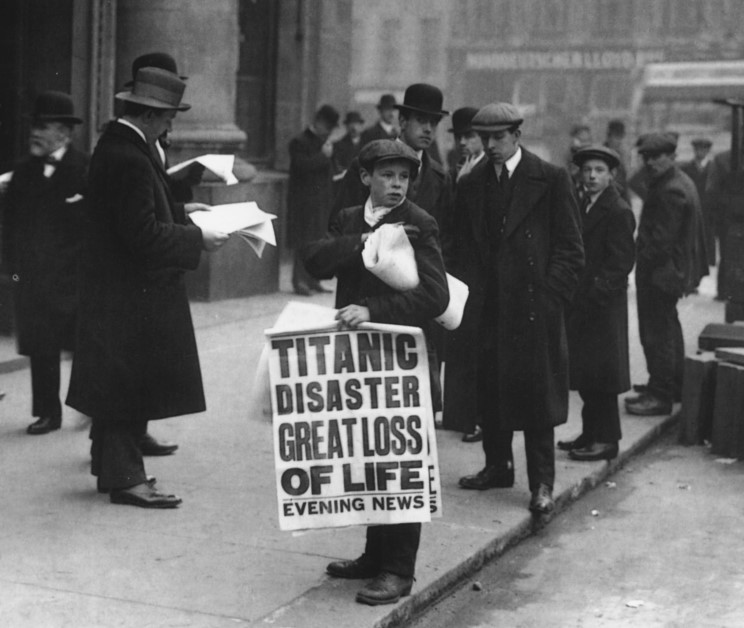
Before leaving Armenia, David reportedly had taught himself to swim in a nearby creek; he would maintain that this incidental choice saved his life that night in the Atlantic.

David Vartanian always maintained that he swam for the nearest lifeboat, but when he reached it, the occupants within slapped and pounded at his hands to make him let go. They were terrified, he believed, that he would capsize the boat while attempting to climb in. 

David did not speak English at the time. He did not understand.

He back away, but had to swim back. When those in the lifeboat saw that David was only attempting to hold on, and not crawl in, they let him alone. He shortly fell into unconsciousness, and they hauled him into the boat.

This is sometimes speculated to have been Collapsible A, which was partially submerged.

David’s family have since been told that sometime after David had been pulled aboard unconscious, that the lifeboat went under. David swam to another, it is said, where he entered without any hesitation from the passengers in the boat.

In the end, there is no conclusive evidence to be had about which version of events is true. We only know for certain that he was somehow saved from the water.

David Vartarian and Neshan Krekorian were the only survivors of the five in their party. 

Upon reaching New York, the two men were hospitalized. According to David’s grandson, "The lower half of my grandfather’s body had a bluish tint from being in the frigid water for so long, and remained that way.”

While he and Neshan were convalescing, a reporter visited at the hospital with a translator in tow. At some point during the interview, this journalist informed David that he was one of two survivors with the same first name. When asked which he preferred, he replied, “Titanic David.”

He went by “Titanic David” for all the rest of his life.
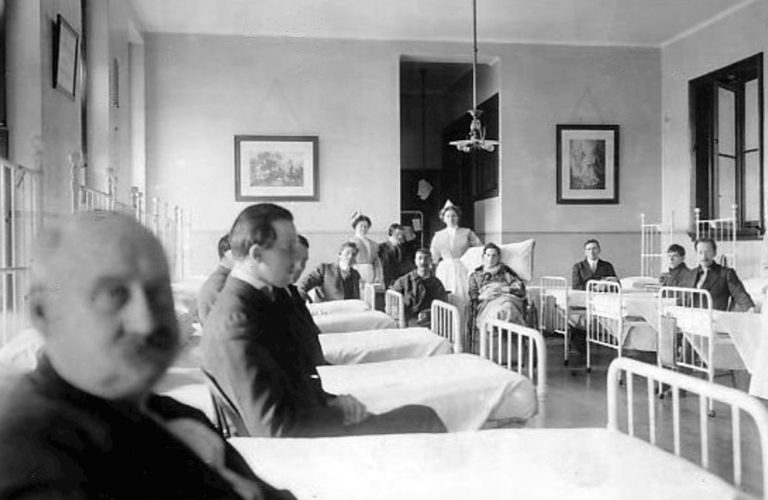
But David’s saga had not concluded in his survival.

David eventually left Canada for Toledo, Ohio. By 1915, he had heard that the village he had left behind had been decimated in the ongoing invasion by the Ottoman Empire.

He was led to believe that his beloved wife, Mary, was dead--inevitably killed in the genocide of the Armenian people.

In 1915, Mary’s brothers had miraculously found their ways to America and had set up in Pennsylvania. David met up with them to begin a campaign to track down his dear Mary. 

Dead or alive, he had to find her.

David proceeded to write to relatives, churches and convents, orphanages, newspapers, and anyone or anything else  that occurred to him.

And six years after he left Armenia, David Vartanian found Mary alive. 

Mary had fled her village in the genocide, but had returned to live with her sister.

She herself, having heard of the disaster and nothing more, had believed that David had been killed in the sinking of the Titanic.

According to the Vartanian family, David sent Mary money for the journey for nearly five years. Their daughter Rose revealed that money in Armenia was gold coin, so Mary kept each coin on a necklace. 

One day, Mary would reunite with her husband in America. Because she was not a legal citizen, she would travel to Canada first, and then cross the border.

Immediately before Mary left Armenia for her passage to Canada, her family convinced her to leave the necklace behind because, as Rose Vartanian repeated decades on, “where you are going, the streets are paved with gold.”

Their great-granddaughter Melissa has mused on the significance of the Titanic not just from the vantage of trauma, but also of promise.

While I do agree that the sinking led to great loss and devastation, the Titanic was also a vessel of hope to so many that were fleeing persecution, or searching a better life.

Upon her arrival in Canada, Mary Vartanian was met by an Armenian friend of her husband’s. He escorted her to the Rainbow Bridge at Niagara Falls.

According to her great-granddaughter, “They told [Mary] to walk across the bridge, to keep a good pace, and not look back, because she was obviously entering the country illegally at the time.”

And at the other end of Rainbow Bridge, waiting for his lost bride, was David Vartanian.

They had not seen each other for ten years.

Open post

“Locker 14, F Deck”: Sidney Sedunary

"Locker 14, F Deck": Sidney Sedunary

Samuel “Sidney” Sedunary signed onto Titanic on April 4, 1912. He hailed from Berkshire, England, and was the eldest of 7 children.

Sidney was assigned as a Second Steward in Third Class. He had only recently been married to his sweetheart, Madge Tizzard, in late 1911. He was 25 years old; she, 24.

And by the time he boarded Titanic, Madge was pregnant.

Even though he was comparatively young at the time of his assignment, but he’d already had 8 years of experience at sea. In April of 1904, at just age 17, Sidney joined the Royal Navy. His record indicates that he was acknowledged for excellent conduct; his appearance is also noted with brown hair, brown eyes, and a tan complexion. 

After 1908, Sidney moved to the private sector, serving on the Adriatic, and then on Titanic’s elder, and practically identical, sister, the RMS Olympic.

A promotional postcard distributed by the White Star Line to advertise the quality of Third-Class accommodations in the Olympic class.

PUBLIC DOMAIN

As the Second Steward in Third Class, Sidney was required to support the Chief Steward, a man named James W. Kieran. 

Most stewards were roomed en masse on F Deck. But Sidney was gifted with a E-Deck cabin shared with only one other crew member: Ludwig Muller, the sole translator hired for the entirety of Third-Class passengers.

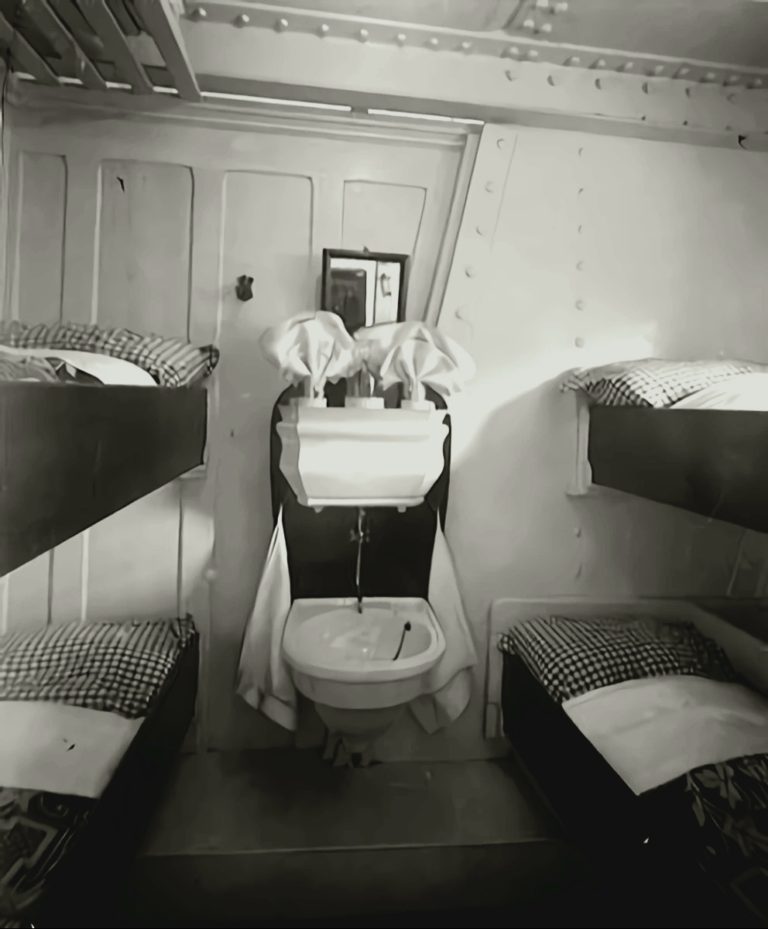
A Third-Class passenger cabin on the RMS Olympic, circa 1911 or 1912.

PUBLIC DOMAIN

There is comparatively little information regarding the circumstances of Third Class on the night of the sinking. Much of what is known is ascribed to the testimony of John Hart, one of the eight surviving Third-Class Stewards.

Third-Class evacuation during the sinking was inevitable bedlam. With multiple languages and a single ship translator, confusion was rampant. But it wasn’t just that. Many passengers, even in Third Class, were adamant that it was safer to stay on the ship. John Hart testified that many of the 59 people in his charge “refused to put [lifebelts] on… they said they saw no occasion for putting them on; they did not believe the ship was hurt in any way.” 

John Hart continued.

Some of them went to the boat deck, and found it rather cold, and saw the boats being lowered away, and thought themselves more secure on the ship, and consequently returned to their cabin… I heard two or three say they preferred to remain on the ship than be tossed about on the water like a cockle shell.

During the British Board of Trade Inquiry cited above, John Hart testified to witnessing Sidney working with his superior mid-sinking. (Please do note that Sidney's surname is transcribed phonetically as "Sedginary").

I waited about there with my own people trying to show them that the vessel was not hurt to any extent to my own knowledge, and waited for the chief third class steward, or some other Officer, or somebody in authority to come down and give further orders. Mr. Kieran [id est, the Chief Steward] came back. He had been to sections S, and Q, and R to see that those people also were provided with lifebelts… he had also his assistant with him, one by name, Sedginary. [Sidney Sedunary.]

Immediately thereafter, when asked again, Hart repeated that Sidney had been assisting James Kiernan in distributing lifebelts.

What about the assistant; you say his assistant was with him?

- Yes.

John Hart estimated that he received his initial orders to get lifeboats on his passengers after “three parts of hour” after the iceberg strike at 11:40pm, so he believed it was about 12:30pm. He came across Sidney and Chief Steward James Kieran sometime after that, after they had been to Section S, Q, and R, which were toward the stern and split between three decks: S on G Deck, R on F Deck, Q on E Deck.

G Deck had started to flood at 11:55pm. The forward section F Deck saw water by 12:05am; forward E Deck, around 12:10am, along with water traveling down Scotland Road—the well-known but rarely-named ship-long hallway.

The Chief Steward had to instruct all the other Third-Class stewards throughout the ship. While those stewards receiving instruction were ferrying people in groups up to boat deck—John Hart testified to having taken two or three trips up—the Chief Steward and his assistant were completely embroiled in managing directions on G, F, and E Decks.

The Third-Class General Room, as depicted in a promotional illustration by the White Star Line to advertise Third-Class accommodations in the Olympic class.

PUBLIC DOMAIN

Inevitably, since Sidney was in the company of James Kieran or otherwise transmitting his orders to lower Stewards, he presumably moved between the forward (bow) and aft (stern) sections on E, F, and G Decks—which were already flooding to variable degrees.

Segregated in the depths of the ship and at points likely wading through frigid seawater as he acted as Kieran’s right-hand man, Sidney had to have known how frail his chances of survival truly were.

But even as he watched others—colleagues and passengers—move to the upper decks and back again, Sidney was dedicated in his duties as the ship foundered. 

As far as we can deduce from the evidence, he spent the majority of the sinking down below, unlocking cupboards and distributing lifebelts instead of seeking a lifeboat.

A Third-Class Stairwell on C-Deck on the RMS Olympic, circa 1911. Courtesy of Bedford Lemere & Co.

PUBLIC DOMAIN

Sidney Sedunary likely did get up to boat deck. Only once it was too late.

And after the exhaustion and adrenaline of the evacuation, he could not survive the cold.

His corpse was the 178th recovered by the crew of the Mackay-Bennett, and was noted thusly.

NO. 178. - MALE. - ESTIMATED AGE, 25. BROWN - HAIR, LIGHT MOUSTACHE.

CLOTHING - Blue serge suit; black boots and socks; uniform coat and waistcoat, with buttons.

TATTOO ON RIGHT ARM - Anchor and rose.

EFFECTS - Gold ring; knife; nickel watch; pawn ticket; pipe; ship's keys; 20s.; $1.40; 8 francs 50.

NO MARKS ON CLOTHING

Sidney Sedunary was buried at sea.

White Star sent Madge a death notice that was cursory at best.

MUCH REGRET SEDUNARY NOT SAVED

With that, they returned his effects to his 24-year-old widow: some change, Sidney’s broken pocket watch, which had frozen shortly after he entered the water and before Titanic went under—and a key with a metal tag that read “Locker 14, F"D"k.”

So this key that had been taken from Sidney’s body and remitted to Madge Sedunary was more than a simple key: it was a tribute to his unsung and steadfast courage on the last night of his life.

Madge gave birth to Sidney’s son and only child at the end of 1912. He was named after his late father. And in 1921, 9 years after Sidney’s death, Madge remarried—to his younger brother Arthur. They  had a son 5 years later, in 1926.

Sid Sedunary, Jr., died in 2010, at the age of 97. He was the last known surviving Titanic orphan.

6 years following Sidney Jr.’s death, the key that had been removed from his father’s body was sold at auction for £85,000.

Open post

“My God, If I Could Only Forget”: Eugene Daly

"My God, If I Could Only Forget": Eugene Daly

Titanic had two stopovers after leaving Southampton: the first in Cherbourg, France, on April 10, and the last in Queenstown, Ireland, on April 11. 

On board the tender America as it marched toward the Titanic, Eugene Daly played “Erin’s Lament” on his uilleann pipes.

Eugene was from Athlone, Co. Westmeath, Ireland, and was 29 years old when he boarded Titanic.

Per census records circa 1911, Eugene was living with his widowed mother and two siblings. Eugene, as the eldest son, was the unmarried head of household, and was noted as a wool “heaver”. In addition, he supplemented his income by taking jobs as a mechanic.

And of course, Eugene also belonged to the Clan Ulseach War Pipers’ Band and the Irish National Foresters Band, as well as hid local chapter of the Gaelic League.

But Eugene decided to break free and try out a new life for himself in the United States.

So he saved for a few years and purchased steerage passage on Titanic. He boarded at Queenstown, in the company of his cousin Maggie and their friend, Bertha. Like all steerage accommodation, he had a shared cabin. Per Eugene’s accounts, he was bunked with two other lads in C-23.

The days in steerage seem to have been pleasant and minimally structured. Lawrence Beesley, a survivor from Second Class, shared his observations. And he seems to have spotted Eugene among the jollity, although he mistook his nationality.

Looking down astern from the boat deck or from the B deck to the steerage quarter, I often noticed how the Third-Class passengers were enjoying every minute of the time; a most uproarious skipping game of the mixed-double type was the great favorite, while ‘in and out and roundabout’ went a Scotchman with his bagpipes playing...

Lawrence Beesley, as written in "The Loss of the S.S. Titanic." © First Mariner Books, 2000.

It appears that Eugene played often for his fellows. Even on the night of the sinking, he played his pipes during a party held in steerage.

When Titanic struck the iceberg later that night, Eugene was nearly thrown out of his bed. He dressed in his trousers and shoes and went out to the gangway, but was assured by a steward that nothing serious had occurred and that he should just go back to bed.

Eugene did just that, if only for a little while.

But commotion made him go back up on deck, where he saw a lot of people panicked and running around. So he rushed down to steerage to retrieve Maggie and Bertha.

They came out with me, but a sailor told us there was no danger. He said the ship would float for hours. He also said to go back, and that if there was any danger he would call us.

The group went to the stern to procure lifejackets, and Eugene reported that he had a “scuffle” with a man for one, which ended up being given to Maggie.

There was a great deal of noise at this time and water was coming in. We knelt down and prayed in the gangway. Then the sailor said there was danger. We went to the deck but there were no boats going off. Then we went to the second cabin deck. A boat was being lowered there. It was being filled with women. Maggie and Bertha got in, and I got in. The officer called me to go back, but I got in. Life was sweet to me and I wanted to save myself. They told me to get out, but I didn’t stir. Then they got hold of me and pulled me out.

As cited in "On Board RMS Titanic," by George Behe. © The History Press, 2012.

After he saw Maggie and Bertha safely off, Eugene went to find another boat that would let him on. And that is when he bore partial witness to one of the Great Mysteries of Titanic: an officer shooting two male passengers, before committing suicide.

In May of 1912, Eugene reported to the Daily Sketch that he saw an officer shoot two passengers who were fighting to break through the crowd to board a lifeboat.

There was a terrible crowd standing about. The officer in charge pointed a revolver and waved his hand and said that if any man tried to get in he would shoot him on the spot… Two men tried to break through and he shot them both. I saw him shoot them. I saw them lying thereafter they were shot. One seemed to be dead. The other was trying to pull himself up at the side of the deck, but he could not… Afterward, there was another shot and I saw the officer himself lying on the deck. They told me he shot himself, but I did not see him.

As cited in "On Board RMS Titanic," by George Behe. © The History Press, 2012.

Unable to find a ready lifeboat and with water rushing the deck, Eugene clamored to a “sort of canvas craft,” which may have been Collapsible lifeboat A or B. He worked frantically with a group of other men to free it from “a wire stay which ran up to the mast.”

But when the canvas lifeboat was washed off the deck, there was no choice for Eugene Daly but to dive into the ocean. And so he did.

Eugene swam for the same lifeboat that he believed he had been attempting to cut loose. The boat he found was Collapsible B, which had floated away upside down as Titanic submerged. Eugene climbed on top of it; he estimated that over a dozen men followed. Together, they watched Titanic groan and vanish.

Eugene Daly survived the night balancing on the back of Collapsible B, alongside many other men, including Second Officer Charles Lightoller, 17-year-old Jack Thayer, Colonel Archibald Gracie, and Junior Marconi Officer Harold Bride. He often credited his survival to the heavy coat he wore, and he held onto his “lucky coat” for the rest of his life.

Eugene's daughter, Marion Joyce, wrote the following about her dad's lucky coat.

On that fateful night aboard the RMS Titanic, he put on his shoes and his trousers and, a heavy block overcoat with an Astrakhan fur collar. He still had it on when picked up by the Carpathia - that coat and his watch and rosary were treasured relics of his survival.

Many a cold night in my childhood in Ireland, that coat would be thrown over us in bed to keep us warm. We called it "the Titanic." It had a greenish tinge to it, maybe from the sea water, but it still had heaviness and warmth in it.

When Eugene was brought on board Carpathia, he blacked out and was carried to the cabin of a passenger named Dr. Frank Blackmarr, who worked to revive Eugene with hot drinks and unspecified “stimulants.” And then Dr. Blackmarr transcribed Eugene’s account, word for word.

[NOTED BY DR. BLACKMARR: Here this man fell back on his pillow crying and sobbing and moaning, saying: ‘My God if I could only forget!’ After a bit, he proceeded.]

My God, if I could only forget those women’s cries. I reached a collapsible boat that was fastened to the deck by two rings. It could not be moved. During that brief time that I worked on cutting one of those ropes, the collapsible was crowded with people hanging upon the edges. The Titanic gave a lurch downwards and we were in the water up to our hips.

She rose again slightly, and I succeeded in cutting the second rope which held her stern. Another lurch threw this boat and myself off and away from the ship into the water. I fell upon one of the oars and fell into a mass of people. Everything I touched seemed to be women’s hair. Children crying, women screaming, and their hair in their face. My God, if I could only forget those hands and faces that I touched!

As I looked over my shoulder, as I was still hanging [on] to this oar, I could see the enormous funnels of the Titanic being submerged in the water. These poor people that covered the water were sucked down in those funnels, each of which was twenty-five feet in diameter, like flies.

Eugene was hospitalized along with other survivors at St. Vincent’s in New York, and from there, he sent the following letter to his mother.

Dear Mother, got here safe. Had a narrow escape but please God, I am all right, also Maggie. I think the disaster caused you to fret, but things could have been worse than what they were.

As cited in "On Board RMS Titanic," by George Behe. © The History Press, 2012.

Soon thereafter, he filed a claim with White Star for the loss of his pipes, and was compensated $50. He was very pleased with the sum, thinking it more than that pipes had been worth.

Eugene was celebrated as a hero, especially back home in Ireland. "The Westmeath Independent" commented that "the courage credited to Eugene Daly in the foregoing will not surprise his fellow townsmen, who knew him as a man of principle and pluck. In the present deplorable disaster, he appears to have upheld the traditions of the Gael."

He went on to become a machinist for the Otis Elevator Company, and that led him to meet his future wife: the sister of his coworker Jimmy, an English woman named Lillian who owned silk mills in the neighboring state of Connecticut. They married in 1917, and the couple appears to have begun life in New York but eventually moved back to Ireland. Quite by accident and due to his trauma, according to Eugene's daughter.

In 1921, they got a cable from home to say that Eugene's mother was dying. So my Mom booked passage right away and they sailed for home.

...As soon as the ship was a few hours out Eugene lost all sense of security. He was in an extreme state of panic. He couldn't eat or sleep. He walked the decks the whole voyage, and my Mom paid a steward to look out for him.

Once they arrived in Ireland, Eugene refused to sail again. He did not return to the United States until he was widowed in 1961--and only then because flight was a travel option.

In his later years, Eugene was noted as a devout parishioner and quite musical, although he was also described as “very loud.” But people seem to have forgiven him this, as he was probably somewhat deafened from years of working in the mills.

Eugene Daly died on Halloween, 1965, in New York City. He was 82 years old.

In recent years, a curious artifact was salvaged from the wreck site: an instrument with undeniable similarities to uilleann pipes.

SOURCE MATERIAL

Behe, George. "On Board RMS Titanic: Memories of the Maiden Voyage." The History Press, 2012.

Beesley, Lawrence. "The Loss of the S.S. Titanic: By One of the Survivors." First Mariner Books edition, 2000. Originally published by Houghton Mifflin Company, 1912.

https://www.encyclopedia-titanica.org/eugene-dalys-account.html

https://www.encyclopedia-titanica.org/eugene-daly-his-daughter.html

https://www.encyclopedia-titanica.org/titanic-survivor/eugene-patrick-daly.html

https://www.irishcentral.com/news/eugene-daly-irish-titanic


Open post

“Wishing You All Good Things Until We Meet”: Daniel Coxon

"Wishing You All Good Things Until We Meet": Daniel Coxon

In Merrill, Wisconsin, there once lived an Englishman, and they called him Popcorn Dan.

Daniel Coxon was beloved. He was genial and bright and the precise definition of “a character.”

In a small, dirt-road town such as Merrill, Dan was a delightful sight to behold. Because—as you may have deduced from his nickname—Dan Coxon was a popcorn vendor.

Every day, he walked the dusty streets of Merrill, with his pretty red-and-yellow popcorn cart, pulled along by his white horse. It was a noticeable spectacle, for sure. Add to that the steam ever whistling from the boiler and Dan’s renowned conviviality, and he never seemed to want for patrons.

Popcorn Dan most often set up shop on the corner of Poplar Street and East Main Street. Along with popcorn, he also sold freshly roasted peanuts.

But Dan did more than popcorn.

He took a lot of odd jobs around town, primarily manual labor and painting. He offered hauling services thanks to his horse and wagon. He even worked for a time as the live-in caretaker of a haunted house: a Queen Anne mansion, perched eerily on the banks of the Wisconsin River.

One might think that odd jobs and a popcorn cart wouldn’t pay out much in dividends. But one would be wrong.

On his varied income, Dan was the proud owner of a rare and pricey phonograph. His horse and popcorn cart, of course. And he was even able to purchase TWO houses. One, he paid $400.00 for; the other, $1,000.00. And being a savvy gentleman, he resided in the former, while leasing out the grander.

His tenant was Harry Krom, who had emigrated from Russia and opened the fanciest men’s dress shop in Merrill, called Krom Clothing & Co.

And industrious individuals are always impressive, sure. But Dan Coxon was particularly so. And this was because he worked all his many labor-intensive jobs with a physical handicap.  Specifically, Dan’s left arm was shriveled from birth.

Dan Coxon had emigrated from London to Canada sometime in the 1870s, and then Wisconsin sometime in the 1880s. He wasn’t married and was in no rush to do so; his brother said he “made a laugh out of it.”

By 1911, Dan was in his early 50s. He was well-established in Merrill and successful—and he wanted to open the first movie theater in northern Wisconsin.

And so, Popcorn Dan traveled back to the UK to learn more about the movie-theater business, and to visit with his family for the holidays.

But before he did, he had to get snazzy.

Just a few days before Thanksgiving, Dan went to Krom Clothing and dropped $15 on a new suit—as well as $115 on a proper fur coat. Today, that coat would cost approximately $3,000.00.

Dan arrived in London on December 23, stayed through Christmas, and then through the winter months into the springtime with his sights on Easter. He wrote the following to his friend on April 1, 1912.

I am now writing to let you know that I am coming back. I have already booked my passage back by the “Titanic,” which will leave Southampton on the Wednesday after Easter… I have had a pretty good time on the whole but am getting rather tired now of holiday making and shall be very glad to get back again and settle down once more.

As cited in "The Last Night on the Titanic," by Veronica Hinke, 2019.

Dan also ribbed his friend for some lazy and imprecise addressing.

I was very delighted to receive your letter. It was quite a wonder though that I did get it as the envelope was only addressed “Mr. Daniel Coxon London, England” which of course is not sufficient for a place like London. Anyway, I was glad to get it (thanks to the post office people here).

As cited in "The Last Night on the Titanic," by Veronica Hinke, 2019.

Popcorn Dan delayed his departure past Easter in order to sail on Titanic. He could easily have afforded a Second-Class ticket, but elected instead to only purchase steerage accommodation.

Dan left his brother Alfred’s house to reach Waterloo station at 7am and headed out from there to Southampton, which was over an hour away. Alfred accompanied them, as well as their nephew John, who was the son of their sister Elizabeth.

According to Alfred Coxon, Dan had a particularly difficult time trying to board Titanic because of his withered arm. The overseeing officers, Alfred said, subjected Dan to an inordinate amount of scrutiny and were extraordinarily suspicious of him. Dan even had to produce paperwork to prove that he was, in fact, a naturalized US citizen.

Once he was finally permitted to board, Dan, Alfred, and John spent about an hour and fifteen minutes exploring the ship. Once Alfred and John disembarked, they stayed on the dock and “waved [their] hands to him as far as [they] could see him.”

Like so many steerage passengers, we know comparatively little to absolutely nothing about Dan's time on board Titanic.

On the morning of April 15—the very same morning of Titanic's sinking—a letter written by Dan was delivered to Hans van Kaltenborn, a friend and newspaper editor in Brooklyn, NY.

If you happen to have the time I should, of course, be only too pleased if you could manage to come and meet me on the arrival of the boat. I have had a very good time, but now feel that I should be glad to get back and return to work, for I am getting a little tired of fooling around. I should think that by the time I get back the weather will be settling for the better, and the rougher kind will, I hope, be all over. It is growing pleasant over here now, and spring here, as you may know, is very delightful. Wishing you all good things until we meet.

Popcorn Dan died in the sinking. His body was never found.

His wallet, however, has been recovered from the wreck. It has been determined that the wallet was Dan's because the $10 and $15 bills within bore stamps from Merrill, Wisconsin.

SOURCE MATERIAL

Hinke, Veronica. "The Last Night on the Titanic: Unsinkable Drinking, Dining, & Style." Regnery History, 2019.

https://www.encyclopedia-titanica.org/titanic-victim/daniel-coxon.html

https://www.encyclopedia-titanica.org/mr-coxon-may-be-lost.html

Open post

“That Together With Sorrow and Worries”: Anna & Adolf Dyker

“That Together With Sorrow and Worries”: Anna & Adolf Dyker

Adolf Fredrick Dyker, who went by “Fred,” was born on a ship.

Fred’s parents were making a transatlantic journey from Sweden to New Haven, Connecticut, where public records indicated his father had lived since about 1870.

But the elder Mr. Dyker, who was naturalized in 1879, still owned a café in Stolkholm, where he traveled often. So Fred, despite spending at least some of his childhood in the United States, received his education in Sweden.

After a stint in a New York bank, Fred found work in his kinda-sorta hometown of New Haven, Connecticut, as a tram conductor on the Woodmont line during the summer of 1911.

It was recorded by the American Red Cross that Fred’s pleasant and courteous approach made him “an unusually valuable employee” who would have been fast-tracked for promotion. He earned $14 a week, which was probably a reasonably handsome paycheck for 1911.

Union Station in New Haven, Connecticut, circa 1914, where Fred Dyker would have reported to work as a tram conductor.

PUBLIC DOMAIN

I’ve also read that Fred kept a collection of the tram stubs he’d taken on his shifts, but I cannot find a primary source for this. It’s pretty adorable, though, so let’s assume it’s true.

In 1908, Fred married Anna Elisabeth Judith Andersson, a Massachusetts-born American who was also of Swedish descent.

Anna went by “Liza,” and was a musician and singer. She had attended Yale School of Music and sometimes participated in church choir, and was also giving music lessons to get by. Per census records, they lived in West Haven, Connecticut, with Liza’s parents.

In 1911, Liza and Fred received word that Fred’s father was dying in Sweden; they re-mortgaged their home to enable themselves to go abroad to arrange and settle his estate.

Titanic was their ride home. They boarded as Third-Class passengers at Southampton on April 10, 1912.

The steerage class is often considered minimal at best—particularly in contrast to the nearly criminal opulence of First Class—but in truth, it was some of the best quarters, dining, and overall treatment than some of its passengers would experience elsewhere or ever again.

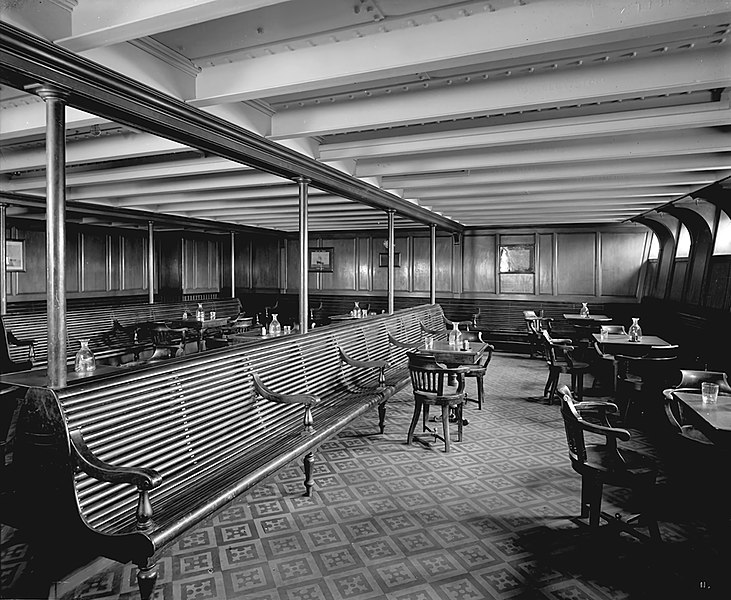
The Third-Class Dining Saloon on RMS Olympic, Titanic's elder sister, circa 1991. Courtesy of Bedford Lemere & Co.

PUBLIC DOMAIN

On the night of the collision, Liza and Fred were wakeful. They were so awake, in fact, that Liza reported that she was still in her dayclothes, sans hat.

The couple soon found themselves at Lifeboat 16, which was far aft and under the supervision of Second Officer Charles Lightoller.

By all reports, Fred did not attempt to board the lifeboat with his wife, but rather stepped aside for other women and children. Fred gave Liza a kiss, as well as his hand to help her climb the gunwale, and said, “I’ll see you later.”

His tone has been reported to be flippant and cheery, and this is not unlike many husbands and fathers who put their loved ones into lifeboats alone. As the lifeboat pulled away from Titanic's side, Fred waved at Liza from the boat deck.

And as was true for so many broken couples and divided families, Liza and Fred would never see each other again. The Brooklyn Daily Eagle reported Liza’s statement in its April 19, 1912, issue.

I ran to the deck where I met Adolph. He had with him a satchel which contained two gold watches, two diamond rings, a sapphire necklace and 200 crowns. He couldn’t be saved in the boat I was in and he grabbed a preserver and said he would jump and try to save himself. That was the last I saw of him.

To add cruel insult to debilitating injury, Liza said the satchel that Fred had given to her was stolen as she was boarding Carpathia.

On board the rescue ship, Liza was suffering from extreme exposure and was under the care of the doctors on board. She managed to send only a brief telegram to New Haven that said, “Liza saved, Fred lost.”

At only 22 years old, she was already widowed.

The Brooklyn Daily Eagle reported on April 19, 1912, that Liza was “hysterical” when she disembarked from the Carpathia.

R.M.S. Carpathia docked in New York City after rescuing Titanic survivors, April 1912. From the George G. Bain Collection, courtesy of the Library of Congress

PUBLIC DOMAIN

When she finally got home, Liza was weary, bereaved, and bedridden for “many weeks.” According to her American Red Cross file, she was caused to lose her singing voice entirely from the illness and trauma that she’d suffered, and was fearful that she’d never regain it.

I lost my husband and everything I owned, I was wounded when I was brought from Titanic, that together with sorrow and worries has completely broke me down. My health have not recovered, I have tried to done some work to earn my living... 

Liza sued the White Star Line for the loss of her husband, as well as her luggage.

It would seem that Liza’s voice eventually recovered, as she reportedly returned to music lessons. She remarried some years later, and died in New Jersey in 1971.

Fred Dyker’s corpse, if found, was never identified. As was the case for the remains of virtually all Third-Class passengers, if it had been recovered, it would have been buried at sea.

As Fred Dyker was born on a ship, so he died on the same.

He was 23 years old.

Open post

“Our Babe”: The Mystery of Titanic’s ‘Unknown Child’

"Our Babe": The Mystery of Titanic's 'Unknown Child'

Clifford Crease was 24 years old when he and his crewmates embarked on the grimmest journey of their lives: collecting the dead from Titanic.

The crew of the Mackay-Bennett recovers a Titanic victim.

PUBLIC DOMAIN

The Mackay-Bennett arrived to the site on the night of April 19, and saw that there were far more bodies than anyone could have anticipated.

At 6:00 a.m. on April 20, their work began.

All crew on the Mackay-Bennett were required to keep a log or diary of their gruesome task in the wake of Titanic. Only Clifford's, which has been donated, and one other are known to remain in existence.

One by one, small skiff boats were dispatched from the Mackay-Bennett, where they began manually pulling corpses from the water, to describe their faces and rifle through their pockets.

It had already been almost a week that they'd been bobbing in the water, exposed to the elements and ships passing through the massive debris field. Most of the bodies were mangled from the sinking--lacerated, bruised, many with broken bones.

(Please take a moment to reflect on how traumatic this reaping truly was. The men on board the Mackay-Bennett never get the credit they deserve.)

After the third body, a female third-class passenger, had been pulled aboard and catalogued, Clifford Crease's work turned from solemn to sorrowful.

Over the side of the boat, he scooped up a fourth body. Tiny. Blond, ocean-pale, and eerily still. Unlike the corpses all around them, this body was pristine--more doll than person, we might imagine. Clifford cradled the dead baby boy in what seemed like interminable silence.

After searching for identification and finding none, they reverently noted the baby as follows.

NO. 4 - MALE - ESTIMATED AGE, 2 - HAIR, FAIR
CLOTHING - Grey coat with fur on collar and cuffs; brown serge frock; petticoat; flannel garment; pink woolen singlet - brown shoes and stockings.
NO MARKS WHATEVER
PROBABLY THIRD CLASS

Clifford and his mates were in shock.

Back on board the Mackay-Bennett, the decision had been made to bury steerage passengers at sea, owing to a lack of space and shortage of embalming fluid. So only the First and Second Classes were embalmed or put on ice and returned to Halifax.

An exception was made for the nameless baby that was "probably third class." No one could bring themselves to commit him to the sea, all alone forever.

After recovering a total of 306 bodies from the site, the Mackay-Bennett returned to Halifax. Bodies were distributed to funeral homes, morgues, and grieving families. Photos were taken. Days passed.

But no one claimed the baby.

Hearses queued at Halifax Wharf, waiting to transport the corpses of Titanic victims to local funeral parlors. Courtesy of Nova Scotia Archives & Records Management (NSARM).

PUBLIC DOMAIN

The sailors who had been on board the Mackay-Bennett that nightmarish day then took matters into their own hands and adopted the child in death. Spearheaded by Clifford Crease, they arranged a funeral and pooled their wages for a small coffin and headstone.

In the coffin, they placed a brass plate engraved with two words: "Our babe."

Clifford acted as one of the baby's pallbearers.

The Unknown Child now rested in the Halifax's Fairview Cemetery. Suspecting that his identity might be that of 2-year-old Gosta Palsson, youngest son of Third-Class passenger Alma Palsson, he was interred in close proximity to her grave.

Years went by, and Clifford could never bring himself to forget The Unknown Child. Every year on the anniversary of the sinking, he laid a wreath on the grave.

And when Clifford Crease died in 1961, he was interred mere meters away from the child who had haunted him all of his life.

According to his family, Clifford didn't speak about his grim time on the Mackay-Bennett until the end of his life, prompted by a program he was watching on television about Walter Lord's "A Night to Remember." According to Clifford's granddaughter, "He never fully recovered... He told our father it was the worst thing that ever happened to him."

In 2001, two Canadian scientists named Ryan Parr and Alan Ruffman collaborated in order to find the identity of Titanic's Unknown Child.

They exhumed the remains, but there was nothing left other than a fragment of an arm bone, and three little teeth. Mercifully, the plate laid in the coffin by the crew of the Mackay-Bennett had protected these scarce remains. And miraculously, that was enough.

The remains were not a match to the Palsson family, who had originally given permission for the remains to be disinterred. They expanded the scope of their candidates from among 5 boys under the age of 3 who had died on Titanic.

In addition to Gosta Palsson, there were:

Gilbert Danbom 5 months old, from Sweden

Alfred Peacock 7 months old, from England

Eino Panula 13 months old, from Finland

Sidney Goodwin 19 months old, from England

Eugene Rice 2 years old, from Ireland

With the long-term assistance of geneaologists and historians, as well as willing descendants, Ruffman and Parr tracked down genetic samples from all 5 families of the little boys.

From the candidates remaining after Gosta Palsson was ruled out, 3 were evident non-matches; this left only Sidney Goodwin and Eino Panula as the possible Unknown Child, due to a shared mutation in their mitochondrial DNA.

Looking at the teeth that had been recovered from the grave, the scientists determined that they'd belonged to a child in the 9-15 month range. By process of elimination, Ruffman and Parr published their results: The Unknown Child was 13-month-old Eino, whose family was traveling from Finland.

It was accepted by the majority that the Unknown Child finally had a name.

But some, including Parr and Ruffman, suspected it was the incorrect one.

All because of a pair of shoes.

In 2007, Dr. Parr admitted that they may have made a mistake.

Back in 2002, a man named Earle Northover had donated a pair of brown-leather baby shoes to the Maritime Museum of the Atlantic. They had belonged, he said, to the Unknown Child.

According to Earle, the wee shoes had been removed from the baby, and saved from destruction by his grandfather Clarence Northover, a sargeant for the Halifax Police Department. Earle wrote the following in his letter to the Museum.

Clothing was burned to stop souvenir hunters but he was too emotional when he saw the little pair of brown, leather shoes about fourteen centimeters long, and didn’t have the heart to burn them. When no relatives came to claim the shoes, he placed them in his desk drawer at the police station and there they remained for the next six years, until he retired in 1918.

The shoes, Dr. Parr thought, were too big for a 13-month-old to wear. So they retested the DNA samples with the U.S. Armed Forces Identification Laboratory, where the team isolated a single, but significant and rare, genetic distinction.

With around a 98% certainty, Parr's team amended their previous results.

Thanks to the little shoes hidden in Sargeant Northover's desk drawer, the Uknown Child was identified as Sidney Goodwin.

Sidney Goodwin, Titanic's Unknown Child.

PUBLIC DOMAIN (taken in 1911)

At 19 months old, Sidney was the youngest of six children. His entire family was traveling from England to America where their father, Frederick, was set to have a new job at the new power station in Niagara Falls.

The Goodwins had planned to set to sail on the S.S. New York, but were transferred to Titanic as a result of the coal miners' strike.

All eight members of the Goodwin family--both parents, and all of their children--died when Titanic sank.

Aside from Sidney, who would spend almost a century unidentified, no member of the Goodwin family was recovered.

Sidney Goodwin's parents and five older siblings circa 1910. The entire family died in the sinking.

PUBLIC DOMAIN (published in UK periodical(s) in 1912)

The Goodwin descendants held a memorial service at the grave of The Unknown Child on August 6, 2008. One by one, they read the name of each child lost on Titanic out loud, ringing a bell for each.

The family elected to leave the headstone installed by the crew of the Mackay-Bennett.

As a Goodwin cousin said in an interview, "The tombstone of the unknown child represents all of the children who perished on the Titanic, and we left it that way."

Open post

“I Trust That They Are Better Off”: Rhoda Abbott

"I Trust That They Are Better Off": Rhoda Abbott

Rhoda Abbott had long been an elusive Titanic survivor.

As it turns out, this was because her name, on Titanic's manifest and in contemporary articles, was inaccurately written as Rose or Rosa. Regardless, on her birth, death, and marriage certificates, her name is listed as Rhoda. And with that, a comparative wealth of information has been discovered.

Rhoda about was born in England, and emigrated to Providence, RI, in 1894. There, she met and married a fellow expat named Stanton Abbott, who rose to fame as a middle-weight boxing champion. This fame, however, accelerated the deterioration of their marriage, and in 1911, Rhoda and Stanton separated.

Rhoda returned to England with their two teenaged sons, Rossmore and Eugene, on Titanic's longest-lived sister ship, the RMS Olympic.

They struggled to get by in England. Rhoda worked as a seamstress and Rossmore as a bootmaker, while Gene was still receiving schooling. But Rhoda soon realized that her boys were homesick--she was English, but they were American. So she decided to take them home.

Rhoda Abbott boarded Titanic as a third-class passenger with her two boys. Rossmore was 16 by this point; Gene was 13.

It's been reported that the boys, excited to get stateside and dazzled by Titanic, almost immediately peaced out from their mom to explore the ship. Rhoda spent time conversing at length with fellow English women in adjoining cabins, particularly Amy Stanley and Emily Goldsmith.

As a whole, those in Third Class, being low within the vessel, felt the greatest shudder upon impact with the iceberg. After feeling the collision, the boys wanted to get up to the boat deck to see what had happened. But their mother wanted to wait for instruction from a steward, so she made them stay put and go to bed.

At a quarter past midnight, a steward threw open their door, yelling, "All passengers on deck with life jackets."

Rhoda, Rossmore, and Gene managed their way up to the boat deck with a little maneuvering. As they shuffled in the mass across the stern's deck, the last of the distress signals was launched above them. Eventually, they reached Collapsible C, the boat that some of Rhoda's cabin neighbors, including Amy Stanley and Emily and Frankie Goldsmith, got in. With the assertion of 'Women and Children First' in full effect, Rhoda's sons were too old to be considered children.

At around 2:00 a.m., when Rhoda was frantically offered a place in Collapsible Lifeboat C, she pressed her two boys to her and refused. It was about 2:00 a.m.

Twenty minutes later, Titanic submerged.

Water overtook the boat deck as the officers were desperately trying to launch Collapsible A, which Rhoda and Gene were waiting for--Rossmore, in accordance with Rhoda's worst fear, was put firmly back with the other men.

Rhoda grabbed Gene's hands, but when she surfaced, both Rossmore and Gene had been dragged away underwater.

She never saw her boys again, alive or dead.

Rossmore's corpse was recovered by the Mackay-Bennett and committed to the sea on April 24, 1912. He was listed as follows.

NO. 190 - MALE - ESTIMATED AGE, 22 - VERY FAIR
CLOTHING - Brown overcoat; grey pants; green cardigan; blue jersey; black boots.
EFFECTS - Watch; chain and fob, with medal marked "Rossmore Abbott"; pocket book empty and two knives.
PROBABLY THIRD CLASS - NAME - ROSSMORE ABBOT

Gene's body was never found.

With no sight of her lost sons, Rhoda sank again, but was blown back to the surface by the exploding Titanic boilers, which she believed caused burns to her thighs.

Rhoda managed to make it to Collapsible A--which having been washed away only half-prepped, had taken on a few inches of water--and was pulled aboard. She recounted her experience to the Pawtucket Times.

Soon the raft tilted and all slid off into the water. Many of them managed to get back on it and some did not. I managed somehow to get on it, but I don’t know how. We were forced to stand on the float in lockstep to keep our balance for over six hours. Had it not been for Officer Laws I would have been drowned. I was nearly exhausted when he lifted me into his lifeboat. It would have been impossible for an officer to show more courtesy and many of the criticisms that have been made against this man are very unjust.

"Officer Laws" was, in fact, Fifth Officer Harold Lowe, of Lifeboat 14, the only lifeboat to return for survivors.

Officer Lowe left Collapsible A behind. It was recovered one month later, in May of 1912, with three corpses still within.

Rhoda had been practically unconscious when removed from Collapsible A, and was cared for by a fireman until taken aboard Carpathia. She had no memory of any of it. According to fellow survivor Amy Stanley, once on board Carpathia, Rhoda was mute and shellshocked.

 We were very close since we were on the Titanic together. And her stateroom had been near mine. I was the only one that she could talk to about her sons because I knew them myself. She told me that she would get [sic] in the lifeboat if there hadn't been so many people around. So she and her sons kept together. She was thankful that [the] three of them had stayed with her on that piece of wreckage. The youngest went first then the other son went. She grew numb and cold and couldn't remember when she got on the Carpathia. There was a piece of cork in her hair and I managed to get a comb and it took a long time but finally we got it out.

Meanwhile, Rhoda's ex-husband Stanton had been informed of the loss of his young boys. The New York Times reported it on it, with a distinct lack of sentiment, on May 4, 1912.

Stanton Abbott, an Englishman residing at Providence, R. I., inquired at the White Star Line office yesterday for his two sons, Rosmore Edward, 17 years old, and Eugene Joseph, 13, who were passengers with their mother, Mrs. Rose Abbott, 45 years old, on the Titanic, and were lost. The mother, he said, is in the New York Hospital in a dangerous condition from shock and fever. He was told that the body of the older boy had been recovered, and Mr. Abbott said he would go to Halifax to claim it.

Rhoda's physical recovery was slow, and she was one of the last survivors to be released from care at St. Vincent's Hospital in New York City.

Her grief, however, knew no real end. Rhoda kept in touch with her cabin neighbors after the sinking, and in 1914, she wrote to Emily Goldsmith, and her grief was no less palpable for the passage of time.

I have so envied you with Frankie, and me losing both mine, but I trust that they are Better off out of this hard world...

I read by the papers the terrible weather you are having. I suppose Frank enjoys it. I know my little fellow used to when he was alive. I have his sled now that he used to enjoy so much, bless his little heart. I know he is safe in God’s keeping, but I miss him So Much.


Rhoda Abbott was the only woman to go down with Titanic and somehow survive.

And therefore, Rhoda, thereafter and for so long called "Rosa" or "Rose," was the only woman rescued from the water.

Open post

Ghost Boats & Lost Souls

Ghost Boats & Lost Souls

Recovery of bodies from Titanic took weeks.

The Canadian vessel Mackay-Bennett was tasked with collecting them, and they were overwhelmed with the job--there were more bodies than the ship could hold.

On board with crew and supplies were a priest and an embalmer.

First-class passengers were embalmed and stored in coffins; second-class, the same except for canvas instead of coffins. Third-class corpses and many crewmembers were buried at sea. Of these 116, only 56 were identified.

Recovery of a Titanic victim by the crew of the Mackay-Bennett.

PUBLIC DOMAIN

Out of over 1,500 dead, a total of 328 bodies were found by the Mackay-Bennett, and 306 of those were recovered. Still, this was far more than they had prepared for.

In addition, the bodies were saltwater-bleached, bruised, crushed, with broken limbs and all cut up. The sinking is often portrayed as sanitary, depicting vistims that died frozen but otherwise unharmed.

In truth, it was gruesome.

Captain and crew of the Mackay-Bennett, taken between 1910 and 1915. From the George Grantham Bain Collection, courtesy of the Library of Congress.

PUBLIC DOMAIN

Multiple crewmembers of the Mackay-Bennett suffered PTSD for the rest of their lives, including one man named Clifford Crease, who, at the end of his long life, even elected to be interred mere feet from the grave of a Titanic victim whose recovery had irrevocably scarred him. He honored the memory of this unidentified passenger all of his life.

Frederick Hamilton, a cable engineer on Mackay-Bennett, wrote about the reaping in his diary.

The tolling of the bell summoned all hands to the forecastle where thirty bodies are ready to be committed to the deep, each carefully weighed and carefully sewn up in canvas. It is a weird scene, this gathering. The crescent moon is shedding a faint light on us, as the ship lays wallowing in the great rollers. The funeral service is conducted by the Reverent Canon Hind, for nearly an hour the words For as must as it hath pleased - - ' we therefore commit his body to the deep' are repeated and at each interval comes, splash! as the weighted body plunges into the sea, there to sink to a depth of about two miles. Splash, splash, splash.

© Caption.

Even then, there were others to find, and many more that never would be.

Collapsible A had been launched only moments before submersion--so close to, in fact, that it was washed away without the officers being able to pop up its canvas sides.

Thus, even though people found it and boarded it, it had taken on water--so much, in fact, that those people were standing on it were knee-deep in water, and dying.

They did this for hours until they were rescued by Fifth Officer Harold Lowe, who was the only officer to attempt rescue of more people from the water.

Out of the thirty or so survivors who made it to Collapsible A, Officer Lowe found no more than a dozen survivors.

And many frozen corpses.

Fifth Officer Harold Lowe, the only Titanic officer to return for survivors.

PUBLIC DOMAIN

Lowe left three bodies in Collapsible A, which he commented on in his characteristically straightforward tone during the United States Senate Inquiry.

As to the three people that I left on her - of course, I may have been a bit hard hearted, I can not say - but I thought to myself, "I am not here to worry about bodies; I am here for life, to save life, and not to bother about bodies," and I left them.

...The people on the raft told me they had been dead some time. I said, "Are you sure they are dead?" They said, "Absolutely sure." I made certain they were dead, and questioned them one and all before I left this collapsible.

On May 13, 1912, the crew of the Oceanic were approximately 200 miles from the wreck site when the spotted a strangely shaped plank in the flat distance. Using binoculars, they realized it wasn't a plank. It was a lifeboat.

And it wasn't vacant.

Sire Shane Leslie, on board Oceanic, recalled, "Orders from the bridge dispatched a lifeboat with an officer and a medical officer. What followed was ghastly."

Collapsible A, boarded by crewmembers of Oceanic on May 13, 1912.

PUBLIC DOMAIN (photo taken prior to 1923)

Six Oceanic crewmen rowed out to meet the partially collapsed Collapsible A.

Slumped within, faces blackened from rot and a month under Atlantic sunlight, were three "unrecognizable" corpses: two firemen, and one wearing a dinner jacket.

According to the firsthand account by Sir Shane Leslie, the arms of one corpse snapped off in the crewmember's hands.

Two sailors could be seen, their hair bleached by exposure to sun and salt, and a third figure, wearing evening dress, flat on the benches. All three were dead and the bodies had been tossing on the Atlantic swell under the open sky ever since it had seen the greatest of ocean liners sink.

The names of the sailors, reported to be firemen, are to date unknown, but the well-dressed corpse was identified: First-class passenger Thomson Beattie, 37, from Canada.

Thomson Beattie, whose body was recovered from Collapsible A on May 13, 1912, one month after Titanic sank.

PUBLIC DOMAIN

The Oceanic crew wrapped the three corpses in canvas, said a prayer, and buried them at sea.

Upon hauling the lifeboat on board, the Oceanic discovered something else: a gold wedding ring. Inscribed in its band was "Edvard to Gerda."

It would later come to light that the wedding band belonged to Swedish third-class passenger Elin Gerda Lindell. She and her husband Edvard had boarded Titanic bound for a new life in Hartford, Connecticut.

After sliding down the steepening deck into the ocean, the couple had both made it to Collapsible A.

But Gerda had been too cold, and the others too weak, to pull her aboard. She eventually fell silent and still, and Edvard was forced to let her drift away.

Before he let go, he removed her wedding band.

Gerda Lindell’s wedding band, as displayed in Titanic: The Exhibition in New York City, 2022.

© soliloquism, 2022. Courtesy of #TitanicExhibitionNYC.

According to survivor August Wennerstrom, "Edvard's hair turned all gray in lesser time than 30 minutes".

Edvard died shortly thereafter, bereft at the loss of his wife, and still cradling her wedding ring. It is thought that his body was pushed overboard to lighten the load of the partially submerged Collapsible A, but the wedding ring was dropped in the process.

Neither Edvard nor Gerda Lindell were ever recovered.

Open post

Alma Paulsson

PASSENGER PROFILE: Alma Paulsson

Alma Palsson (Americanized: Paulson) was an immigrant from Sweden; she was 29 when she boarded Titanic as a third-class passenger with her four young children.

Alma had been waiting for enough funds for her husband, Nils, to purchase tickets so they might finally join him in Chicago. The children--daughters Torborg and Stina, sons Paul and Gosta--ranged in age from 2 to 8 years old.

Nils had emigrated to America after realizing that he didn't want to be a miner anymore, and that mining was pretty much the only gig around where the Palssons lived in Sweden.

He arrived in Chicago in 1910; after landing a job as a tram conductor, he set to saving up enough money for his family to reunite in their new country. Swedish immigrants were the third-most robust nationality on Titanic, after the British and the Americans.

When Titanic struck the iceberg, Alma apparently struggled to gather and dress her children. By the time they got to the boatdeck from steerage class, it was too late; all the lifeboats had gone.

Another Swede named August Wennerstrom tried to look after the patriarch-less family in their distress. He said that he tried desperately to hold onto two of the Palsson children as the water washed the deck, but they were swept away. Wennerstrom survived.

Little else is known about Alma and her children; she was not seen again until her corpse was recovered by the crew of the Mackay-Bennett. It is thought that she must have presented an eerie and heartbreaking sight when she was found floating on the sea, her fair hair undone around her beautiful face.

She was listed as follows.

No. 206 - FEMALE - ESTIMATED AGE 30 - FAIR HAIR.

Brown Coat; green cardigan; dark shirt; brown skirt under; boots; no stockings

Wedding ring; brass keeper; mouth organ; purse and two coins; a letter; 65 kroner; had four children with her; letter from husband, Neil Paulsson, 94 Townsend St, Chicago.

Memory persists of Alma playing songs on the listed mouth organ (a harmonica) for her frightened children as they waited helplessly for the ship's submersion.

None of the Palsson children, if recovered, were ever identified. For decades, it was assumed that little Gosta was Titanic's famed "Unknown Child," but genetic testing has at last proved otherwise.

An account of Nils Palsson's reaction exists, including his desperate attempts to find out if an orphaned boy was his son. At the White Star Offices in Chicago, Nils begged for information about his family.

He was told they were not listed on the roster of survivors.

In broken English, he hoped out loud that maybe they didn't sail.

Your family was on the boat, but none of them are accounted for.' The man on the other side of the counter was assisted to a seat. His face and hands were bathed in cold water before he became fully conscious.

He was finally assisted to the street by Gust Johnson, a friend who arrived with him. Paulson's grief was the most acute of any who visited the offices of the White Star, but his loss was the greatest. His whole family had been wiped out.

Nils eventually remarried and moved, where he planted 4 trees in his backyard to mourn and honor his lost family. Gosta, only two years old, was born after his father's departure; Nils never met his youngest son.

Open post

Dining Facilities

Dining On Board

Behold, what First-Class passengers were eating for lunch on April 12, 1912.

There is a noticeable disparity in quality to the modern eye between this fare and the menu options for Second and Third Class, but in 1912, First-Class passengers had never felt more adored, and Second- and Third-Class passengers had never felt more privileged.

The White Star Line commissioned work with various companies for proprietary silverware, china, dishes, pots, and state-of-the-art electric equipment for the kitchens. All menu items were coordinated by 2nd Steward Andrew Latimer, whose recipe book was left behind in Southampton.

First-Class passengers had a dining saloon. They also had exclusive access to the Verandah Cafe, which was more often called 'the Palm Court' because of its trellis walls cloaked in ivy and its potted plants on pretty tile floors. It was also replete with wicker chairs and oversized windows to make full use of the soft light.

The Palm Court on R.M.S. Olympic.

PUBLIC DOMAIN

They were also privy to "The Restaurant," which was available exclusively to their class of ticket.

Tables in The Restaurant had to be reserved in advance; lucky passengers could even get a seat with Captain Smith, or White Star Chairman J. Bruce Ismay. An Italian restauranteur was in charge of The Restaurant; he in turn brought in his head chef from Olympic, a Frenchman by the name of Rousseau.

Adjacent to The Restaurant was Cafe Parisien, which the White Star Line hyped as a "charming sun-lit veranda, tastefully decorated in French trellis-work with ivy and other creeping plants." It was, naturally, exclusive to First Class.

Moreover, Cafe Parisien was also exclusive to Titanic herself, as it had been installed to replace what was an oft-untrod promenade deck on her older sister ship Olympic.

Cafe Parisien on Titanic. Taken by Robert John Welch for Harland & Wolff.

PUBLIC DOMAIN

First-Class passengers could also get room service. Given how gargantuan Titanic was, a hot water jacket was used to keep the meals warm on the commute from kitchen to suite, which had a separate dining area.

Second-Class options were expectedly less highfalutin.

The Second-Class dining area hosted crewmembers as well as passengers, and its kitchen was shared with First Class, but the diners did not enjoy all the same luxuries.

For instance, silverware, although likewise silver-plated, was more utilitarian. Whereas First-Class passengers were given the extremely vital grape scissors at their tables, for example, Second-Class passengers were expected to pull the wanted grape from its bunch by hand.

In addition to Second Class, Titanic had a dining area for the maids and servants of first-class passengers on C Deck, which was accessed just off the Grand Staircase. Their silver napkin rings were engraved with the word "SERVANTS," lest they forgot themselves.

Third Class had plainer fare but no want for enthusiasm.

The Second-Class Dining Saloon on Titanic's elder sister, R.M.S. Olympic, circa 1911.

PUBLIC DOMAIN

In addition to Second Class, Titanic had a dining area for the maids and servants of first-class passengers on C Deck, which was accessed just off the Grand Staircase. Their silver napkin rings were engraved with the word "SERVANTS," lest they forgot themselves.

Third Class had plainer fare but no want for enthusiasm.

Many Third-Class passengers had never eaten better--or received better treatment--than they had on board. Not only were the chairs unbolted to the floor as was customary for Third Class, but the tables had linens, and they were given tissue napkins printed with the White Star logo.

In a marketing bid, Third-Class passengers were encouraged to keep their menus, which doubled as a postcard that White Star hoped they would send back home, thereby enticing their family and friends to buy a steerage ticket and experience the luxury. Despite the opulence that so often springs to mind at the mention of the RMS Titanic, First-Class tickets were not White Star's bread and butter: steerage, thanks to immigration to America, paid the bills.

Third-Class Dining Saloon on R.M.S. Olympic. Courtesy of Bedford Lemere & Co.

PUBLIC DOMAIN

A single Third-Class menu card, dated April 14, 1912, survives. It was safeguarded in the purse of steerage passenger Sara Roth, who was in Collapsible Lifeboat C.

SOURCE MATERIAL

Babler, Gunter. "Guide to the Crew of Titanic: The Structure of Working Aboard the Legendary Liner." The History Press, Gloucestershire, England. 2017.

https://www.encyclopedia-titanica.org/titanic-survivor/sarah-roth.html

https://titanicexhibition.com/nyc/

Posts navigation

1 2
Scroll to top