Open post

“A First-Class Raconteur”: Chief Purser Hugh McElroy

"A First-Class Raconteur": Chief Purser Hugh McElroy

Hugh McElroy was Titanic's Chief Purser--that is, the man in charge of the ship's business affairs, especially as it pertained to passenger expenses and needs.

Tickets for additional luxuries, like the Turkish baths and extra deck chairs. Wireless messages to friends and family. Drinks. Valuables locked in the ship's safe for secure storage. Cabin complaints and exchange. A seat at the Captain's dinner table. The so-called face of the entire crew. All the job of the Purser.

In short, Hugh was The Guy.

Everyone knew him; everyone loved him. He had previously served both the Adriatic, the Majestic, and Titanic's elder sister Olympic, all under Captain E.J. Smith. Hugh was beloved for his robust humor, his geniality, and his ability to "hold his own" without causing offense. He was a "first-class raconteur" and often called the "Commodore Purser" of White Star.

Hugh McElroy (standing far right) with the rest of the crew of R.M.S. Olympic, taken in 1911. Note that he is standing next to William McMaster Murdoch, First Officer on Titanic.

PUBLIC DOMAIN (photo taken prior to 1923)

Hugh was one of three White Star representatives documented to have dined with the passengers, the others being Captain Smith and White Star Chairman J. Bruce Ismay.

And since Hugh was such a delight, many set their dining schedules around when Hugh had seats available at his table. In particular, Purser McElroy was known to invite solo passengers to his table; for instance, one of Hugh's regular entertainees was Second-Class passenger Lawrence Beesley.

In summary: Hugh was jolly and amenable, with a booming brogue, hearty laugh, and a whole lotta charm that came in handy often, particularly when dealing with the demands of high-maintenance passengers... or you know, when impulse-buying exotic pets.

By the time Hugh sailed on Titanic, he had a well-established reputation as a Bird Man. During his stint on the troopship Britannic during the Boer War, Hugh was strolling the docks at Cape Town, South Africa, when he heard "Landlover off the starboard!" squawked nearby.

The source was a stunning and boisterous white Australian parrot. Hugh bartered for him with his reluctant owner, reasoning that he would be a great source of morale on board. The owner relented, but he had a single condition: that the parrot, named "Petroleum Pete" to his chagrin, would be rechristened Baden-Powell.

The deal was struck, and the newly named Baden-Powell the Parrot became quite famous as Hugh's talkative shoulder accessory on board for years thereafter. "The Cedric's Parrot Mascot" was even so popular as to merit an article in the New York Times in 1903.

An acquaintance of McElroy knocked at the door.  "Keep out No lobsters wanted", was what the knocker on the outside heard from within, 'Shut up Baden, Come in it's alright" answered McElroy; and the friend opened the door. McElroy greeted his friend warmly while Baden-Powell with a look of disdain on his pealed countenance eyed him critically.

'Bum looker, don't eat much ice" piped the parrot.

Some time later, Hugh's affinity for avians preceded him, and he was asked to mind another parrot en route home to Brooklyn named Jack Binns (the parrot, that is; not the passenger.)

So it makes sense that when a prized canary owned by a Mr. Meanwell boarded Titanic, Hugh was asked to mind it. The canary is often erroneously cited as one of the non-canine pets to go down with the ship, but in fact, it disembarked at Cherbourg to be reunited with its owner--but only after paying its ticket of 25c.

All in all, Hugh had been with White Star about thirteen years by 1912, though he had previously studied to join the clergy. Which is quite interesting, since it was actually Hugh who befriended Father Francis Browne and escorted him about the Titanic while it made port in Queenstown on April 11, 1912. As a result, Father Browne took what would become the last known photos of the Titanic, as well as some of her passengers and crew.

Shortly before Titanic set sail, Hugh wrote to one of his friends, a priest named Phillip Corr, on a postcard.

Many thanks for your letter and good wishes which I reciprocate, the “Titanic” is in many ways an improved Olympic and will I trust be a success, I am sorry I could not get down to Swanage this time but I was tied to Southampton and the train service too erratic to take chances, all kind of messages to you both.

This message, though wholly confident, belies Hugh's premonitory anxiety about the voyage according to his colleague, Dr. Beaumont.

Purser McElroy had been woken on several occasions on the R.M.S. Olympic due to suffocating nightmares, which gave way to him having some premonitions about sailing on the R.M.S. Titanic, he would have nightmares of being in a dark tunnel or cave with no means of escape.

When Titanic struck the iceberg, Hugh was reportedly on C Deck, just completing his nightly rounds of collecting receipts from bars and visiting the Marconi wireless room.

It is said that, considering eyewitness testimony and his long-standing relationship with Captain Smith, Hugh was one of the first crewmembers to bear witness to Titanic's death sentence. After the collision, Hugh was seen with Captain Smith inspecting the mailroom.

He was then found at the Purser's office, trying to appease the throng of people to retrieve their valuables and claim receipts. After Captain Smith gave the order to abandon ship, Hugh went on deck and used his famous ease with passengers--as well as his imposing stature--to help speed along the filling of the lifeboats.

Hugh labored alongside his longtime colleague and friend, First Officer William Murdoch, in helping launch the lifeboats on the starboard side. And trying without reprieve to assist them was none other than the most shamed man on Titanic: J. Bruce Ismay, who was savaged by the entire world for saving himself.

White Star Chairman J. Bruce Ismay.

PUBLIC DOMAIN

Titanic was secured with a total of twenty lifeboats--which was four more than was required by contemporary maritime law. There were sixteen wooden boats, and four so-called collapsibles, labeled A through D. The latter, for reference, were flimsier but fully functional boats with canvas sides.

Collapsible D with canvas sides up, as taken by a passenger on the rescue ship Carpathia.

PUBLIC DOMAIN

As Hugh and First Officer Murdoch attempted to launch Collapsible C, a desperate and terrified mob swarmed the area. Jack Thayer, a survivor age 17, stated the mob was made entirely of men, and that two jumped down into the boat from the upper deck.

In one motion, Hugh McElroy's famously jovial voice bellowed over the bedlam, and he drew his pistol, firing it twice into the air. The two leapers were quickly removed and Hugh somehow brought the mob under control. He thereby saved 21 women and 10 children who would have otherwise been overturned--all third-class passengers.

There are multiple reports of gunshots that night, including the supposed suicide of an officer rumored initially to be Captain Smith, and most often to be First Officer Murdoch. But it would seem that at least two of those shots, fired by Purser McElroy, actually saved lives.

Hugh McElroy was last seen standing on deck near the gym with his colleagues.

There is no testimony as to how Hugh McElroy died. His body was recovered by the Mackay-Bennett and listed as follows.

NO. 157. — MALE. — ESTIMATED AGE, 32. — HAIR, DARK.
CLOTHING - Ship's uniform; white jacket; ship's keys; 10 pence; 50 cents; fountain pen.
CHIEF PURSER. — NAME — HERBERT W. McELROY.

Hugh was buried at sea on April 22 because his body was in very bad shape. This has led some to conclude that, since Hugh was in the immediate vicinity and the advanced decomposition of his corpse, that he was, in fact, crushed by the falling first funnel.

Hugh’s last known words were preserved by a number of sources—including a letter received by his friend, Charles Brown, which was reported in the Chicago Examiner dated June 12, 1912.

A small group of the Titanic's staff were waiting for the final plunge.  The water was lapping the deck at their very feet, and the end was merely a question of a few minutes.  McElroy turned to his companions with a smile and shook hands with them, saying:

"Well, good-by, fellows. It looks like sand for breakfast to-morrow."

"That was typical of McElroy," says Brown.  "He was one of the merriest, bravest men who ever lived.  It was like him to have his little joke in the face of death."

Hugh McElroy was 37 years old.

He had been married less than two years.

Open post

Shipyard Casualties

SS401 & Shipyard Casualties

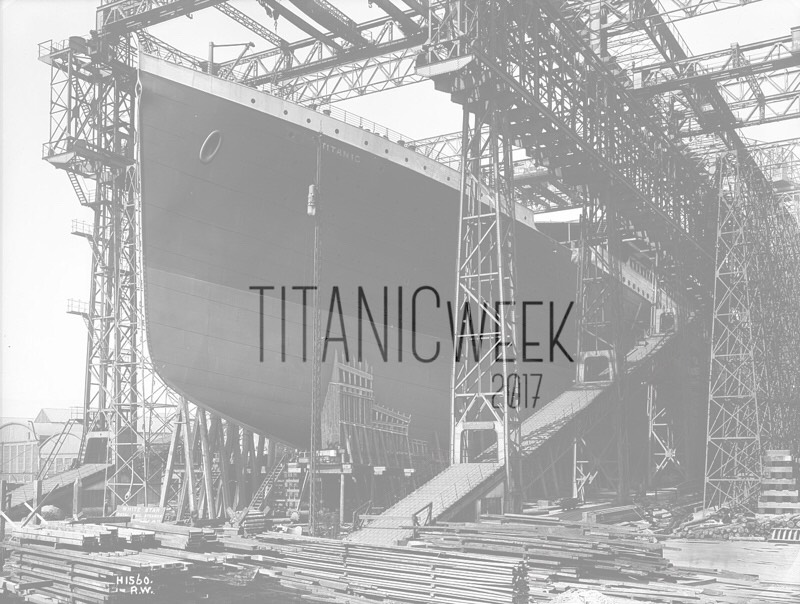
Titanic, along with her sister vessels the Olympic and Britannic, were constructed in Belfast, Ireland. Belfast was an industrial city, and jobs were labor-intensive. And thanks to Belfast's ship-building company, Harland & Wolff, the construction of the behemoth liners was a city-wide operation that everyone talked about morning, noon, and night.

Belfast women primarily worked in the local linen industry, and their men were localized to the Harland & Wolff shipyards. These ladies were nicknamed "Millies," and the 15,000 men employed by Harland & Wolff worked in "The Yard."

Workers "knock off" at the Harland & Wolff shipyard, with Titanic in the background, circa May 1911.

PUBLIC DOMAIN

Belfast women primarily worked in the local linen industry, and their men were localized to the Harland & Wolff shipyards. These ladies were nicknamed "Millies," and the 15,000 men employed by Harland & Wolff worked in "The Yard."

Workshop at Harland & Wolff shipyard at Queen's Island, Belfast. Taken by Robert John Welch for Harland & Wolff, circa 1910.

PUBLIC DOMAIN

Shipyard workers had 6am-5:30pm hours, Monday through Saturday. After work on Saturday, many often headed off to rally for the Glens--their shipyard football team--at The Oval, a local stadium, in a game against their local rivals, the Linfields. Then they would go on to exalt or lament in local pubs through East Belfast later in the evening. Rinse, repeat.

Sunday, of course, was for church. But for some, God could wait. According to Francis John Parkinson, Jr., who was less than five years old at the time and whose father was a woodworker for Titanic.

"I can well remember one Sunday afternoon, my father said... 'You tell your Sunday School teacher you'll not be in Sunday School next Sunday, for your dad's going to take you down to see the Titanic at Harland & Wolff.'"

"I remember looking up at this big steel hulk... and he described to me how someday they'll take away all the timber props that held up the ship, and they would release it into the water. And I remember quite well saying, 'But Dad, how can that big ship stay up in the water?' 'Oh,' he said, 'that ship will always stay up in the water. It will always stay up.'"

From "Titanic: The Complete Story" (formerly "Titanic: Death of a Dream) © A&E Television Networks, 1994.

Parkinson's warm confidence speaks to the comeraderie felt throughout Belfast.

Building these ships was an extremely personal and sentimental effort for the thousands of people employed and bearing witness to their construction. Thomas Andrews, the ship's designer, was regularly found walking through The Yard with plans in his pockets, to talk with and best appreciate his workforce.

Contrary to popular imagination, White Star did not declare Titanic unsinkable. But a periodical called "The Shipbuilder" did. Therein, the RMS Titanic was pronounced "practically unsinkable" due to its novel fittings--such as the three-propeller system and fancy boilers--and its safety features, such as its watertight compartments and double hull, which would theoretically allow it to float even in spite of a crash.

Cross-section of Titanic, illustrating double hull plating. Published by Harland & Wolff, circa 1912. Courtesy of Internet Archive Book Images.

PUBLIC DOMAIN

One of the reasons safety regulations are so stringent today is because up until recent history, they didn't exist at all. If you crushed a finger, lost an arm, burnt your face on duty? That was the hazard of the job; wish your livelihood farewell. And a number of men, often referred to as Titanic's First Victims, were subject to that reality.

A total of eight shipyard men died during the construction of the world's finest ocean liner, although some could hardly be called that. Samuel Scott was the youngest at only 15 years old; John Kelly, 19. Many workers in the shipyard were as young as 13.

Riveters on the deck of a ship in Harland & Wolff's shipyard in Glasgow, Scotland, during the First World War. Courtesy of Imperial War Museum Photograph Archive Collection.

PUBLIC DOMAIN

Samuel lived on his own down the street from his mum, who was listed in contemporary census as having six of her children living with her; in addition, the Scotts shared the house with another couple, who had three children themselves. Having the elders clear out to make space was common practice at the time, despite how objectively young Sam was.

On April 20, 1910, Sam was working on SS 401. As everyone did, Sam lined up to get his "bourd," the bit of wood with his assigned ship's number written on it. Sam was what they called a "catch boy" at The Yard, working as part of a riveting crew.

Essentially, the rivets were stoked in a coal bucket to white-heat by the "bellows boy;" the rivets were then removed with tongs and immediately tossed high in the air up to Sam, who caught them with his tongs and placed them in the hull so another boy, the "holder on," could keep it in place while it was driven in with a sledge hammer, and then a bevy of boys with hammers would alternatively work away at the still-cooling rivet to mold it into shape.

The boys were paid per rivet, so the smoother the teamwork, the hIgher the profit. But, if stories up from the ground and just a little clumsy, a catch boy could lose his job. Or his life.

Titanic and her elder sister, Oylmpic (foreground) under construction. Taken by Robert John Welch for Harland & Wolff, circa 1910. From the George Grantham Bain Collection, courtesy of the Library of Congress

PUBLIC DOMAIN

High up alongside SS 401 on April 20, 1910, Sam slipped from a ladder on staging stories above the ground, and fell to his death; according to the inquiry performed as a result, no one witnessed his actual fall. His death was attributed to shock from fracture to the skull.

Sam was buried in an unmarked grave, but in 2011, Belfast historical organizations endeavored to get Sam a headstone.

Samuel Scott was one of eight to die building SS 401--the ship that a year following his death would be launched and christened the Titanic--but he's only one of five whose names we know. Three men are still unidentified. In spite of this, the Harland & Wolff Football and Social Club commissioned a commemorative plaque, which was dedicated in 2012.

SOURCE MATERIAL

[ital]

Open post

“Nearer, My God, to Thee”: Bandmaster Wallace Hartley

"Nearer, My God, To Thee": Bandmaster Wallace Hartley

Wallace Hartley is one of Titanic's famed heroes: the bandleader who played until he was swallowed by the sea, along with his seven-man orchestra. It was and still is considered "one of the noblest in the annals of heroism at sea."

Bandmaster Wallace Hartley.

PUBLIC DOMAIN

Wallace Hartley was from Lancashire, England, and was engaged to be married to Maria Robinson when he was asked to transfer from Cunard's Mauretania to be Titanic's bandmaster for her maiden voyage.

Wallace was described by his friend, Thomas Hyde, as "a very nice lad" who was "incapable of anything mean," despite being "a bit what you might call 'roughish.'"

We also know that Wallace hated the 9-to-5 life, because he took an job as a bank clerk under pressure from his father, who didn't want him to pursue a musician's lifestyle for fear of financial insecurity. Wallace found work in a mundane office "irksome".

Wallace was an outstanding musician, though his fellow classmate didn't recall him being a prodigy when they started violin together at school around age 12. But the headmaster's son wrote in 1958 of Wallace having had notable talent from the start... and some really cool toys.

He was one of my heroes, for I knew from the talk of my elders that he was already a musician of repute, but more definitely because he possessed a bicycle.

As cited in © "The Band That Played On" by Steve Turner.

So in 1912, Wallace signed on to Titanic.

Having only just proposed Maria, rumor is that Hartley was reticent to leave his fiancee, but ultimately accepted the position because a) repairs to the Mauretania had recently left him without work for about two months and b) he could make more connections for future gigs.

Wallace wrote what was fated to be his last letter home on April 11, 1912, and sent it off to be taken ashore at Queenstown before Titanic sped for open sea.

This is a fine ship and there ought to be plenty of money around. We have a fine band and the boys seem very nice. I miss coming home very much and it would have been nice to have seen you all, if only for an hour or two, but I could not manage it. Shall probably arrive home on the Sunday morning.

All love,

Wallace

As cited in © "The Band That Played On" by Steve Turner.

A lesser-known fact is that Titanic's band was actually split into two independently functioning units: Wallace's, which played at dinners and Sunday services, and a second three-man, violin-cello-piano unit that stationed themselves in the room outside the entrance to the The Restaurant and Cafe Parisien.

It's most often reported that it was Wallace who roused his fellow musicians to go to the First Class Lounge and play after Titanic struck the iceberg, although there's speculation that he did so under the instruction of Chief Purser Hugh McElroy or even Captain Smith.

Multiple witnesses attested to them playing light, happy tunes, as well as ragtime. But at the end, Wallace tapped at his violin and began to lead the band in what would become one of the most contested piece of trivia in Titanic lore: The Last Song.

Harold Bride, the Junior Marconi Operator, really threw the wrench in this, because he testified that he heard "Autumn".

From what is known about Bride, though, he had no aptitude for music. He had also been working at the wireless all night, and may have had difficulty with his memory following his survival in the water.

However wrong he was about the song, though, his testimony is no less moving.

...I guess all the band went down. They were playing 'Autumn' then…The way the band kept playing was a noble thing. I heard it while still we were working wireless, when there was a ragtime tune for us, and the last I saw of the band, when I was floating out in the sea with my lifebelt on, it was still on deck playing 'Autumn.' How they ever did I cannot imagine.

Harold Bride's statement to the New York Times, as reported in the April 19, 1912, issue. As cited in © "The Band That Played On" by Steve Turner.

Most witnesses, however, report that the band played the hymn "Nearer, My God, to Thee".

This makes sense. It was the official hymn played graveside for every member of the Musicians Union.

It was also one of Wallace's favorites--he even introduced it to his congregation as a musician back home. Moreover, a band-mate of Wallace's from Mauretania reported to the Daily Sketch that years before, he asked Wallace how he would conduct himself if he were on the deck of a sinking ship. Wallace told him that he'd get his orchestra together and play either "O God, Our Help In Ages Past" or "Nearer, My God, to Thee."

The eight men of the Titanic orchestra played for over an hour, some wearing lifebelts. Eyewitness reports attest to the water climbing from their ankles to their knees.

Still, they played on.

As things became more grave, Wallace reassembled the orchestra on the boat deck, near the entrance to the Grand Staircase. Only minutes before the ship split, at around 2:10 a.m., the entire band was washed away.

Wallace Hartley was 33 years old.

His body was recovered by the crew of the Mackay-Bennett, and was list as follows.

No. 224 - MALE - ESTIMATED AGE, 25 - HAIR, BROWN

"CLOTHING - Uniform (green facing); brown overcoat; black boots; green socks.

EFFECTS - Gold fountain pen, "W.H.H."; diamond solitaire ring; silver cigarette case; letters; silver match box, marked "W.H.H., from Collingson's staff. Leeds"; telegram to Hotley, Bandmaster "Titanic"; nickel watch; gold chain; gold cigar holder; stud; scissors; 16s; 16 cents; coins.

BANDMASTER WALLACE H. HOTLEY

Wallace's body was returned to his hometown in May 1912, and his funeral was held in the same church where he had once been a choirboy.

Wallace's eulogy was delivered by Thomas Worthington, a preacher who was a family friend of the Hartleys.

The unexpected happened; the unthinkable occurred. The ship that everyone thought could not sink is now two miles at the bottom of the Atlantic.

But our friend kept his word. The inevitable command to get the boats ready in the middle of that dark but clear Sunday night, with the subsequent order "Women and children first" found those hands, now stiff in death, gliding along the strings of that beloved violin and guiding the companion stick, producing the tune that at once became articulate and interpreted the desires of many hearts as they were lifted to heaven.. This was done until the waves claimed both him and his violin.

As cited in © "The Band That Played On" by Steve Turner.

The final hymn, of course, was "Nearer, My God, To Thee."

As the mourners slowly filed out, Maria came forward toward the altar. She laid down the tribute she'd brought onto the brass plaque that adorned the lid of her fiance's coffin: a floral cross made of deep red roses, tied up with a message.

"O teach me from my heart to say 'Thy will be done.'"

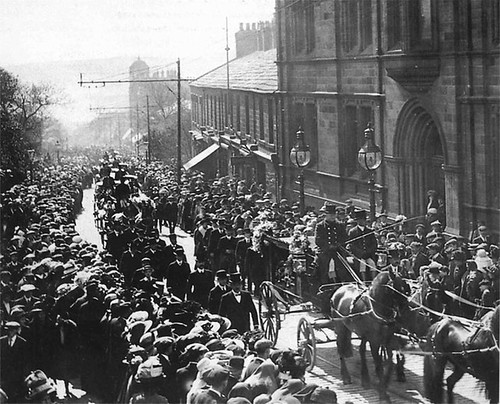
Upward of 1,000 people were in attendance to pay respects to Wallace, and an estimated 30,000-40,000 more people lined his funeral route.

It took over an hour for the cortege, accompanied by nine carriages, eight brass bands, and myriad representives, dignitaries, and police officers, to make its way through the streets, crowded as they were with mourners.

When they at last reached the cemetery, twelve pallbearers carried Wallace's coffin from the gates to the Hartley family sepulcher.

Still, some have blamed the band for giving passengers the wrongful impression that the situation was not as dire as it truly was. But by a number of contemporary accounts, this was essentially the point: to keep the passengers calm by playing frivolous tunes, so as not to cause alarm.

And it appeared to have worked to calm nerves that were fraught and raw. Second Officer Charles Lightoller was glad of the band's presence and their selection in the face of death. "I could hear the band playing a cheery sort of music," he said. "I don't like jazz music as a rule, but I was glad to hear it that night. I think it helped us all."

Others, such as First-Class passenger Colonel Archibald Gracie, insisted the band never played at all. Moreover, he insisted that if they had, and played "Nearer, My God, To Thee," that he would have been outraged.

I assuredly should have noticed it and regarded it as a tactless warning of immediate death to us and one likely to create a panic that our special efforts were directed towards avoiding.

As cited in © "The Band That Played On" by Steve Turner.

There were also dissenters to the posthumous lauds for the band, specifically because their deaths should not have occurred to begin with. Joseph Conrad, for instance, wrote with weary disdain--not for the bandmembers themselves, but for the saccharine spectacle of it all.

I, who am not a sentimentalist, think it would have been finer if the band of the Titanic had been quietly saved, instead of being drowned while playing--whatever tune they were playing, poor devils. I would rather that they had been saved to support their families... I am not consoled by the false, written-up, Drury Lane aspects of that event, which is neither drama, nor melodrama, nor tragedy, but the exposure of arrogant folly... And that's the truth. The unsentimental truth stripped of the romantic garment the press has wrapped around this most unnecessary disaster.

As cited in © "The Band That Played On" by Steve Turner.

Wallace Hartley's violin was returned to his bereaved fiancee.

After decades in an attic, it was painstakingly authenticated and auctioned in 2013 for $1.6 million, the most that has ever been paid for a Titanic artifact.

SOURCE MATERIAL

Turner, Steve. "The Band That Played On." Thomas Nelson Publishing, 2011.

Open post

“Warm Devotion”: Jenny the Ship Cat

"Warm Devotion": Jenny the Ship Cat

On April 10, 1912, at 12:00 p.m., Titanic set off from Southampton.

And, since people love a good conspiracy theory, there are countless rumors of passengers and crew experiencing a sense of foreboding, some even going so far as to cancel their passage.

And one of those was a tabby cat named Jenny.

Jenny was a cat and Titanic's official mouser, transferred from the RMS Olympic to its new sister Titanic, to stymie the inevitable vermin population on board.

As any nautically inclined individuals will attest, cats were common on board sailing vessels of all sorts. They were pest control agents and predictors of bad weather. They were companions. And, of course, they were supposed to bring good luck.

In short, ship cats were beloved. And there are many stories of prescient ship cats throughout the years.

Jenny, Titanic's cat, was no exception.

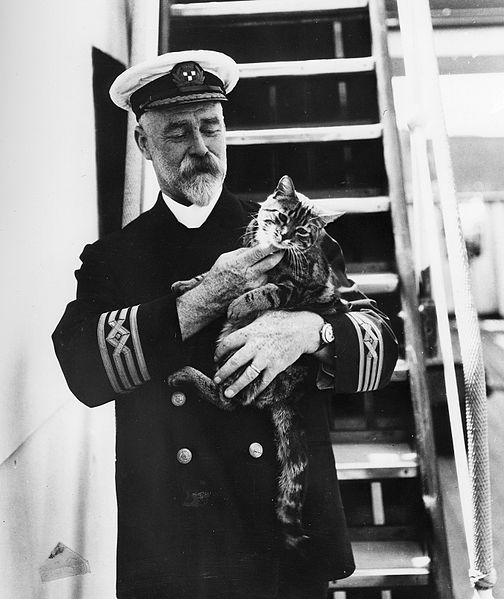
Captain A J. Bailey of the R.M.S. Empress of Canada with the ship's cat, circa 1922. From the Rare Books and Special Collections, courtesy of the University of British Columbia Library.

PUBLIC DOMAIN

About a week prior to Titanic's departure, Jenny birthed a litter.

Jenny and her babies were tended to and fed scraps from the kitchens by a crewmember named Jim Mulholland, who boarded in Belfast for the Delivery Run to Southampton.

Stewardess and Woman-Famous-For-Surviving-Disasters-On-All-Three-Doomed-Olympic-Class-Vessels, Violet Jessop, wrote in her memoirs that Jenny "laid her family near Jim, the scullion, whose approval she always sought and who always gave her warm devotion."

Sailor with ship cat and kitten, circa 1910. From the Samuel J. Hood Studio Collection, courtesy of Australian National Maritime Museum.

PUBLIC DOMAIN

Jim had been considering working through Titanic's maiden voyage when shortly after docking at Southampton, Jim saw Jenny trot down the gangplank with her kitten in her mouth. Jenny then returned to the galley and retrieved the others, one by one, until all were on the quay and off the Titanic.

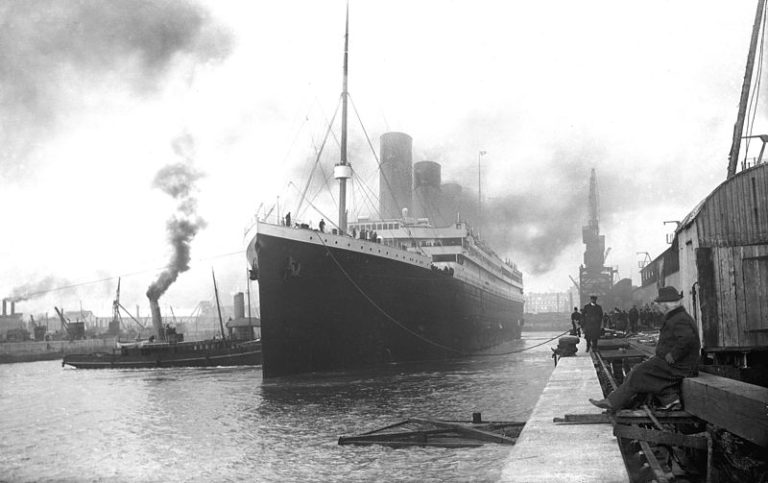
Titanic docked in Southampton and dressed in flags on Good Friday, April 5, 1912.

PUBLIC DOMAIN

Jim watched until Jenny had disappeared with her babies.

He saw her departure as an omen and followed her lead, turning down the trip and extra pay and disembarking before Titanic set sail.

This story was first reported in the Irish News Global Edition.

Ship cat on the H.M.A.S. Encounter circa 1914 to 1918. Courtesy of the Australian War Memorial.

PUBLIC DOMAIN

Posts navigation

1 2 3 4
Scroll to top