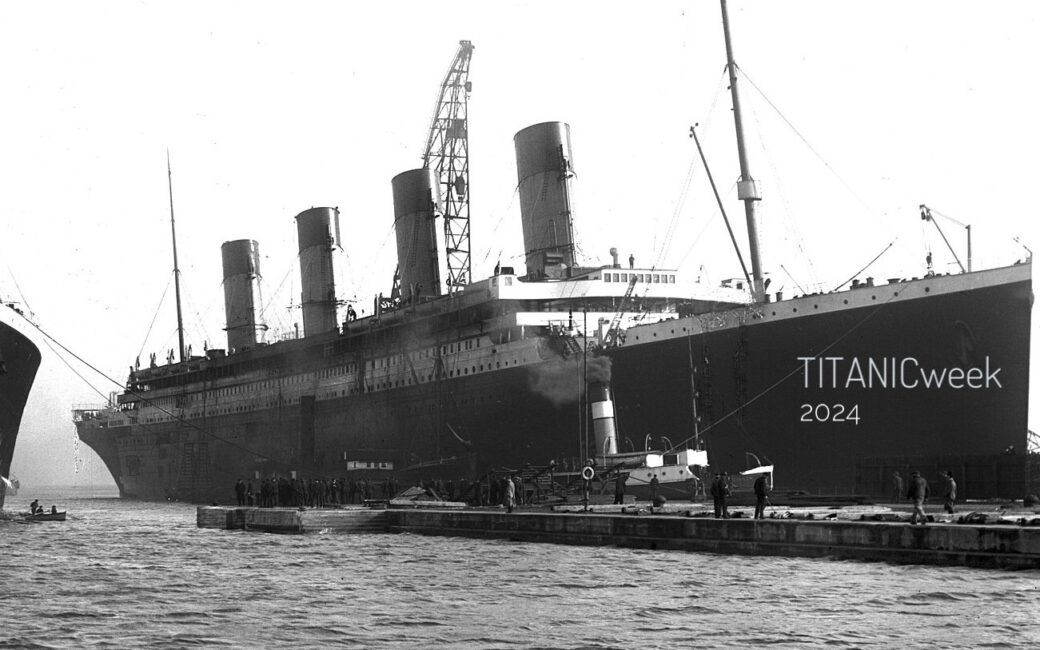
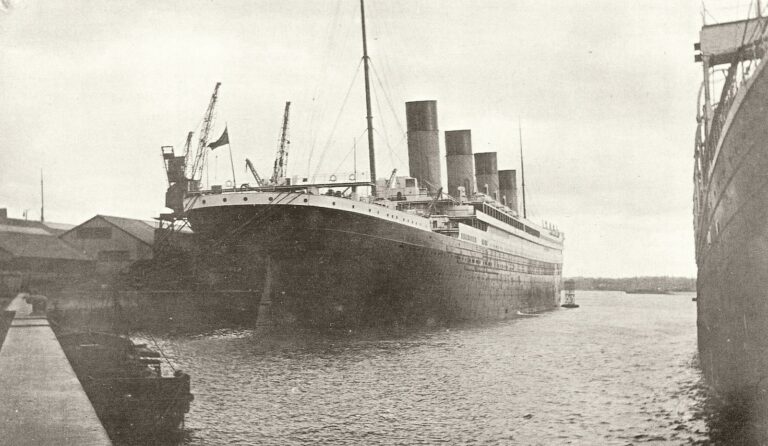
"Good-bye For Ever": James Farrell
The Kates of Co. Longford might not have survived that night, had it not been for James Farrell.
James, born in 1886, was one of nine children, and thus a middle child amongst a swarm of siblings.
According to census data, his family owned a farm; by 1911, records indicate that his mother, Ellen, had died.
In the 1911 census, 24-year-old James was noted on the same farm property as his father, as an unmarried farmer’s son. And as a farmhand, he was reportedly a rather brawny lad.
What reason James had for traveling to America in 1912 is still uncertain. Records suggest he might have been due to meet a Patrick McGrath, or perhaps a James Keating, both of whom resided in Brooklyn.

Precious little else is known about James Farrell—aside from his heroism as Titanic sank.
James was 26 years old when he boarded Titanic at Queenstown at 11 April 1912. He almost certainly rode the train there.

A fair few Third-class ticket-holders, who like James were leaving their homes in Co. Longford, also traveled by train to the Queenstown dock that day.
That particular group reportedly made fast friends with each other, having recognized one another from neighboring villages in Co. Longford. This group included Kate Gilnagh and Thomas McCormack, amongst quite a few others.
They chatted and joked, and even had a sing-song on the train ride, according to a secondhand account.
All things considered, this group most likely included James Farrell.

The deck of an unidentified ship. Courtesy of NARA.
PUBLIC DOMAIN
From the train, the Co. Longford crew boarded the tender ship SS America.
As the little ship shuffled to Titanic’s side, the group likely watched the hills, the churning waves, and the colorless facade of Queenstown receding from view.
In those moments, fellow steerage passenger and musician Eugene Daly rested his pipes against his shoulder, bit down on the mouthpiece, and began to play. It was a moment much adored by those on board.
Once embarked on Titanic, the 113 newly arrived steerage passengers would have descended to the lower decks.
It might have been tiresome, navigating the corridors toward their assigned berths: single men to the bow section; unwed girls aft, in the stern. Married couples—or those couples pretending to be—shared the stern with the ladies.
Later, a settle-in was followed by a hungry pilgrimage to the Third-class dining saloon, which was located on F Deck. The passengers were obligated to arrive to dinner in shifts, since the dining saloon could not accommodate everyone at once.
Therein, rows of long, dressed tables awaited them. The sight of pressed tablecloths and electric lights were a delight that many had never before beheld.

As it was in the berths, the unmarried men were secluded from maidens and families while dining; the saloon, divided as it was by a watertight bulkhead, facilitated this separation.
Coats were hung on pegs along the white walls, and seats were taken. The dinner was served by stewards; the food was robust, and the room presumably boisterous.
After dinner, the Co. Longford company might have reconvened in the Third-class general room to spend time in each other’s company.
They might have taken up a game of chess, cards, or dominoes; alternately, they might have decided to enjoy music by the upright piano. One of the Co. Longford girls, named Kate Murphy, had brought her violin along.
The men likewise might have adjourned to the adjacent Third-Class Smoking Room, which was designated exclusively for their use.
The Co. Longford group almost certainly spent time out on the aft decks as well.
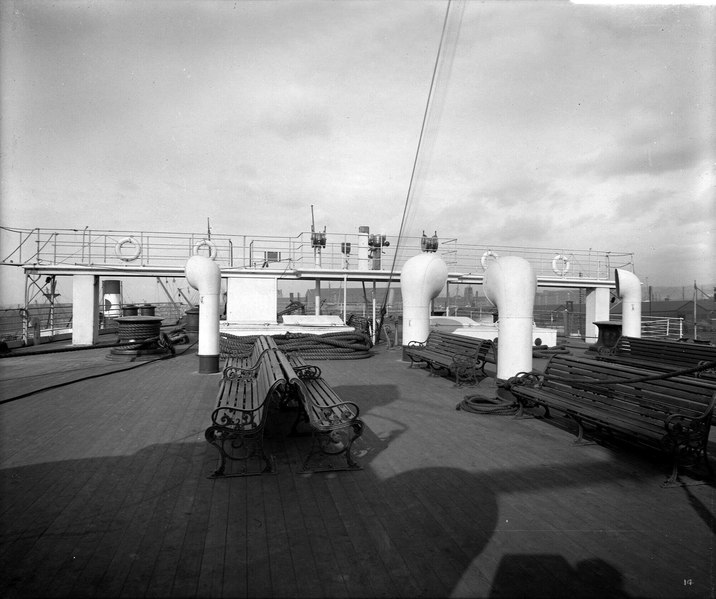
Much of James Farrell’s time was likely spent this way: reporting for meal times, and spending time with his new friends from Co. Longford.
The men and women from Co. Longford—James Farrell among them—seem to have done their utmost to stick together throughout the sinking.
After Kate Gilnagh and her cabin mates were awoken and alerted to the emergency by Eugene Daly, they tried to ascend the decks as quickly as they could.
But, according to survivor testimony given to author Walter Lord, the steerage passengers were held back, and thus barricaded from salvation in a lifeboat.
In that dire moment, James Farrell appears in a survivor account for the first time.
Others somehow reached the second class Promenade space on B deck, then couldn’t find their way any further… Others beat on the barriers, demanding to be let through. Third class passenger Daniel Buckley… jumped to his feet and raised up the steps again. The seaman took one look, locked the gate and fled. The passenger smashed the lock and dashed through, howling what he would do if he caught the sailor...
At another barrier a seaman held back Kathy Gilnagh, Kate Mullins, and Kate Murphy… Suddenly a steerage passenger, Jim Farrell, a strapping Irishman from the girls’ home county, barged up. “Great God, man!” He roared. “Open the gate and let the girls through!” It was a superb demonstration of sheer voice power. To the girls' astonishment, the sailor meekly complied.
Excerpt from "A Night to Remember," by Walter Lord, page 57.
In the calamity that followed the girls' escape from behind the unspecified "barrier" between the Third- and Second-class decks, Kate Gilnagh found herself temporarily separated from her Co. Longford friends.
They were, at that moment, located a full deck above her.
She did manage, under curious circumstance, to rejoin the other Co. Longford lasses up on the boat deck, where they had just boarded Lifeboat 16.
And it was here that Kate Gilnagh would encounter James Farrell one more time.
Kate had just been denied entry to the lifeboat; it was too full to take on any additional passengers, she was told. But she finagled her way aboard with a compulsive fib.
Defying great odds, James Farrell had succeeded in securing the girls their survival. And so, as the lifeboat descended, he took the opportunity to bestow upon Kate Gilnagh a last kindness.
In her letter, [Kate Gilnagh] states that she and another girl named McCoy were the last two girls taken on the last boat, and a young man who had previously got into the boat was taken out of it. She further states that she was wearing a small shawl on her head which got blown off, when a person named Mr. James Farrell of Clonee [sic], gave her his cap.
As they were being lowered, he shouted: 'good-bye for ever’, and that was the last she saw of him.
As reported in the Irish Post, 25 May 1912. Citation Courtesy of The Irish Aboard Titanic, by Senan Moloney.
Kate Gilnagh never saw James Farrell again.
But Kate Mullen, who was another of the Co. Longford colleens, spotted James the boat deck after the lifeboats oared themselves afar.
He was kneeling next to his suitcase, praying the Rosary.
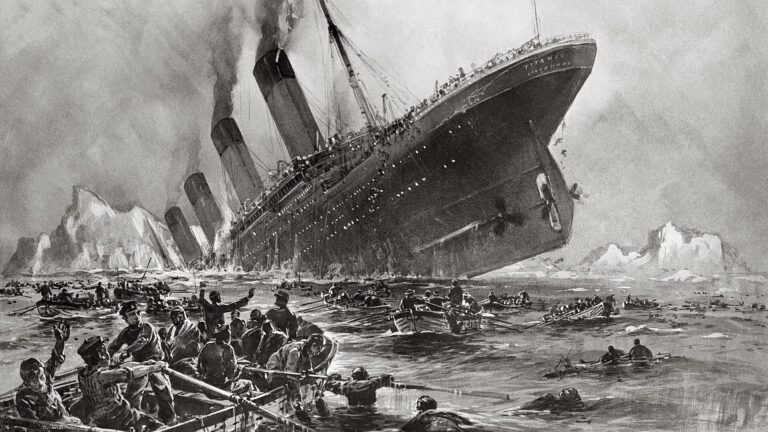
James Farrell died in the Titanic disaster.
Nine days later, on 23 April 1912, his body was pulled from the water by the recovery ship Mackay-Bennett.
James still held his Rosary beads in his hands.
NO. 68. - MALE. - ESTIMATED AGE, 40. - HAIR, DARK; MOUSTACHE, LIGHT
CLOTHING - Dark suit; black boots; grey socks.
EFFECTS - Silver watch; two purses (one empty), the other with $10.00, 3s. 2 1/2d., and 10 kronor; two studs; cameo; beads, left on body.
NAME ON THIRD TICKET NO. B67233. JAMES FARRELL, Longford.
James Farrell was the 68th Titanic victim found in the Mackay Bennett's recovery expedition. On 24 April 1912, his corpse was committed to the sea.
They buried him with his Rosary beads.
Kate Gilnagh, along with multiple other Co. Longford girls, survived the sinking.
And Kate believed that James Farrell's bellow across the barrier that night was what saved her life.
Kate was interviewed about her survivor experience in November of 1956. Even then, after more than four decades, she was moved to reflect on James Farrell's fearlessness.
"Well, we were standing on the steerage, Third Class, they call it, and then we couldn't get up to Second," Kate said. "And of course then there was one man with us.
And he was our guardian angel."
SOURCE MATERIAL
Molony, Senan. "The Irish Aboard Titanic." Wolfhound Press, 2000.
https://archives.novascotia.ca/titanic/fatalities/archives/?ID=68
https://www.longfordleader.ie/news/local-news/138600/Titanic-hero-s-nephew-retraces-family.html
https://www.longfordleader.ie/news/local-news/196754/Titanic-hero-s-cuff-links-make.html
https://amp.miamiherald.com/news/local/obituaries/article253912593.html
https://titanicarchive.org/collections/interviews/kate-gilnagh/first-hand-kate-gilnagh