Open post

“Some Curious Things”: Charles Joughin

"Some Curious Things": Chief Baker Charles Joughin

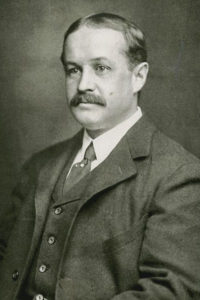
Previously assigned to Olympic, Charles Joughin (pronounced "Jock-In") was the Chief Baker on Titanic. As such, he managed a crew of 13 men.

It's reported he had been at sea since the age of 11, with a number of men in his family already serving in the Navy. In 1901, he was listed as a "baker at sea" in census data.

When he boarded Titanic, he was 33 years old.

Charles Joughin, circa 1912.

PUBLIC DOMAIN

Titanic's food was truly luxurious, even for Third Class. Second Class was considered better than First Class on other vessels. And we're all aware of how opulent First Class was. Desserts on various class menus include apple tart, cornbread, currant buns, plum pudding, and soda & sultana scones.

Fresh bread and butter, as well as Swedish bread, were included on the Third Class menu.

And the final dinner in First Class had Waldorf pudding, peaches in chartreuse jelly, chocolate and vanilla eclairs, and French ice cream.

As Chief Baker, these all would have fallen under Charles's purview.

Charles occupied what he called “The Confectioners Room,” as had been the case during his time on both the Olympic and Teutonic. He provided no explanation for his occupancy of these quarters other than “it is the better room.”

He was already off-duty and settled in his bunk when Titanic struck the iceberg, and he felt the impact. He said that he immediately understood the significance of the strike and went up on deck, but saw nothing amiss.

In time, he began hearing "general orders" filtered down from higher ups, and he prepared accordingly. He mustered his team in their shop, located on D Deck, and sent all 13 bakers up to boat deck with four loaves of bread each, as well as biscuits by some accounts, in order to stock provisions for the lifeboats.

He then backtracked to his cabin for, as he would later testify, "a drop of liqueur."

British Wreck Inquiry during Sir Cosmo Duff Gordon's testimony, taken May 25, 1912 and published by "The Graphic"

PUBLIC DOMAIN

According to his testimony in the British Board of Trade inquiry, Charles recalled his name on a list in the galley, as the overseer of Lifeboat 10, in the case of an emergency.

But when he reported to his post by about 12:30 a.m., he was made to feel obsolete.

Chief Officer Henry Wilde had taken charge and was screaming at stewards to stay back. Charles interceded, because the men weren't actually pushing forward or causing chaos. Charles then assisted in loading women and children into the boat, but when all were aboard, he saw it was only half-full.

Joughin said a number of women actually ran away, prefering to stay on the ship--this may seem ridiculous in hindsight, but was actually a common phenomenon on Titanic. Without knowing how severe the damage was and how lethal the sinking would be, the liner felt much safer and more solid than a tiny little lifeboat, in the cold and dark, being slapped about the waves indefinitely.

Charles and some stewards ran down to A Deck, where they found some women and children confused, or immobilized by fear, and crouched on the deck.

Joughin and Co. more or less forced them up on top and "threw them in" the lifeboat.

The list to port had resulted in a yard-wide berth between the boat deck and the Lifeboat, and one woman actually slipped. By some miracle of God she was caught by steward William Burke, and hung upside down until she was pulled inside by people on A Deck.

William Burke (center), the steward who caught a woman from falling from the deck as witnessed by Joughin. From the harris & Ewing Collection, courtesy of the Library of Congress.

PUBLIC DOMAIN

When the boat was properly filled, Chief Officer Wilde ordered steward Burke and two other seamen in instead of Joughin, despite the lifeboat being his assignment.

He did not step in to save himself, insisting it would have set a bad example. They pushed off without him, and Charles went back to his cabin below deck.

To imbibe.

Now, it was against company policy to drink or have alcohol on board a White Star liner, so it’s been speculated that Charles's testimony at the inquiry about how much alcohol he'd thrown back may have been intentionally inaccurate.

Officially, he testified that it was a "tumbler half-full.”

With that in mind, depictions of Charles have probably exaggerated how drunk he really was.

Unfortunately, thanks in part to his own testimony, Charles Joughin’s legacy is one of comedic relief.

Charles stated that he was off-deck for nearly an hour. At some point while down below, he said he ran into the "old doctor" that is assumed to have been Dr. William O'Loughlin, who was Titanic’s chief surgeon.

Joughin testified that he saw Dr. O’Loughlin while he was having his “drop” in his cabin, which he stated was already awash in ankle-deep water.

According to Charles, they had a brief exchange, but there appears to be no primary documentation of the conversation.

Now we just want to finish your experience. You say you went below after No. 10 had gone. Did you stay below or did you go up again?
- I went down to my room and had a drop of liqueur that I had down there, and then while I was there I saw the old doctor and spoke to him and then I came upstairs again.

Charles is believed to have been the last person to see Dr. O’Loughlin alive.

Dr. William O'Loughin in American Medicine's tribute in its May 1912 issue.

PUBLIC DOMAIN (Published prior to 1923.)

While the assumption may be that Charles may have been inclined to understate his alcohol consumption to protect his livelihood or reputation, that is unproven.

Furthermore, even if Charles did fib a little, that does not necessarily mean he was drunk.

No eyewitness accounts speak to how much Charles Joughin actually drank.

We do know at one point that an unnamed drunk man stumbled past First-Class passenger Jack Thayer. And it is a myth often perpetuated that the inebriated man who young Thayer saw, was Charles Joughin.

It is generally agreed upon, however, that this is very likely false—that is, a speculation not supported by primary sources.

It is most probable that Jack Thayer saw someone else entirely. This is because, per his account, someone informed him that the drunk man was a Virginia senator. No passenger was serving in the Senate at the time, but one survivor later became one. Unfortunately, Jack Thayer didn't specify when he was told this fact.

Moreover, we don't know what Charles chose to drink.

In the unlikely event that Jack Thayer did encounter Charles Joughin, then Jack said he was drinking gin. Some others believe it was whiskey.

But in his testimony during the British inquiry, Charles kept it vague.

When you found your boat had gone you said you went down below. What did you do when you went down below?
- I went to my room for a drink.

Drink of what?
- Spirits.

The Commissioner:
Does it very much matter what it was?

Mr. Cotter:
Yes, my Lord, this is very important, because I am going to prove, or rather my suggestion is, that he then saved his life. I think his getting a drink had a lot to do with saving his life.

The Commissioner:
He told you he had one glass of liqueur.

(Mr. Cotter.) Yes. (To the Witness.) What kind of a glass was it?
- It was a tumbler half-full.

A tumbler half-full of liqueur?
- Yes

That escalated quickly.

When Joughin reappeared on B Deck after having his liqueur, he took to throwing anything he could find overboard, particularly deck chairs. Charles testified that, knowing he was screwed without a lifeboat, he did this to give himself a fighting chance at survival once he entered the water.

At all events, all the boats had gone?
- Yes.
Yes, what next?

- I went down on to "B" deck. The deck chairs were lying right along, and I started throwing deck chairs through the large ports.

What did you do with the deck chairs?
- I threw them through the large ports.

Threw them overboard?
- Yes.

 They would float, I suppose?
- Yes.

I think one sees why. Just to make it clear, why did you do that?
- It was an idea of my own.

Tell us why; was it to give something to cling to?
- I was looking out for something for myself, Sir.

Quite so. Did you throw a whole lot of them overboard?
- I should say about 50.

Were other people helping you to do it?
- I did not see them.

You were alone, as far as you could see?
- There was other people on the deck, but I did not see anybody else throwing chairs over.

He then went up to an A Deck pantry to “get a drink of water”, and while there, Charles heard and felt a buckling of the ship as she split.

By early reports, Charles Joughin appeared to have jumped from A Deck.

But according to his own testimony at the inquiry, Charles alone climbed onto the outside of the stern railing, and was The Last Man to Leave Titanic.

He said that he saw no one else on the railing, and he rode Titanic's stern down until it submerged. According to Charles, he more or less stepped off the stern, barely even wetting his head as he entered the water.

Then what happened?
- Well, I was just wondering what next to do. I had tightened my belt and I had transferred some things out of this pocket into my stern pocket. I was just wondering what next to do when she went.

And did you find yourself in the water?
- Yes.

Did you feel that you were dragged under or did you keep on the top of the water?
- I do not believe my head went under the water at all. It may have been wetted, but no more.

Are you a good swimmer?
- Yes.


He also maintained that the stern never reached a vertical height.

Charles went on to testify that he swam for a few hours "just paddling and treading water" before finding his friend, cook Isaac Maynard, struggling on Collapsible B.

How long do you think you were in the water before you got anything to hold on to?
- I did not attempt to get anything to hold on to until I reached a collapsible, but that was daylight.

Daylight, was it?
- I do not know what time it was.

Then you were in the water for a long, long time?
- I should say over two, hours, Sir.

Were you trying to make progress in the water, to swim, or just keeping where you were?
- I was just paddling and treading water.

And then daylight broke?
- Yes.

Did you see any icebergs about you?
- No, Sir, I could not see anything.

Did it keep calm till daylight, or did the wind rise at all?
- It was just like a pond.

Then you spoke of a collapsible boat. Tell us shortly about it?

- Just as it was breaking daylight I saw what I thought was some wreckage, and I started to swim towards it slowly. When I got near enough, I found it was a collapsible not properly upturned but on its side, with an Officer and I should say about twenty or twenty-five men standing on the top of it.

Given the timeline we know, it would seem that Charles’s memory may have suffered from a misperception of time—understandable, given the immediate trauma of the sinking.

All things considered—including the science of human biology in regard to hypothermia—it’s may be realistic to assume that he swam for up to a half-hour before coming to Collapsible B.

Regardless of how long Charles swam, Mr. Maynard clung to Joughin by the hand until Officer Lowe arrived, at which point Joughin swam over and was pulled aboard.

Charles said he was colder in that lifeboat than he ever felt in the water.

The retrieval of Collapsible B by the crew of the Mackay-Bennett.

PUBLIC DOMAIN

Charles's cool and calm decision to break into the liquor stores was lauded as the act that saved his life, although scientists have stated that excessive alcohol consumption can actually accelerate hypothermia.

Sometimes life is stranger than science allows.

The truth is that, regardless of intoxication, Charles was savvy enough to stay out of the water for as long as possible.

Charles was found to be pretty much entirely unharmed.

"I was alright barring my feet; they were swelled," he said. It's reported that due to this small inconvenience, Charles climbed the ladder to Carpathia on his knees.

Joughin later wrote to Walter Lord, author of A Night to Remember, to commend Lord's more accurate presentation of the sinking. He described his departure from the ship and his survival in the water, and openly questioned his less dramatic, more pointless actions.

Some curious things are done at a time like this... Why did I lock the heavy iron door of the Bakery, stuff the heavy keys in my pocket, alongside two cakes of hard tobacco.

Here's to Charles.

Open post

“For God’s Sake, Be Brave, and Go!”: Harvey & Charlotte Collyer

"For God's Sake, Be Brave, and Go!": Harvey & Charlotte Collyer

Harvey and Charlotte Collyer were an English couple boarded Titanic as Second Class with their young daughter Marjorie.

Harvey and Charlotte had met in Surrey while she was employed as a cook for Reverend Sidney Sedgwick, and Harvey was the church sexton. They married in 1905. In time, Harvey also became the church bellringer and a grocer in town, where the entire family was loved.

The Collyers had dreamt big. Charlotte suffered from tuberculosis, and so they elected to move to Idaho, where some other family had already settled and had consistently sent the Collyers letters in which they lauded the pleasant climate. Seeking to better Charlotte's health, they purchased a fruit farm. Before departing, Harvey withdrew the family's life savings from his bank and kept it on his person. What little possessions the family had were ALL in Titanic's cargo hold.

Before they departed, the church community organized a surprise farewell for Harvey. Charlotte wrote, "They led him to a seat under the old tree in the churchyard and then some went up into the belfry and, in his honour, they rang all the chimes that they knew." She said it was a kind gesture, but it made her uneasy.

Harvey wrote a letter to his parents that was sent off while Titanic was stopped in Queenstown on April 11, 1912.

My dear Mum and Dad
It don't seem possible we are out on the briny writing to you. Well dears so far we are having a delightful trip the weather is beautiful and the ship magnificent. We can't describe the tables it's like a floating town. I can tell you we do swank we shall miss it on the trains as we go third on them. You would not imagine you were on a ship. There is hardly any motion she is so large we have not felt sick yet we expect to get to Queenstown today so thought I would drop this with the mails...

Lots of love don't worry about us. Ever your loving children
Harvey, Lot & Madge

Charlotte, nauseous the night of April 14 from too rich a dinner, was in bed. She wrote of the collision, "The sensation, to me, was as if the ship had been seized by a giant hand and shaken once, twice; then stopped dead in its course."

Harvey went up on deck and Charlotte had begun to drift off to sleep by the time he returned. He said they'd hit an iceberg--"a big one"--but an officer had assured him there was no danger. But as a clamour began to resound above them, Charlotte asked Harvey if anyone had seemed frightened. Soon thereafter, Charlotte threw on a coat, tied her hair back with a ribbon, and wrapped her daughter in a White Star blanket over her pajamas, and the three went out on deck. Marjorie was crying, as she had left behind her "dollie" from two Christmases past, and no one would go back to rescue it.

Officers kept yelling that there was no danger. But then Charlotte saw a horrific sight.

Suddenly there was a commotion near one of the gangways, and we saw a stoker come climbing up from below. He stopped a few feet away from us. All the fingers of one hand had been cut off. Blood was running from the stumps, and blood was spattered over his face and over his clothes. The red marks showed very clearly against the coal dust with which he was covered.

Excerpt from 'How I was Saved from the Titanic" as printed in the May 1912 issue of "Semi-Monthly Magazine."

When she asked him if there was danger, he frantically presented his mangled hand. The unnamed stoker then laid his head down on a coil of rope and fainted.

The Collyers were on Second Officer Charles Lightoller's side of the ship, but Charlotte wrote with admiration mostly about First Officer William Murdoch, as well as Fifth Officer Harold Lowe. Like survivor Charles Joughin, Charlotte Collyer attested to a number of women being afraid to go in the lifeboats, or otherwise leave their husbands behind.

Charlotte held her husband tightly, and not taking seats in the first two boats before them.

When the third boat was half-full, she wrote that "a sailor caught Marjorie, my daughter, in his arms, tore her away from me and threw her into the boat." Then, "A man seized me by the arm. Then, another threw both his arms about my waist and dragged me away by main strength. I heard my husband say: 'Go, Lotty! For God’s sake, be brave, and go! I’ll get a seat in another boat.'"

The men who held me rushed me across the deck, and hurled me bodily into the lifeboat. I landed on one shoulder and bruised it badly. Other women were crowding behind me; but I stumbled to my feet and saw over their heads my husband’s back, as he walked steadily down the deck and disappeared among the men. His face was turned away, so that I never saw it again.

Excerpt from 'How I was Saved from the Titanic" as printed in the May 1912 issue of "Semi-Monthly Magazine."

As far as Charlotte claimed, Marjorie never got the chance to say goodbye to her father because she was flung into the boat so fast.

But according to Marjorie herself, she did. "My father raised me in his arms and kissed me, and then he kissed my mother. She followed me into the boat... The women in one of the other boats said they wanted somebody to row for them and father got in that boat."

There's fair reason for either of them to have rearranged the truth: trauma, wishful thinking, false memories.

Charlotte's account of the night is considered one of the more graphic survivor stories. It includes a young lad who pleaded, sobbing, for a spot on the lifeboat, and then for his life with an officer's pistol aimed at his forehead, as well as another man who ran across the deck and flung himself into the boat, supposedly injuring a girl by landing on her. He was forcibly removed.

Charlotte and Marjorie watched the sinking in horror from Lifeboat 14.

I shall never forget the terrible beauty of the Titanic at that moment. She was tilted forward, head down, with her first funnel partly under water. To me, she looked like an enormous glow-worm; for she was alight from the rising water line, clear to her stern — electric lights blazing in every cabin, lights on all the decks and lights at her mast heads.

Excerpt from 'How I was Saved from the Titanic" as printed in the May 1912 issue of "Semi-Monthly Magazine."

Charlotte was also of the minority of passengers who witnessed the break.

She heard the "deafening roar" of an explosion within the ship, then "millions of sparks shot up to the sky, like rockets in a park on the night of a summer holiday. This red spurt was fan-shaped as it went up; but the sparks descended in every direction, in the shape of a fountain of fire." According to Charlotte Collyer, the stern stood straight on end before lowering into the water. And like young survivor Jack Thayer, she described the passengers on board as akin to swarms of bees.

I saw hundreds of human bodies clinging to the wreck or leaping into the water. The Titanic was like a swarming bee-hive, but the bees were men, and they had broken their silence now.

There was water in the bottom of the lifeboat.

At one point, Charlotte half-fainted, and her long hair got caught in the oar and was ripped from her scalp. Someone gave her a blanket.

Little Marjorie continued to cry for her lost doll, desolate with the thought that it was going to the bottom of the sea with no one to take care of it. Her beloved dollie was gone, along with her father, her family's entire savings, and everything else the Collyers owned in the world.

Lifeboat 14 (with mast up) approaching the rescue ship Carpathia. Courtesy of the Library of Congress.

PUBLIC DOMAIN

Once on board Carpathia, Charlotte searched in desperation for her husband, but learned that he was not among the saved.

The scene on board Carpathia that morning, as the lifeboats crept in, was harrowing by all accounts. "We could only rush frantically from group to group, searching the haggard faces, crying out names and endless questions."

Harvey Collyer's body, if ever recovered, went unidentified.

Charlotte grieved in a letter to her mother written on April 21, 1912, from Brooklyn, New York.

Oh mother there are some good hearts in New York, some want me to go back to England but I can't, I could never at least not yet go over the ground where my all is sleeping.

Sometimes I feel we lived too much for each other that is why I've lost him. But mother we shall meet him in heaven. When that band played 'Nearer My God to Thee' I know he thought of you and me for we both loved that hymn and I feel that if I go to Payette I'm doing what he would wish me to, so I hope to do this at the end of next week where I shall have friends and work and I will work for his darling as long as she needs me. 

Oh she is a comfort but she don't realize yet that her daddy is in heaven. There are some dear children here who have loaded her with lovely toys but it's when I'm alone with her she will miss him. 

Oh mother I haven't a thing in the world that was his only his rings. Everything we had went down. Will you, dear mother, send me on a last photo of us, get it copied I will pay you later on. 


Mother and daughter did soldier on and get to Idaho, but not without significant monetary help raised in the wake of their total loss, as well as the $300 Charlotte was paid for her exclusive story.

Charlotte ended her exclusively (ghost)written story as follows.

I must take my little Marjorie to the place where her father would have taken us both. That is all I care about — to do what he would have had me do.


But they did not stay in the United States. The pair were photographed on a porch swing in Payette, Idaho, while making use a White Star Line blanket.

Charlotte and Marjorie shortly after the sinking. From the George Grantham Bain Collection, courtesy of the Library of Congress.

PUBLIC DOMAIN

They returned to England, and Charlotte Collyer remarried in 1914. Sadly, she died as a result of her tuberculosis in late 1916. Then Marjorie's stepfather died in March 1919.

Marjorie, now three times an orphan by the age of fifteen, was sent to live with her uncle Walter on his farm, where she lived until she was married on Christmas Day of 1927.

SOURCE MATERIAL

[ital]

Open post

“I Trust That They Are Better Off”: Rhoda Abbott

"I Trust That They Are Better Off": Rhoda Abbott

Rhoda Abbott had long been an elusive Titanic survivor.

As it turns out, this was because her name, on Titanic's manifest and in contemporary articles, was inaccurately written as Rose or Rosa. Regardless, on her birth, death, and marriage certificates, her name is listed as Rhoda. And with that, a comparative wealth of information has been discovered.

Rhoda about was born in England, and emigrated to Providence, RI, in 1894. There, she met and married a fellow expat named Stanton Abbott, who rose to fame as a middle-weight boxing champion. This fame, however, accelerated the deterioration of their marriage, and in 1911, Rhoda and Stanton separated.

Rhoda returned to England with their two teenaged sons, Rossmore and Eugene, on Titanic's longest-lived sister ship, the RMS Olympic.

They struggled to get by in England. Rhoda worked as a seamstress and Rossmore as a bootmaker, while Gene was still receiving schooling. But Rhoda soon realized that her boys were homesick--she was English, but they were American. So she decided to take them home.

Rhoda Abbott boarded Titanic as a third-class passenger with her two boys. Rossmore was 16 by this point; Gene was 13.

It's been reported that the boys, excited to get stateside and dazzled by Titanic, almost immediately peaced out from their mom to explore the ship. Rhoda spent time conversing at length with fellow English women in adjoining cabins, particularly Amy Stanley and Emily Goldsmith.

As a whole, those in Third Class, being low within the vessel, felt the greatest shudder upon impact with the iceberg. After feeling the collision, the boys wanted to get up to the boat deck to see what had happened. But their mother wanted to wait for instruction from a steward, so she made them stay put and go to bed.

At a quarter past midnight, a steward threw open their door, yelling, "All passengers on deck with life jackets."

Rhoda, Rossmore, and Gene managed their way up to the boat deck with a little maneuvering. As they shuffled in the mass across the stern's deck, the last of the distress signals was launched above them. Eventually, they reached Collapsible C, the boat that some of Rhoda's cabin neighbors, including Amy Stanley and Emily and Frankie Goldsmith, got in. With the assertion of 'Women and Children First' in full effect, Rhoda's sons were too old to be considered children.

At around 2:00 a.m., when Rhoda was frantically offered a place in Collapsible Lifeboat C, she pressed her two boys to her and refused. It was about 2:00 a.m.

Twenty minutes later, Titanic submerged.

Water overtook the boat deck as the officers were desperately trying to launch Collapsible A, which Rhoda and Gene were waiting for--Rossmore, in accordance with Rhoda's worst fear, was put firmly back with the other men.

Rhoda grabbed Gene's hands, but when she surfaced, both Rossmore and Gene had been dragged away underwater.

She never saw her boys again, alive or dead.

Rossmore's corpse was recovered by the Mackay-Bennett and committed to the sea on April 24, 1912. He was listed as follows.

NO. 190 - MALE - ESTIMATED AGE, 22 - VERY FAIR
CLOTHING - Brown overcoat; grey pants; green cardigan; blue jersey; black boots.
EFFECTS - Watch; chain and fob, with medal marked "Rossmore Abbott"; pocket book empty and two knives.
PROBABLY THIRD CLASS - NAME - ROSSMORE ABBOT

Gene's body was never found.

With no sight of her lost sons, Rhoda sank again, but was blown back to the surface by the exploding Titanic boilers, which she believed caused burns to her thighs.

Rhoda managed to make it to Collapsible A--which having been washed away only half-prepped, had taken on a few inches of water--and was pulled aboard. She recounted her experience to the Pawtucket Times.

Soon the raft tilted and all slid off into the water. Many of them managed to get back on it and some did not. I managed somehow to get on it, but I don’t know how. We were forced to stand on the float in lockstep to keep our balance for over six hours. Had it not been for Officer Laws I would have been drowned. I was nearly exhausted when he lifted me into his lifeboat. It would have been impossible for an officer to show more courtesy and many of the criticisms that have been made against this man are very unjust.

"Officer Laws" was, in fact, Fifth Officer Harold Lowe, of Lifeboat 14, the only lifeboat to return for survivors.

Officer Lowe left Collapsible A behind. It was recovered one month later, in May of 1912, with three corpses still within.

Rhoda had been practically unconscious when removed from Collapsible A, and was cared for by a fireman until taken aboard Carpathia. She had no memory of any of it. According to fellow survivor Amy Stanley, once on board Carpathia, Rhoda was mute and shellshocked.

 We were very close since we were on the Titanic together. And her stateroom had been near mine. I was the only one that she could talk to about her sons because I knew them myself. She told me that she would get [sic] in the lifeboat if there hadn't been so many people around. So she and her sons kept together. She was thankful that [the] three of them had stayed with her on that piece of wreckage. The youngest went first then the other son went. She grew numb and cold and couldn't remember when she got on the Carpathia. There was a piece of cork in her hair and I managed to get a comb and it took a long time but finally we got it out.

Meanwhile, Rhoda's ex-husband Stanton had been informed of the loss of his young boys. The New York Times reported it on it, with a distinct lack of sentiment, on May 4, 1912.

Stanton Abbott, an Englishman residing at Providence, R. I., inquired at the White Star Line office yesterday for his two sons, Rosmore Edward, 17 years old, and Eugene Joseph, 13, who were passengers with their mother, Mrs. Rose Abbott, 45 years old, on the Titanic, and were lost. The mother, he said, is in the New York Hospital in a dangerous condition from shock and fever. He was told that the body of the older boy had been recovered, and Mr. Abbott said he would go to Halifax to claim it.

Rhoda's physical recovery was slow, and she was one of the last survivors to be released from care at St. Vincent's Hospital in New York City.

Her grief, however, knew no real end. Rhoda kept in touch with her cabin neighbors after the sinking, and in 1914, she wrote to Emily Goldsmith, and her grief was no less palpable for the passage of time.

I have so envied you with Frankie, and me losing both mine, but I trust that they are Better off out of this hard world...

I read by the papers the terrible weather you are having. I suppose Frank enjoys it. I know my little fellow used to when he was alive. I have his sled now that he used to enjoy so much, bless his little heart. I know he is safe in God’s keeping, but I miss him So Much.


Rhoda Abbott was the only woman to go down with Titanic and somehow survive.

And therefore, Rhoda, thereafter and for so long called "Rosa" or "Rose," was the only woman rescued from the water.

Open post

“Like Locusts on a Midsummer Night”: Jack Thayer

"Like Locusts on a Midsummer Night": Jack Thayer

Jack Thayer boarded Titanic at all of 17 years old, as a First-Class passenger with his parents John and Marian, and Marian's maid Margaret Fleming.

Jack Thayer in his youth.

PUBLIC DOMAIN

On April 14, at 11:40 p.m., Jack was winding his watch and preparing for bed when he felt the breeze coming from his open window stop altogether, and the engines ceased their turnings.

He wrote, "The sudden quiet was startling and disturbing. Like the subdued quiet in a sleeping car, at a stop, after a continuous run."

Throwing on a coat over his pajamas, Jack hollered to his parents he was "going out to see the fun" and went up to the boat deck, but noticed nothing out of the ordinary. He moved toward the bow and, as his vision became accustomed to the night, saw pieces of ice on the well deck.

Jack retrieved his parents. On the way, they all noted that Titanic was listing to port.

The Thayers returned immediately to their stateroom and dressed. Jack, in a fit of clarity, put on two vests and a coat to try to safeguard himself from the cold.

Jack, his parents, and Miss Fleming banded together on boat deck until the Women-And-Children-First decree, when they parted ways with Marian and her maid at the top of the Grand Staircase.

Jack and his father assumed Marian and Margaret were safely off the ship, until a steward informed them otherwise. They chased the ladies down, and while John, Marian, and Margaret wandered off looking for a lifeboat, Jack was left behind.

Jack's mother Marian circa 1900, taken when Jack was 6 or 7 years old.

PUBLIC DOMAIN.

It's possible that Jack was caught up in conversation with Milton Long, an acquaintance he'd only made earlier that same evening over coffee.

Jack and Milton went searching for boats, but the boys were impeded by the melee and missed out. At one point, they paused in between a set of empty lifeboat davits and traced a star's movement as it rose in between the davits, to determine how quickly the ship was going down.

Two collapsible boats were available, but the boys felt uneasy, having seen how precariously the traditional, all-wood lifeboats had been launched.

So they elected to remain on board Titanic instead of seeking placement in any of the collapsible lifeboats.

As Jack and Milton went back and forth on how to proceed, a man came out through a nearby door and staggered by, pounding down an entire bottle of gin as he went. Jack recalled thinking, "If I get out of this, that's one man I'll never see again."

Jack's father, John.

PUBLIC DOMAIN

As the ship's angle grew more drastic, the boys heard "deadened explosions" within. Jack was haunted by the sound of it all.

It was like standing under a steel railway bridge while an express train passes overhead, mingled with the noise of a pressed steel factory and wholesale breakage of china.

Excerpt from "The Sinking of the S.S. Titanic" by Jack Thayer.

Jack wanted to jump in and swim for it as he saw people doing down by the stern, but Milton was reticent as he was not a strong swimmer. Eventually, though, Milton relented.

Milton climbed over the railing, and with his legs dangling down, paused and called back, "You are coming, boy, aren't you?" Jack said he'd be right behind him, and Milton slid down the side of the ship.

Jack never saw him again.

Milton Long's corpse was recovered by the Mackay-Bennett, and listed as follows.

NO. 126. - MALE. - ESTIMATED AGE, 35. - HAIR, DARK.
CLOTHING - Black clothes; flannel vest, and black and white vest; white shirt marked "M. C. L."; handkerchief marked "M. C. L." (monogram), and brown boots.
EFFECTS - Gold wrist watch; gold ring with crest; three gold studs; keys; pocket box; £30.00 in gold; 12s. 1 1/2d. in purse; letter of credit.
FIRST CLASS. - NAME - MILTON C. LONG.

Jack jumped in feet first almost immediately after Milton disappeared in the water. He guessed in his account that Milton was sucked in by the deck, instead of pushed out by the backwash as he himself had been only moments later.

Jack surfaced a fair distance away from the ship, and was transfixed by the sight.

The ship seemed to be surrounded with a glare and stood out of the night as though she were on fire. I watched her. I don’t know why I didn’t keep swimming away. Fascinated, I seemed tied to the spot. Already I was tired out with the cold and struggling, although the life preserver held my head and shoulders above the water.

Excerpt from "The Sinking of the S.S. Titanic" by Jack Thayer.

Jack Thayer's survival is particularly notable because he was one of the minority who insisted that Titanic had broken in half, and never faltered in his assertions.

Suddenly the whole superstructure of the ship appeared to split, well forward to midship, and blow or buckle upwards. The second funnel, large enough for two automobiles to pass through abreast, seemed to be lifted off, emitting a cloud of sparks. It looked as if it would fall on top of me. It missed me by only 20 or 30 feet. The suction of it drew me down and down.

Excerpt from "The Sinking of the S.S. Titanic" by Jack Thayer.

When Jack managed against all odds to resurface, he struck his head on the overturned Collapsible B lifeboat.

Jack was pulled up onto the back of the upside-down "canvas craft," where there were, he guessed, four or five other men already on board.

[Titanic's] deck was turned slightly toward us. We could see groups of the almost 1,500 people still aboard, clinging in clusters or bunches, like swarming bees; only to fall in masses, pairs or singly...

Here it seemed to pause, and just hung, for what felt like minutes. Gradually she turned her deck away from us, as though to hide from our sight the awful spectacle.

We had an oar on our overturned boat. In spite of several men working it, amid our cries and prayers, we were being gradually sucked in toward the great pivoting mass. I looked upwards — we were right underneath the three enormous propellers.

For an instant, I thought they were sure to come right down on top of us. Then, with the deadened noise of the bursting of her last few gallant bulkheads, she slid quietly away from us into the sea...

I don’t remember all the wild talk and calls that were going on on our boat, but there was one concerted sigh or sob as she went from view.

Probably a minute passed with almost dead silence and quiet. Then an individual call for help, from here, from there; gradually swelling into a composite volume of one long continuous wailing chant, from the 1,500 in the water all around us. It sounded like locusts on a midsummer night, in the woods in Pennsylvania.

Excerpt from "The Sinking of the S.S. Titanic" by Jack Thayer.

Jack wrote that, after the sinking, 28 men ended up on the back of Collapsible B.

Every moment was spent desperately trying to keep the upside-down lifeboat from going completely underwater by maintaining a precarious balance on its back.

For hours, all the men on board held utterly still in the oddest and most painful of positions, to keep from slipping into the lethally cold water.

We were standing, sitting, kneeling, lying, in all conceivable positions, in order to get a small hold on the half-inch overlap of the boat’s planking, which was the only means of keeping ourselves from sliding off... I was kneeling. A man was kneeling on my legs with his hands on my shoulders, and in turn somebody was on him. Once we obtained our original position we could not move.

Excerpt from "The Sinking of the S.S. Titanic" by Jack Thayer.

The men prayed.

They sang hymns.

And when daylight finally broke, the Carpathia followed slowly. The men moved to stand, shifting their weights to and fro to the counter the swells as the air pocket that kept the lifeboat afloat continued to diminish. Every moment, more water overtook it.

Finally, hearing the cries from Collapsible B, Lifeboats 4 and 12, which were lashed together, crept over to take the surviving men on board.

Jack's mother was on Lifeboat 4.

He did not notice her. She did not notice him.

The recovery of Collapsible B by the crew of the Mackay-Bennett.

PUBLIC DOMAIN.

When Jack reunited with his mother on Carpathia, she was reported to have embraced him and asked, "Where's daddy?"

Jack told her that he did not know.

John B. Thayer, Sr., did not survive, and his corpse was not recovered. For the remainder of his life, Jack was dogged by shame and remorse about his father. "I only wish I had kept on looking for my father. I should have realized that he would not have taken a boat, leaving me behind."

Jack was loaned pajamas and a bunk, and before crumpling into bed, he took a desperate shot of brandy, only then realizing it was his first encounter with hard liquor.

Once rested and in possession of his full faculties, Jack spoke with Carpathia passenger L.D. Skidmore, who, while listening to Jack's story, sketched his recollections of Titanic's break.

Jack Thayer's account of Titanic breaking, sketched by Carpathia passenger L.D. Skidmore as Jack spoke to him.

PUBLIC DOMAIN

Jack kept a stiff upper lip and by all accounts, persevered to honor Titanic. When Colonel Archibald Gracie--a man whom Jack had shared space with on Collapsible B--passed away in December of 1912, Jack and his mother attended the funeral services.

And when Jack received a letter from the bereaved father of Milton Long, the friend that he had made while on board Titanic, Jack wrote the following reply.

My dear Sir:

I received your letter this morning. Mother and I were very touched by it. Words cannot express how much we sympathise with you and Mrs. Long.

...Your son was perfectly calm all the time and kept his nerve, even to the very end. I wish I had more to tell you, but I hope this will be of some comfort to you. I am sending you my picture, thinking you might like to see who was with him at the end. I would treasure it very much if you could spare me one of his.

With our heartfelt sympathy, believe me,

Sincerely yours, John B. Thayer, Jr.

Jack went on to graduate from UPenn and pursue a banking career, get married, and have six children: three daughters and three sons, although one boy did not survive infancy. Both of Jack's surviving sons, Edward and John, served in the Second World War.

Edward Thayer had signed on as a bomber pilot, and was lost in the conflict when his plane was shot down in the Pacific theater in 1943. His remains were never recovered.

And the following year, on April 14--the anniversary of Titanic's collision with the iceberg--Jack's mother died. Doubly and profoundly bereaved, Jack's depression deepened.

He went missing in September of 1945, when he was 50 years old. He hadn't been seen for days. When he was finally found, he was dead in his car, parked alongside a trolley loop in Philadelphia.

He had slit his wrists, as well as his own throat.

When Jack's belongings were posthumously sorted, a small booklet was discovered; produced in 1940, it was one of 500 copies made for family and friends.

SOURCE MATERIAL

Cornwall, Thomas [compiled & edited by.] "Titanic: The John B. "Jack" Thayer Jr. Chronicles." 2019.

https://www.encyclopedia-titanica.org/titanic-survivor/john-borland-thayer-jr.html

Open post

“My God, Don’t Ask Me Too Much”: Daniel and Mary Marvin

“My God, Don’t Ask Me Too Much”: Daniel Warner Marvin & Mary Farquharson Marvin

Mary Farquharson was born in Edinburgh, Scotland, in 1894. She emigrated to New York with her parents when she was 9 years old.

Mary’s mother Jessie and her Aunt Margaret established a successful modiste business, Farquharson & Wheelock. So successful, in fact, that the Scottish atelier would go on to produce a gown worn by Cornelia Vanderbilt and others displayed in the Metropolitan Museum of Art.

A portrait of Mary, originally published in the Butler Citizen (Pennsylvania) in 1914. Courtesy of Encyclopedia Titanica as provided by Gavin Bell.

PUBLIC DOMAIN (image taken & published prior to 1923)

Daniel Warner Marvin, by contrast, was New York born-and-raised. His daddy Henry was the co-founder of the famed American Mutoscope and Biograph Company. It was the premier motion picture company at the time, founded in part by William Kennedy Dickson, a scientist who had only just left the employ of Thomas Edison, and which innoculated the founders against Edison's notorious litigious approach.

We don't know how Daniel and Mary met. What we do know is that when they fell in love, Daniel was only 18, and Mary was still in school at 17. They wed in a civil ceremony on January 8, 1912, without their parents' knowledge.

Young Mary found herself pregnant almost immediately thereafter. Once found out, Daniel and Mary had a staged do-over wedding in her parents' home on March 12, 1912, which was filmed. It's reported that this ceremony was the first wedding ever "cinematographed".

Mary's wedding gown was designed, of course, by Farquharson & Wheelock, and Mary was featured in Vogue.

Still from Daniel & Mary's "cinematographed" wedding, filmed on March 12, 1912.

PUBLIC DOMAIN (image taken & published prior to 1923)

Daniel and Mary elected to honeymoon in Europe, departing on the Mauretania. And in a twist of cruel, even maniacal fate, they were set to return to New York on the Carpathia--the very ship that rescued Titanic survivors--but were persuaded by Captain Smith, a friend of the family, to take the trip on Titanic with him.

Before they departed, Daniel's father gave him a hand-crank camera.

The young Marvins took to suite D-30. It's reported that they were fairly private during the voyage, and spent a significant amount of time filming around the ship.

After the collision at 11:40 p.m., a steward knocked on the couple's door around 12:25 a.m. He advised that lifeboats were being loaded as a precaution.

Mary dressed in a life-vest and a fur coat, and Daniel led her up to the boat deck. Mary was sent off in Lifeboat 10, which contained a number of very young children, including Titanic's youngest and last-to-die survivor: Millvina Dean, who was only two months old.

We know of Mary and Daniel's last exchange thanks to Mary herself.

"My God, don’t ask me too much," she said [when being asked after by a reporter]. "Tell me, have you any news from Dan? He grabbed me in his arms and knocked down men to get me into the boat. As I was put in the boat he cried: 'It’s all right, little girl; you go ahead, I will stay a while. I’ll put on a life preserver and jump off and follow your boat.' As our boat shoved off he threw a kiss at me, and that is the last I saw of him."

As reported in the New York Times dated April 19, 1912. © Citation: Holman, Hannah. "Titanic Voices: 63 Survivors Tell Their Extraordinary Stories," 2011.

It's been reported that when Mary realized that Daniel was not among the saved, she fainted.

Daniel's body, if recovered, was never identified.

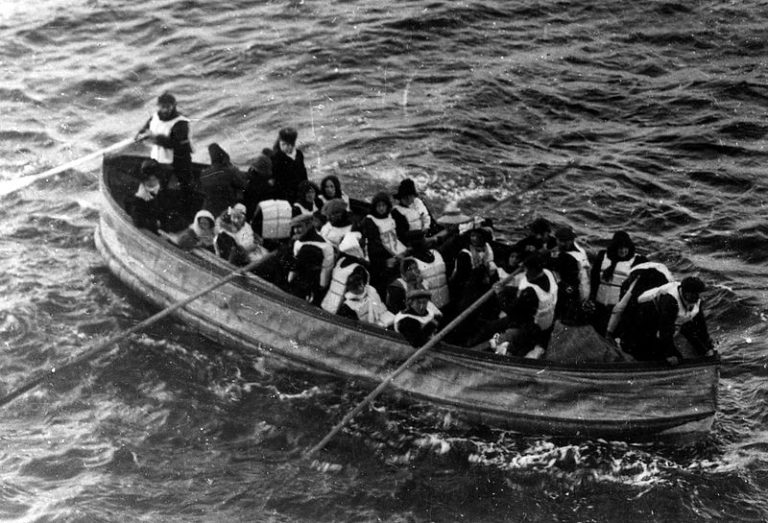
Titanic survivors on board the rescue ship Carpathia. Courtesy of Library of Congress.

PUBLIC DOMAIN

Mary gave birth to Daniel's daughter in October of 1912. On Christmas Day of 1913, Mary married her late husband's best man, Horace de Camp. Together, they had two children, and Horace adopted Daniel's daughter.

Mary spent the remainder of her life in the Adirondacks.

Mary's first daughter disclosed that tensions between Mary's family and the grieving Marvin family were heightened in the wake of Daniel's loss. Specifically, she said that Mary was determined to keep the Marvins from ever learning too much about their son's final days on Titanic. I doubt we'll ever know why.

Mary was reportedly reticent to talk about Titanic, going so far as to decline multiple invitations to survivors' reunions. She did assert, however, that she had seen a man use a revolver to force his way into a lifeboat.

As she progressed in years, Mary relaxed her sense of privacy just enough to confide a small amount of things in her young grandson, Stuart de Camp. According to Stuart, he eventually eased his grandmother into discussing Titanic--he recalls that he was around 9 years old at the time.

Moose River in the Adirondacks, as taken by Anne LaBastille in May 1973 for the Enivronmental Protection Agency.

PUBLIC DOMAIN

Around that time, Mary asked Stuart to row out in a family boat with her to the center of Moose River in upstate New York. She brought with her two items completely unknown to Stuart.

Eventually, Mary instructed Stuart to cease his rowing.

As she waited for the boat to still, she revealed the mystery items one by one.

The first was the film reel of her wedding to Daniel Marvin; that is, the staged version her parents had arranged after discovering their elopement.

The second, said Stuart, was the reel Daniel had filmed while he and Mary sailed on Titanic—that same reel that young Mr. Marvin had thrown down into the lifeboat, for his beloved wife to safeguard.

And then, before the eyes of her bewildered grandson, Mary threw both reels into the river.

Open post

Launch Day

Launch Day

No, not April 10, 1912.

May 31, 1911, when liner-in-progress SS401 took its first bath.

It seemed that all of Belfast came to witness Titanic's so-called baptism in the River Lagan; some estimate up to 100,000 in the crowd, elbowing for space wherever it could be found. Recall from last year's post about the Harland & Wolff shipyard that the building of any ship, but especially the White Star liners, required the masterwork of thousands of citizens over a period of years. It forged a deeply personal connection, and was an accomplishment for the entire community. It bound them in elation and, less than a year later, in unbridled grief.

It's a challenge to underestimate just much the Titanic meant to Belfast.

As the design and dimensions of the Titanic and the Olympic are practically identical it is not now necessary to say much on this point, seeing that a detailed description of the latter - which would apply equally to her sister ship - has already been published in our columns. The vessels mark a new epoch in naval architecture. In size, construction, and equipment they represent the last word in this science...

Every detail had to be judged with mathematical accuracy if accidents had to be averted, and the preparations had therefore to be made with great care and caution. Over the bows of the vessel the White Star Company's flag floated, and there was displayed a code signal which spelled the word "success". If the circumstances under which the launch took place can be accepted as an augury of the future, the Titanic should be a huge success.

The ceremony was lost on at least one unnamed shipyard worker, though, who was reported to have said of the launch, "We just builds 'em, then shove 'em in."

Admission was sold with a ticket--the proceeds were reportedly donated to two local children's local hospitals, so: right on, Harland & Wolff. Select tickets to the launch survive today. As evidenced by the creases, the tickets all spent some time in their owners' pockets.

Titanic was not complete by any means--just its hull. It had none of its iconic four funnels, and the opulence that we associate with the ship was not yet installed. This was the day that Belfast would see if its newest baby could float.

An inch-thick coat of soft soap, tallow (id est, animal fat), and train engine oil slicked the tracks to allow the Titanic to slide down Slipway 3 into the waters at Belfast Lough, amounting to 23 tons of what must have been truly putrid grease. A daunting 80 tons of cable and multiple anchors were used to moderate the speed.

White Star was not the break-a-champagne bottle-on-the-hull sort of company. But it still knew how to get its pomp on. At least 90 members of the press were in attendance. Shipyard workers were given holiday without pay--unless they were assisting the launch.

Lord Pirrie (left) and J. Bruce Ismay on May 31, 1911, prior to Titanic's launch. Taken by Robert John Welch for Harland & Wolff.

PUBLIC DOMAIN

By all accounts, the launch of Titanic could not have been scheduled for a more perfect day, though it was a bit hot for those who couldn't find shade.

Ladies formed a considerable proportion of the aggregate attendance, and even if their picturesque frocks appeared a trifle incongruous when contrasted with the surroundings of the shipyard itself they were unmistakably in harmony with the glow of the soft turquoise sky, from which the piercing rays of the sun descended, making the heat exceedingly trying for those who witnessed the launch.

Company dignitaries and those shipyard workers with ticketed admission took to stands that were built above the crowd. Lord William Pirrie, the Harland & Wolff chairman who was also celebrating a shared birthday with his wife that day, returned from inspecting the hydraulic rams shortly after noontime. At approximately 12:05 p.m., a pair of rockets were fired to warn other crafts in the vicinity. After ascending the stands with White Star chairman J. Bruce Ismay and financier J.P. Morgan, Lord Pirrie finally gave the signal at 12:13 p.m.

Another red rocket was set off.

And as little white flags bearing "Good Luck" shuddered en masse, an exclamation of "There she goes!" echoed in the crowd.

It took a total of 62 seconds for the bow to take the water as the crowd chased its descent, after which the empty hull floated serenely to the other side of the Lagan. From there, five tugboats dragged what would become Titanic to the deep water berth where it would be fitted for its maiden voyage next year.

Titanic launching from the dry dock. By Robert John Welch for Harland & Wolff.

PUBLIC DOMAIN

And in the chaos of all this, yes, someone did die.

James Dobbin was what was called an 'old hand'--an established and well-known shipwright about the Yard. On Launch Day, he was assigned to knocking out the wooden support beams as the ship groaned forward. He was cross-sawing one of these shoring timbers when it collapsed and crushed him.

Dobbin was extricated by his colleagues and sent to the Royal Victoria Hospital--and in the company car, no less--where after surgery, he died from his injuries on June 2, 1911, two days following the launch of Titanic. His cause of death was listed by the coroner as "Accidentally crushed under a piece of timber... Shock and haemorrhage following fracture of pelvis."

Jimmy Dobbin was 43, and married. It's reasonably speculated that his wife Rachel and their only child, 17-year-old James, were most likely there that day, witnessing the launch alongside all the rest of Belfast... with no concept of what was happening to Jimmy as Titanic slid away.

And hardly did anyone else. Not Lord Pirrie, who hosted Ismay and Morgan at a private lunch afterward. Not any of the jollymakers celebrating through the day and into the evening. And all the while Titanic bobbed and whispered in its berth, awaiting its engines, its fittings, its crew and its passengers.

From the George Grantham Bain Collection, Library of Congress.

PUBLIC DOMAIN

In 2014, a family photo album containing over 100 before-unknown photos of Titanic and Olympic were auctioned by the family of John Kempster, who was a director and senior engineer at Harland & Wolff; thirteen of those photographs were taken May 31, 1911. On that day, Kempster was acting as the master of ceremonies at one of the celebratory luncheons hosted by Harland & Wolff at Belfast's Grand Central Hotel.

A haunting handwritten caption of the newly discovered photos reads 'Going, going, gone.'

Open post

Ghost Boats & Lost Souls

Ghost Boats & Lost Souls

Recovery of bodies from Titanic took weeks.

The Canadian vessel Mackay-Bennett was tasked with collecting them, and they were overwhelmed with the job--there were more bodies than the ship could hold.

On board with crew and supplies were a priest and an embalmer.

First-class passengers were embalmed and stored in coffins; second-class, the same except for canvas instead of coffins. Third-class corpses and many crewmembers were buried at sea. Of these 116, only 56 were identified.

Recovery of a Titanic victim by the crew of the Mackay-Bennett.

PUBLIC DOMAIN

Out of over 1,500 dead, a total of 328 bodies were found by the Mackay-Bennett, and 306 of those were recovered. Still, this was far more than they had prepared for.

In addition, the bodies were saltwater-bleached, bruised, crushed, with broken limbs and all cut up. The sinking is often portrayed as sanitary, depicting vistims that died frozen but otherwise unharmed.

In truth, it was gruesome.

Captain and crew of the Mackay-Bennett, taken between 1910 and 1915. From the George Grantham Bain Collection, courtesy of the Library of Congress.

PUBLIC DOMAIN

Multiple crewmembers of the Mackay-Bennett suffered PTSD for the rest of their lives, including one man named Clifford Crease, who, at the end of his long life, even elected to be interred mere feet from the grave of a Titanic victim whose recovery had irrevocably scarred him. He honored the memory of this unidentified passenger all of his life.

Frederick Hamilton, a cable engineer on Mackay-Bennett, wrote about the reaping in his diary.

The tolling of the bell summoned all hands to the forecastle where thirty bodies are ready to be committed to the deep, each carefully weighed and carefully sewn up in canvas. It is a weird scene, this gathering. The crescent moon is shedding a faint light on us, as the ship lays wallowing in the great rollers. The funeral service is conducted by the Reverent Canon Hind, for nearly an hour the words For as must as it hath pleased - - ' we therefore commit his body to the deep' are repeated and at each interval comes, splash! as the weighted body plunges into the sea, there to sink to a depth of about two miles. Splash, splash, splash.

© Caption.

Even then, there were others to find, and many more that never would be.

Collapsible A had been launched only moments before submersion--so close to, in fact, that it was washed away without the officers being able to pop up its canvas sides.

Thus, even though people found it and boarded it, it had taken on water--so much, in fact, that those people were standing on it were knee-deep in water, and dying.

They did this for hours until they were rescued by Fifth Officer Harold Lowe, who was the only officer to attempt rescue of more people from the water.

Out of the thirty or so survivors who made it to Collapsible A, Officer Lowe found no more than a dozen survivors.

And many frozen corpses.

Fifth Officer Harold Lowe, the only Titanic officer to return for survivors.

PUBLIC DOMAIN

Lowe left three bodies in Collapsible A, which he commented on in his characteristically straightforward tone during the United States Senate Inquiry.

As to the three people that I left on her - of course, I may have been a bit hard hearted, I can not say - but I thought to myself, "I am not here to worry about bodies; I am here for life, to save life, and not to bother about bodies," and I left them.

...The people on the raft told me they had been dead some time. I said, "Are you sure they are dead?" They said, "Absolutely sure." I made certain they were dead, and questioned them one and all before I left this collapsible.

On May 13, 1912, the crew of the Oceanic were approximately 200 miles from the wreck site when the spotted a strangely shaped plank in the flat distance. Using binoculars, they realized it wasn't a plank. It was a lifeboat.

And it wasn't vacant.

Sire Shane Leslie, on board Oceanic, recalled, "Orders from the bridge dispatched a lifeboat with an officer and a medical officer. What followed was ghastly."

Collapsible A, boarded by crewmembers of Oceanic on May 13, 1912.

PUBLIC DOMAIN (photo taken prior to 1923)

Six Oceanic crewmen rowed out to meet the partially collapsed Collapsible A.

Slumped within, faces blackened from rot and a month under Atlantic sunlight, were three "unrecognizable" corpses: two firemen, and one wearing a dinner jacket.

According to the firsthand account by Sir Shane Leslie, the arms of one corpse snapped off in the crewmember's hands.

Two sailors could be seen, their hair bleached by exposure to sun and salt, and a third figure, wearing evening dress, flat on the benches. All three were dead and the bodies had been tossing on the Atlantic swell under the open sky ever since it had seen the greatest of ocean liners sink.

The names of the sailors, reported to be firemen, are to date unknown, but the well-dressed corpse was identified: First-class passenger Thomson Beattie, 37, from Canada.

Thomson Beattie, whose body was recovered from Collapsible A on May 13, 1912, one month after Titanic sank.

PUBLIC DOMAIN

The Oceanic crew wrapped the three corpses in canvas, said a prayer, and buried them at sea.

Upon hauling the lifeboat on board, the Oceanic discovered something else: a gold wedding ring. Inscribed in its band was "Edvard to Gerda."

It would later come to light that the wedding band belonged to Swedish third-class passenger Elin Gerda Lindell. She and her husband Edvard had boarded Titanic bound for a new life in Hartford, Connecticut.

After sliding down the steepening deck into the ocean, the couple had both made it to Collapsible A.

But Gerda had been too cold, and the others too weak, to pull her aboard. She eventually fell silent and still, and Edvard was forced to let her drift away.

Before he let go, he removed her wedding band.

Gerda Lindell’s wedding band, as displayed in Titanic: The Exhibition in New York City, 2022.

© soliloquism, 2022. Courtesy of #TitanicExhibitionNYC.

According to survivor August Wennerstrom, "Edvard's hair turned all gray in lesser time than 30 minutes".

Edvard died shortly thereafter, bereft at the loss of his wife, and still cradling her wedding ring. It is thought that his body was pushed overboard to lighten the load of the partially submerged Collapsible A, but the wedding ring was dropped in the process.

Neither Edvard nor Gerda Lindell were ever recovered.

Open post

“In Death They Were Not Divided”: Isidor & Ida Straus

“In Death, They Were Not Divided”: Isidor & Ida Straus

Isidor Straus was nine years old when he first set foot on American soil in 1854.

He, along with his three younger siblings, had been brought to New York by their mother. They then set forth to reunite with Isidor’s father Lazarus, who had already settled in Georgia two years prior to establish his mercantile business, which thrived—partly due to Lazarus’s pre-existing connections with wholesale merchants in Philadelphia, and partly due to the prosperity of local cotton plantations.

Reportedly, the Strauses were the sole Jewish family in their new hometown of Talbotton.

In 1861, sixteen-year-old Isidor was ultimately turned away from the Confederate Army of the United States; he was simply too young, he was told.

So, in 1863, after becoming the secretary to a Confederate agent, young Isidor Straus elected to become an international spy.

He hopped a ship from Charleston to Liverpool, which ran the union blockade. Isidor hid himself away—his life savings of $1200.00 in gold was sewn into his undershirt.

And after a layover of some months, staying with relatives in his birthplace of Otterberg, Bavaria, Isidor settled in London. He worked as an aide in financial deals for the Confederacy, and at all of nineteen years old, he even took on a mission to Cuba.

Isidor returned to Georgia in 1865, once the Civil War had ended. He found his family’s business destroyed, and so he convinced his family to reconsider their planned relocation to Philadelphia, in favor of New York City.

So Isidor arrived in New York broke, because he insisted on paying all of his debts prior to his departure, in spite of the fact that Confederate money had been rendered worthless.

In 1871, Isidor married Rosalie Ida Blun, whom he had met in 1863 while traveling to England.

They would go on to have seven children.

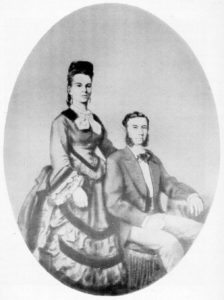
Isidor & Ida Straus's marriage portrait, 1871.

PUBLIC DOMAIN

By 1871, Isidor had already been in business with his father for five years. Isidor’s brother Nathan and their brother-in-law joined in by 1873, thereby creating L. Straus & Sons, purveyors of crockery and fine china.

In 1874, L. Straus & Sons entered into an agreement with Rowland Hussey Macy, founder of Macy’s Department Store, to open a glassware department in the basement.

L. Straus & Sons became internationally successful. In 1888, Isidor and Nathan were invited into official partnership at Macy’s, which at the time boasted just over 2,000 employees.

And by 1896, Isidor and Nathan owned Macy’s outright.

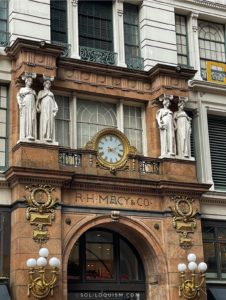
Entrance to Macy’s Department Stire on 34th Street, Manhattan, circa 2022.

© soliloquism, 2022.

Isidor and Ida were reportedly a shining example of love throughout their lives.

They traveled together constantly and were rarely apart. Even when Isidor served in the United States Congress from January 1894 through March 1895, he and Ida exchanged daily correspondence.

Perhaps out of love as well as pragmatism, Isidor declined to seek reelection.

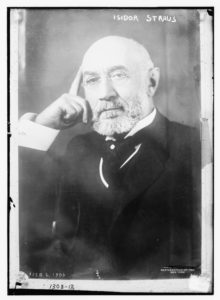
Congressman Isidor Strauss, taken on February 6, 1906. From the George Grantham Bain Collection, courtesy of the Library of Congress.

PUBLIC DOMAIN

They had wintered together in Europe in 1911 through 1912, spending most of their holiday at Cape Martin in southern France.

The Strauses had not planned to travel on Titanic. Like many other passengers, however, they found themselves with no other option due to the ongoing coal miners' strike.

Their daughter had been holidaying with them, but she did not board Titanic with her parents.

The Strauses’ time on board was evidently pleasant. Thanks to the account of Colonel Archibald Gracie, we are privy to an insight as to how Isidor and Ida spent the day of Sunday, April 14.

During this day I saw much of Mr. and Mrs. Isidor Straus. In fact, from the very beginning to the end of our trip on the Titanic, we had been together several times each day. I was with them on the deck the day we left Southampton...

During our daily talks thereafter, he related much of special interest concerning incidents in his remarkable career, beginning with his early manhood in Georgia when, with the Confederate Government Commissioners, as an agent for the purchase of supplies, he ran the blockade of Europe. His friendship with President Cleveland, and how the latter had honored him, were among the topics of daily conversation that interested me most.

On this Sunday, our last day aboard ship, he finished the reading of a book I had loaned him, in which he expressed intense interest. This book was 'The Truth About Chickamauga,' of which I am the author...

I recall how Mr. and Mrs. Straus were particularly happy about noon time on this same day in anticipation of communicating by wireless telegraphy with their son and his wife on their way to Europe on board the passing ship America. Some time before six o'clock, full of contentment, they told me of the message of greeting received in reply. This last good-bye to their loved ones must have been a consoling thought when the end came a few hours later.

Excerpt from "Titanic: A Survivor's Story," by Archibald Gracie, 1912 (reprinted by Sutton Publishing, 2008.)

On the night of the collision, Isidor and Ida found themselves at Lifeboat 8--the same lifeboat where Victor Penasco was desperately trying to get his sobbing bride, Pepita, to leave him and save herself.

Ida Straus stepped in, she expected Isidor to sit next to her; instead, thinking his wife out of harm's way, he stepped back on deck.

Ida immediately removed herself from the lifeboat and refused to reenter without her husband. Other First-Class passengers tried to secure a spot for Isidor aside Ida, but he refused.

Archibald Gracie described the scene as he witnessed it.

The self-abnegation of Mr. and Mrs. Isidor Straus here shone forth heroically when she promptly and empathically exclaimed: 'No! I will not be separated from my husband; as we have lived, so will we die together;' and when he, too, declined the assistance proffered on my earnest solicitation that, because of his age and helplessness, exception should be made and he be allowed to accompany his wife in the boat. 'No!' he said, 'I do not wish any distinction in my favor which is not granted to others.' As near as I can recall them these were the words which they addressed to me. They expressed themselves as fully prepared to die, and calmly sat down in steamer chairs on the glass-enclosed Deck A, prepared to meet their fate.

Excerpt from "Titanic: A Survivor's Story," by Archibald Gracie, 1912 (reprinted by Sutton Publishing, 2008.)

First-Class passenger Hugh Woolner was another survivor who witnessed this, and testified to as much during the Senate Inquiry.

She would not get in. I tried to get her to do so and she refused altogether to leave Mr. Straus. The second time we went up to Mr. Straus, and I said to him: "I am sure nobody would object to an old gentleman like you getting in. There seems to be room in this boat." He said: "I will not go before the other men."

Then, when Idisor tried in desperation to persuade Ida to get back in her seat, she again refused.

She was overheard by several witnesses, including steward Alfred Crawford, who testified at the Senate Inquiry, as stating, "We have lived together for many years; where you go, I go."

It is likewise reported that Ida Straus said, "I will not be separated from my husband. So we have lived, so we will die--together," but witness accounts do not seem to support this very particular word choice.

Archibald Gracie IV.

PUBLIC DOMAIN

In any case, Ida gave her chambermaid, Ellen Bird, her fur coat to keep warm in the lifeboat. Ida simply told Ellen that she would no longer need it.

And Lifeboat 8 was lowered away without the Strauses.

Miss Ellen Bird, maid to Ida Straus.

PUBLIC DOMAIN

Some say Isidor and Ida were last seen holding each other on deck, weeping. Others insisted that they were sitting on deck chairs, holding hands until a wave washed them into the sea. Others still attested only to the couple, arm-in-arm, on deck.

Isidor & Ida Straus.

PUBLIC DOMAIN

Isidor's corpse was the 96th body recovered by the Mackay-Bennett. It was listed as follows.

NO. 96 - MALE - ESTIMATED AGE, 65 - FRONT GOLD TOOTH (Partly) - GREY HAIR AND MOUSTACHE
CLOTHING - Fur-lined overcoat; grey trousers, coat and vest; soft striped shirt; brown boots; black silk socks.
EFFECTS - Pocketbook; gold watch; platinum and pearl chain; gold pencil case; silver flask; silver salts bottle; £40 in notes; £4 2s 3d in silver.
FIRST CLASS - NAME - ISADOR STRAUSS

Ida's corpse was never found.

The last devotion of Isidor and Ida was a tale immediately and widely told, and it galvanized an outpouring of public sentiment and admiration.

Forty thousand people attended the memorial at Carnegie Hall in New York City, which could hold a mere fraction of the mourners.

Isidor was posthumously lauded by the New York Times as “a representative of humanity in its best form.”

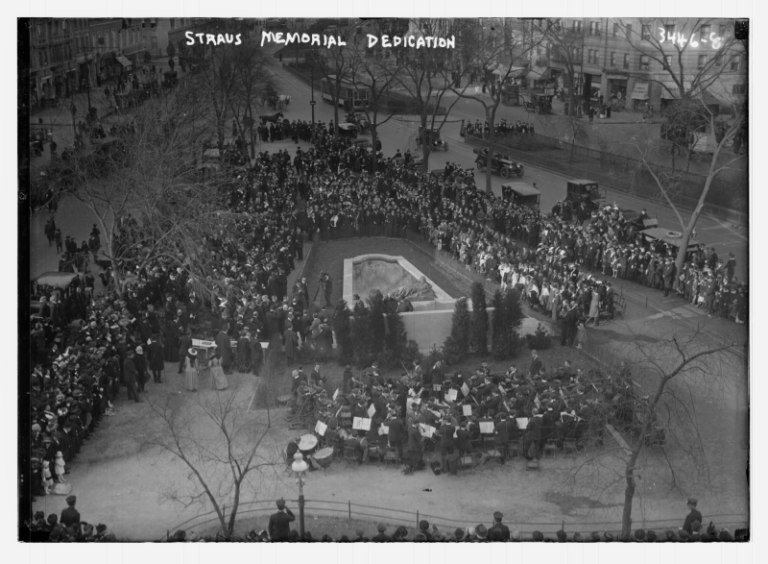
A small memorial was erected in Manhattan, located off of 106th Street. The landscaped plot, aptly christened Straus Park, bears a bronze statue of a water nymph that once gazed upon a reflecting pool. This water feature was transformed into a flower bed in the 1990s with the consent of the Straus family.

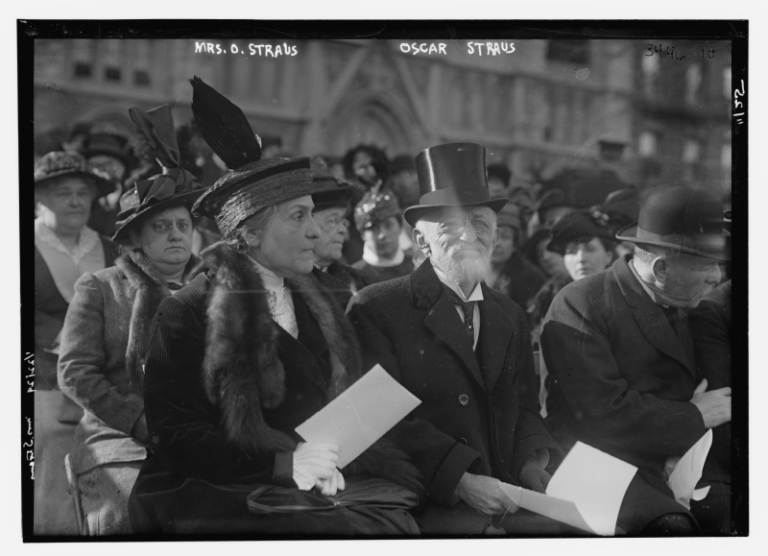
Straus Park was dedicated on April 15, 1915, exactly three years to the date of the Titanic disaster. Isidor’s younger brother, Oscar, was one of many in attendance.

Dedication of Memorial to Isidor & Ida Straus on April 15, 1915. Courtesy of Library of Congress.

PUBLIC DOMAIN

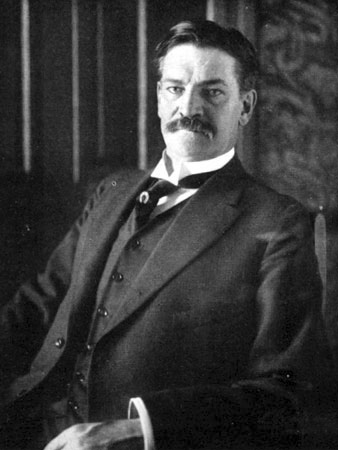
Isidor's brother, Oscar Straus, at the dedication to the memorial of Isidor & Ida Straus on April 15, 1915. Courtesy of Library of Congress.

PUBLIC DOMAIN

Isidor Straus was laid to rest in the couple’s mausoleum in the Bronx. Because Ida’s remains were not recovered, the Strauses collected ocean water from the wreck site in an urn and interred it beside Isidor.

The Straus mausoleum is thusly engraved.

Many waters cannot quench love -- neither can the floods drown it.

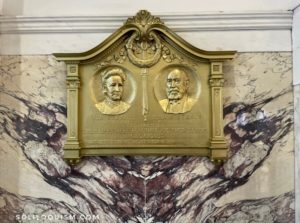
In 1913, approximately 5,000 Macy's employees donated their meager wages toward a memorial plaque for the Strauses, who were much beloved, particularly Isidor.

It's been reported that "'Mr. Isidor,' as he was known, regularly walked the shop floor, a pink carnation boutonnière stuck in the lapel of his dark suit jacket as he greeted workers by name."

The memorial plaque was re-dedicated in 2014 at the so-named "Memorial Entrance" on 34th.

It reads, "Their lives were beautiful and their deaths glorious."

Memorial plaque at Macy's 34th Street Entrance.

© soliloquism, 2022

Open post

“It’s a CQD, Old Man”: Distress Signals

"It's a CQD, Old Man": Distress Signals

It's been my experience that those who aren't obsessed feel like Titanic sank passively, in spite of logically understanding that they were, of course, calling for help.

Titanic, like any vessel, was equipped with emergency gear. According to the report issued following the sinking, Titanic carried 36 distress rockets. Second-Class passenger Lawrence Beesley wrote of them in his account of the sinking.

"Up it went, higher and higher, with a sea of faces upturned to watch it, and then an explosion that seemed to split the silent night in two, and a shower of stars sank slowly down and went out one by one. And with a gasping sigh one word escaped the lips of the crowd: 'Rockets!'"

Except from "The Loss of the S.S. Titanic" by Lawrence Beesley.

Rockets meant disaster. As one man testified: "A ship isn't going to fire rockets at sea for nothing." The passengers waiting for lifeboats began to panic.

Although, just for fun, here's Lightoller correcting the British Inquiry (and us).

INQUIRY: Now, then, about signals from your boat. You have rockets on board, have you not? Were they fired?
LIGHTOLLER: You quite understand they are termed rockets, but they are actually distress signals; they do not leave a trail of fire.
INQUIRY: Distress signals?
LIGHTOLLER: Yes. I just mention that, not to confuse them with the old rockets, which leave a trail of fire.

Whatever, Lights.

The color of these DISTRESS SIGNALS is sometimes debated--most say white, some say multicolors. I think the latter is probably just a mis-perception from the falling starburst.

Fourth Officer Boxhall set off the distress signals, at intervals of a few minutes each, next to Lifeboat 1 on the starboard side. He said he didn't count how many--most historians accept eight to ten, maybe a dozen. Fifth Officer Lowe said he was "nearly deafened by them" and though he didn't know at the time who was watching alongside him, he was standing next to White Star Chairman Bruce Ismay.

Fourth Officer Joseph Boxhall, who fired Titanic's distress signals.

PUBLIC DOMAIN

No one answered the distress signals. But someone saw them.

James Gibson, apprentice on the Californian, testified to the following.

 I then got the binoculars and had just got them focused on the vessel when I observed a white flash apparently on her deck, followed by a faint streak towards the sky which then burst into white stars.

Yes. There was a ship within miles of Titanic--so close that Captain Smith ordered some lifeboats to row for its lights. And it did nothing.

The Californian should and one day might be its own post, but suffice it to say that everything from hypothetical cold-air mirages to the Californian's passive, overly cautious captain prevented it from rescuing Titanic.

The ships each used Morse lights to try to communicate with each other as the sinking progressed, but results on each end were unclear. The captain's reaction to the aforementioned distress signals was that they were probably frivolous "company signals," and to continue trying to reach the ship with the Morse lights. Because of the aforementioned conditions, each message flickered out by one, appeared un-replied to by the other.

But one rescue component is absent from the Californian's efforts to reach Titanic as she sank: the wireless.

And that was because a) the Californian's captain never ordered that it reach out to the mysterious "large liner" via wireless and b) the wireless operator, Cyril Evans, TURNED HIS FREAKING RADIO OFF and went to bed only minutes before Titanic struck the iceberg.

And yet, the Californian crew was aware Titanic was nearby, because earlier in the night (pre-iceberg), the captain had ordered Evans to send a warning to Titanic, once the Californian itself was stopped by ice for the night.

So Evans did send that warning, his second to Titanic over the course of the evening. But he sent it rather unprofessionally, using language that was reserved for casual chats between operators. Meanwhile, the Senior Marconi Operator on Titanic, Jack Phillips, was overtired and working through an enormous backlog of messages that all had to be sent now that the ship was in range of Newfoundland.

Because of this, Evans was "famously rebuked" by Phillips--a moment that I consider to be chronically misrepresented in a sensationalist attempt to assign blame. But I digress.

So after Jack told Cyril to stop interrupting his work, he just listened in on Titanic's transmissions until about 11:25pm. And then he went to sleep until approximately 3:30 a.m.

Titanic, meanwhile, had struck the iceberg at 11:40 p.m.

Junior Marconi Operator Harold Bride, circa 1912.

PUBLIC DOMAIN

Jack and Junior Marconi Operator Harold Bride were desperately calling to any ship in proverbial earshot, using the universal distress call "CQD", as well as "SOS". The latter, which was brand new and is so familiar to us today, was not first used by Titanic, despite many rumors. Harold Bride did, however, advised Jack Phillips to use it, joking that it might be their only opportunity to use the newfangled call.

The ships that received and replied to the distress signals included Titanic's sister, Olympic, the Mount Temple, the Frankfurt, the Baltic, the Asian, the Celtic, the Caronia, the Virginian, the Cincinnati, and, of course, the Carpathia.

Illustration of Titanic's wireless and the ships that responded. Originally published on April 17, 1912. Image courtesy of The Atlantic, from The Day Books of Chicago.

PUBLIC DOMAIN (published prior to 1923)

The following are a mere selection of the distress messages sent by Jack Phillips, assisted by Harold Bride. Even in clipped Morse, you can feel the mounting desperation and frustration. As one article recently put it, "It was like trying to organize a rescue by Twitter."

12:17 a.m. CQD CQD SOS Titanic Position 41.44 N 50.24 W. Require immediate assistance. Come at once. We struck an iceberg. Sinking

12:20 a.m. Come at once. We have struck a berg. It's a CQD, old man. Position 41.46 N 50.14 W

12:26 a.m. Yes, come quick!

12:40 a.m. SOS Titanic sinking by the head. We are about all down. Sinking. . .

1:10 a.m. We are in collision with berg. Sinking Head down. 41.46 N. 50.14 W. Come soon as possible

1:10 a.m. Captain says, “Get your boats ready. What is your position?”

1:27 a.m., when Olympic asked, "Are you steering southerly to meet us?" We are putting the women off in the boats

1:30 a.m. We are putting passengers off in small boats

1:30 a.m. Women and children in boats, can not last much longer

1:35 a.m Engine room getting flooded

1:45 a.m. Come as quickly as possible old man: our engine-room is filling up to the boilers

1:50 a.m., when Frankfurt asked, "What is the matter with u?" You are a fool, stdbi - stdbi - stdbi and keep out

Sometime between 2:15 a.m. and 2:20 a.m., this last message is caught SOS SOS CQD CQD Titanic. We are sinking fast. Passengers are being put into boats. Titanic

© Caption.

Calls from Titanic were crackled and broken as power was diminished and inevitably lost, but Phillips kept at it. Phillips and Bride remained at their posts until water was flooding the wheelhouse nearby--yes, the last possible second, and well after Captain Smith had ordered them to abandon their posts.

Distress signal to S.S. Birma.

PUBLIC DOMAIN

Even when the two Marconi operators knew--better than anyone else--that there was NO hope of a ship reaching Titanic in time, it was reported by a station officer that there was "never a tremor" in Phillips' Morse transmissions as Titanic went down.

Harold Bride survived the sinking. Jack Phillips did not.

Jack Phillips, Senior Marconi Operator on Titanic.

PUBLIC DOMAIN

It was the sudden silence of Titanic's wireless radio that clued in New York Times editor Carr Van Anda that something was gravely wrong. While other papers hedged, the New York Times headline on April 15, 1912, announced what no one wanted to: Titanic was gone.

New York Times dated April 15, 1912.

PUBLIC DOMAIN

Open post

“So That We Might All Live Happily Together”: Michel Navratil & ‘The Titanic Orphans’

"So That We Might All Live Happily Together": Michel Navratil & 'The Titanic Orphans'

Michel Navartil, 32, was a Slovakian tailor who had been living in Nice, France, when he married Marcelle Caretto in 1907. They had two sons, Michel Jr. and Edmond, nicknamed Lolo and Momon by their parents.

Michael Navratil, taken prior to his voyage on Titanic in 1912.

PUBLIC DOMAIN (Photo taken prior to 1923)

By 1912, Michel's business was struggling, and he suspected Marcelle, 21, of cheating on him, so they separated. Even though the boys, 4 and 2 years old, were in the custody of Marcelle, she let Michel take them for the Easter break.

Thing is, Michel had no intention of returning them.

After a stopover in Monte Carlo, he brought them to England, where he bought three second-class tickets on Titanic. He registered himself as Louis M. Hoffman--the name of a friend who helped him accomplish the abduction--and registered his boys as "Louis" and "Lola". They boarded at Southampton.

Titanic departing Southampton on April 10, 1912. Courtesy of the National Maritime Museum, Greenwich, UK.

PUBLIC DOMAIN

When asked, "Mr. Hoffman" told other passengers that he was a widower, and aside from a cardgame during which he let a Swiss girl babysit them, he never let them stray from his side. He wrote back to his mother in Hungary, hoping that his sister and brother-in-law would help take care of the boys if they were not permitted or able to stay in America.

Michel, Jr., had no notion of any wrogdoing on his father's part. He recalled that Titanic was

A magnificent ship! ...I remember looking down the length of the hull... My brother and I played on the forward deck and were thrilled to be there. One morning, my father, my brother, and I were eating eggs in the second-class dining room. The sea was stunning. My feeling was one of total and utter well-being.

On April 14, upon learning of the collision, a still unidentified passenger helped Michel dress the boys and bring them up on deck.

Michel, Jr., said of his father and the stranger carrying them up on deck, "When I think of it now, I am very moved. They knew they were going to die."

The only lifeboats left were the 4 collapsibles, and the only one secure and ready to go was Collapsible D, presided over by Second Officer Charles Lightoller.

Collapsible D, which contained the Navratil boys, as taken from on board Carpathia on April 15, 1912.

PUBLIC DOMAIN

Officer Lightoller was gravely serious about the "Women and Children" order. Due to the maddened crush of third-class passengers--most of them men--Lightoller had ordered a locked-arm circle around the lifeboat, so only women and children could board.

Michel passed his little sons through to be minded in the boat.

Even in his later years, Michel, Jr., recalled his father's last words to him.

"My child, when your mother comes for you, as she surely will, tell her that I loved her dearly and still do. Tell her I expected her to follow us, so that we might all live happily together in the peace and freedom of the New World."

We know a little bit about Michel's and Edmond's night in Collapsible D not from Michel's recollections, but from First-Class passenger Hugh Woolner. Hugh and another passenger had taken their chances together and jumped down into Collapsible D when they noticed room in the bow portion of the lifeboat.

Hugh testified in the American Inquiry, and he recalled how distraught young Michel was.

A sailor offered some biscuits, which I was using for feeding a small child who had waked up and was crying. It was one of those little children for whose parents everybody was looking; the larger of those two... I should think it was about 5, as nearly as I can judge... It looked like a French child; but it kept shouting for its doll, and I could not make out what it said before that. It kept saying it over and over again.

Michel Navratil, Sr., did not survive to be reunited with his sons. His body was recovered and listed as follows.

NO. 15 - MALE - ESTIMATED AGE 36 - HAIR & MOUSTACHE, BLACK
CLOTHING - Grey overcoat with green lining; brown suit.
EFFECTS - Pocket book; 1 gold watch and chain; silver sov. purse containing £6; receipt from Thos. Cook & Co. for notes exchanged; ticket; pipe in case; revolver (loaded); coins; keys, etc; bill for Charing Cross Hotel (Room 126, April 1912).
SECOND CLASS NAME - LOUIS M. HOFFMAN.

"Louis" and "Lola" were the only orphaned survivors of Titanic. And like other young children, they were hauled on board in burlap bags.

On board Carpathia, it was realized that they only spoke French. Survivor Margaret Hays was concerned that the brothers would be separated, so she offered to take them under her care in New York City. The boys spent most of their time playing with Lady, Hays' little Pomeranian, which was one of only three dogs to survive the sinking.

Michel (left) and little Edmond with his toy cat. From the George Grantham Bain Collection, courtesy of Library of Congress.

PUBLIC DOMAIN

In New York, the boys were motherless for some time. According to contemporary newspaper articles, they only answered "oui" to inquiries from Consul representatives, and as little children are prone, they were much more interested in playing with their new toy boats.

The following was reported in "No Light on the Mystery Hiding the Identity of Two Waifs of the Sea," an article published in the Evening World dated April 22, 1912.

Under the shadow of a giant azalea they sat yesterday afternoon, each with a brand-new boat in hand with which they entertained themselves while the French Consul to New York strove vainly to extract some enlightening word from the elder boy, whose age has been given as three and a half.

To every question the little curly haired chap replied with a polite and baffling "Oui" and said nothing more.

   "Do you like to play with your boat?" asked the Consul, taking the little fello [sic] on his knee.
   "Oui," came the monotonous reply.
   "What city do you come from?"
   "Oui."
   "Do you remember the big boat that brought you away from France?"
   "Oui."

Yet the children are by no means stupid. They are sweet, well-mannered, gentle little fellows, and my only hope for them is that having survived the perils of the iceberg and the open sea they may not be adopted by some American family which was born with a gold knife in its mouth.

For what it's worth, the author of this particular article also found the gifts of little toy boats a bit untoward, writing, "Probably I am the only person to whom it seemed in the least incongruous that these two babies should be playing with brand new tin boats."

Edmond (left) and Michel with their toys.

PUBLIC DOMAIN

Many photos were taken of "Louis" and "Lola" to be circulated worldwide. But in addition to their inability to speak English, the boys had been given fake names by their late father, so tracking down their mother was proving impossible.

When asked if the orphans could be traced via their father's tickets, Margaret Hays' father illustrated the fatal class divide perfectly in his response. "I have never travelled second cabin or steerage," he said, "so I don’t know anything about such matters."

Michel, Jr., recounted coming to the realization that, had they not been in Second Class, he and his brother would surely have died.

Michel (left) and Edmond. Courtesy of the National museum of the U.S. Navy.

PUBLIC DOMAIN

Meanwhile, in France, their mother Marcelle was desperately, frantically searching for her sons with no leads. She was entirely unaware that they had even left the country, let alone sailed on the Titanic.

Marcelle knew nothing of the so-called 'Titanic Orphans' until she saw their photos in a newspaper. Marcelle sailed to New York City courtesy of the White Star Line, and was reunited with her boys on May 16, 1912.

Permitted to meet them alone, she found Michel reading an alphabet book on a window seat, and Edmond on the floor, playing with puzzle pieces.

Growing wonder spread over the face of the bigger boy, while the smaller one stared in amazement at the figure in the doorway. He let out one long-drawn and lusty wail and ran blubbering into the outstretched arms of his mother. The mother was trembling with sobs and her eyes were dim with tears as she ran forward and seized both youngsters.

She reportedly was asked if she would talk to them about Titanic, and said, "I do not want them to think about that," she said. "They must only be happy from now on—only happy; no more distress."

Michel and Edmond reunited with their mother. Courtesy of the Library of Congress.

PUBLIC DOMAIN

Edmond died in 1953, after having served in the French Army in WWII.

Michel, Jr., accomplished a doctorate in philosophy, and was a professor. He was one of the longest-lived survivors, and the last-living male survivor. He died in 2001, having said throughout his life that since four years old, he had "been a fare-dodger of life. A gleaner of time."

Because of the fake surname he used when boarding, Michel Navratil Sr. was interred in the Halifax cemetery that was designated for Jewish victims. The headstone has since been replaced to reflect his true identity.

Posts navigation

1 2 3 6 7 8 9 10 11
Scroll to top