Open post

“Look Here, You Crazy Thing”: Edith Rosenbaum Russell

"Look Here, You Crazy Thing": Edith Rosenbaum Russell

When Edith Rosenbaum boarded Titanic as a First-Class passenger at Cherbourg, she brought pretty much her life on board with her in her trunks.

And much of it was what one would typically expect of a young woman working in the fashion industry: lovely dresses and fine jewelry.

Edith Russell, photographed by Henri Manuel.

PUBLIC DOMAIN

But one item was out of the ordinary: a musical toy pig.

Edith, who had been born in Cincinnati, had spent the previous four years living in Paris for haute couture.

Her little toy pig was papier-mache and spotted, wrapped in black and white fur. Upon winding its corkscrew tail, it played the song “La Maxixe.”

It was, as she called it, a mascot. Her mother had given it to her in 1911, after Edith had been in a nearly fatal auto accident. Her fiance, Ludwig Loewe, had been killed.

But Edith had survived, with only a concussion to recover from. And so her mother gifted her with the pig, a traditional symbol of good luck in France, as a charm. Edith promised her mother that she would keep it nearby always.


My mother gave me this pig as a mascot a year earlier. I'd been in tornadoes and fires and floods. I was always in trouble. Then I was in a motoring accident, and was thrown into the tyre on the back of the car. I rolled clear as it crashed into a tree. Everyone else was killed but me.

"My mother brought me this pig and said "Look here, you crazy thing, I'm giving you a mascot.

"Promise me you'll have it with you always."

Edith had originally booked passage on the George Washington, which was set to depart on April 7th, as she was keen to arrive in New York. But her editor wired that she was needed to cover the Paris-Roubaix races. Edith consequently bumped her passage out to April 10, and exchanged her ticket for one on Titanic.

Movie star Gene Gauntier with luggage, circa 1912.

PUBLIC DOMAIN

Later, Edith would say that she should have known better because a fortune teller had warned her. Per an account of her experience that she wrote in 1934:

Were I of a superstitious nature, or given to following my instincts which are very strong, I should never have taken my trip on the Titanic, leaving Cherbourg for New York on April 10, 1912. In the month of January, when in Biskra, Africa, an Arab fortune-teller predicting my fortunes in the sand, held up his hands in amazement saying, ‘Madame will be in a very grave accident at sea.’ I naturally discredited this, but for months afterward felt an impeding sense of calamity…

Arriving in Cherbourg, my premonition of ill was so strong, that again I was tempted not to take the trip, and even telegraphed my secretary, expressing my fears.

On board, Edith Rosenbaum found her First-Class suite on A Deck. It is rumored that she had also booked a secondary cabin on E Deck to accommodate her 19 trunks.

Edith claimed that she had inquired about luggage insurance with a man named Nicholas prior to boarding at Cherbourg, but she had been assured that it was an unnecessary precaution because Titanic was “unsinkable.”

Edith stated that she spent the majority of the trip doing the usual things for a First-Class girl.

The first few days of the trip were uneventful, marked by the usual making of acquaintances, promenades on deck, dinners in the Ritz, tea in the Winter Gardens, etc. As a matter of fact, it was only by looking out at sea; that one realized that one was on the ocean.

Edith recalled that the day of April 14 was “brilliantly fine, but icily cold.” She figured that the only warm place in the whole boat was her bed, so that is where she elected to stay until about 4 o’clock in the evening. “If you were to go inside of your Frigidaire, or hold your hand over a solid block of ice,” Edith wrote, “you would get an idea of the temperature. The cold cramped one’s face and hands.”

After a gala dinner, Edith returned to her stateroom. After turning in, she heard a calamity below-deck and looked out her window to see a “white mass” moving by, into the distance.

Edith put on her fur coat and popped into a friend’s room to suggest they go up to boat deck. Edith said the few people there were in “various stages of undress.” Someone pointed out a nearby iceberg.

Frankly, I was overjoyed. I had always wanted to see an iceberg, from the time of my geographical school days; not realizing the danger of the encounter. I remember one man commenting that if icebergs were supposed to be two-thirds below water, and one- third above, ‘this must be a corker.’ We all regarded it as a joke, and ran to the forward part of the deck, picking up bits of ice scattered about. Someone suggested a snow-ball fight.

An unspecified officer advised the party that they had struck an iceberg but all was perfectly fine and they should get back to bed. Edith said she had returned to her room and was undressing when a steward knocked on her door and told her that all passengers had been instructed to put on lifebelts.

Edith hastily put on a dress and her fur coat, grabbing anything to hand that she could think of. And then, for reasons even she never fully understood, she locked her trunks and tidied her room.

I was met by my room steward, Wareham, fully dressed in overcoat and derby hat. I asked, ‘Wareham, do you think there is any danger, or is it simply the rule that all passengers should put on life belts?’ He answered, ‘It is a rule of the Board of Trade that all passengers must put on life belts and that women and children are put aboard the lifeboats. Now I do not think that the boat can sink. In all probabilities we shall tow her on to Halifax.’ So I said, ‘If you have any idea of going to Halifax, here are my trunk keys, and you better clear my trunks at the customs.’ I remember now, but did not at the time appreciate the significance of his reply, ‘Well, if I were you, I would kiss those trunks good-bye.’

Edith left her room soon thereafter.

I shall always remember the last view of my stateroom – the rosy, soft light of the table lamp, the red reflection of the radiator. Everything so cozy and still: I little thought it was my last look.

On her way out, Edith asked Wareham to go back to her suite for her beloved mascot, which he did gladly. According to her account titled, "I Survived the Titanic," the exchange went something like that. "I said, “Well, don’t you think it would be a good thing for me to keep my mascot with me?” He said, “Yes, it would be rather a good thing.”

She said that as Wareham proceeded down the corridor, she recalled saying that the ship was distinctly aslant.

On her way to the First-Class Lounge, Edith stopped into the quarters of her friend, Robert Daniel, who is noted in Titanic history for bringing with him the most expensive dog on the ship, a French bulldog named Gamin de Pycombe.

Edith recalled, “It was whining and crying. I remember taking it and tucking it under the bed covers, and patting its head.” Edith and Mr. Daniel then carried on to A Deck.

But the dreaded cold and lack of order led Edith to take to an armchair in the First-Class Lounge. She stayed there until she caught the eyes of Bruce Ismay, who was—by Edith’s account and others’ as well—pretty much frantic.

I then went out up to the Boat Deck and found myself standing next to Mr. Bruce Ismay, the Managing Director of the White Star Line, who was wearing his black evening trousers and a nightshirt with frills down the front. He was shouting orders/ A number of men on the other side of him were banked up almost in a solid mass near the cabin bulkhead. He spied me and called out: "What are you doing on this ship? I thought all women and children had left! If there are any more women and children on this ship, let them step forward and come over to this stairways immediately."

Mr.Ismay practically threw me down a narrow iron stairway to the deck below. There has been much criticism of Mr. Ismay, but he certainly saved my life. I passed between two lines of sailors to the rail. Two burly sailors got hold of me and attempted to throw me head foremost into the lifeboat which was suspended alongside. But when I noticed how far from the rail that lifeboat was, swinging on its davits from above, I became terrified -- so much so that my legs and feet went rigid and my slippers fell off. I screamed to the two men: "Don't push me!" One replied, "If you don't want to go, stay!"

Edith guessed she spent the next five minutes searching for her slippers.

One of the crew then grabbed the toy pig from Edith's arms and told her that at least they’d save her “baby.”

And because Edith had promised her mother that wherever she would go, the mascot would go, she—with the assistance of a nearby gentleman who offered to lift her over the side—got into the lifeboat. She found her pig as the boat was being lowered away.

It was Lifeboat 11, which was one of the few to exceed capacity. Edith, seeing the young children wriggling and crying. And so she played the song on her toy pig.

Edith later credited the bravery of many, especially Bruce Ismay—surely some of the only praise he received in the wake pf the disaster. “What thrilling deeds of heroism! Bruce Ismay certainly saved my life, and I don’t doubt that he saved many more."

On board Carpathia, Edith set out to send a telegram to mother that began with “Lost all.” But she took in the decks of the Carpathia, crowded with widows and orphans and the bereaved, and crossed it out. Instead, she wrote, “Safe. Carpathia. Notify Mother.” In 1934, she wrote, “My losses were only material, while there were so many who lost those whom they loved.”

“I survived Titanic,” Edith once said. “But I never really escaped it.”

Edith Rosenbaum went on to become one of the first, if not the first, female correspondent to enter the trenches with soldiers during the First World War by signing on as a journalist with the American Red Cross. In 1920, she changed her surname to Russell due to anti-German sentiments.

She died in 1975 at the age of 95.

In 2001, during a James Cameron expedition to the Titanic wreck, Edith’s stateroom was found and explored. The dressing table was still upright, with its mirror still intact.

Open post

“Immeasurable Sorrow and Unending Grief”: The Allison Family

“Immeasurable Sorrow and Unending Grief”: The Allison Family

Bess Daniels met her future husband, a stockbroker from Montreal named Hudson Allison, in 1907 while they were passengers on a train.

They married in her hometown of Milwaukee, Wisconsin, in December of that same year, on Hudson’s 26th birthday. Bess was newly 21.

Less than five years later, Hudson and Bess boarded the Titanic as First-Class passengers at Southampton on the morning of April 10, 1912. With them were their young children—Lorraine, who was 2 years old, and their infant Trevor—and four servants.

The Allisons occupied First-Class cabins on C-Deck, which they shared with their maid, Sarah, and Trevor’s new nurse, Alice Cleaver.

Their cook, Mildred, and their chauffeur, George Swane, were booked with Second-Class cabins.

The Allison Family

PUBLIC DOMAIN

The Allison family had sailed to the United Kingdom in order for Hudson to attend a meeting of directors, as he was on the Board of the British Lumber Corporation. They took a side trip up to the Scottish Highlands so Hudson could pick up horses for the Allison’s stock farm back home. While there, they also hired the four servants that were traveling with them on Titanic.

On the night of April 14, Hudson and Bess dined with Major Arthur Peuchen and fellow Canadian Harry Molson. Later, Bess brought little Loraine up to the First-Class Dining Room to awe at its Jacobean prettiness.

When Titanic struck the iceberg later that night, the new nursemaid Alice woke the Allisons, but per her (presumably defensive) account, they dismissed her concern, insisting that it was nothing more than her imagination.

Some time after the engines had ceased, Mr. Allison finally consented to go up on deck to seek the trouble. Alice said that she advised that the family would have to evacuate the ship, and Mrs. Allison became “hysterical.” Alice, wrapping the baby, did her best to calm Mrs. Allison.

An officer then came by and advised an immediate evacuation to the boat deck. And so Alice, with the bundled baby Trevor in her arms, exited the suite. She claimed that she found Mr. Allison in the hallway.

[I] here met Mr. Allison outside the cabin but he seemed too dazed to speak. I handed him some brandy and asked him to look after Mrs. Allison and Loraine and I would keep Baby [Trevor]… some confusion occurred outside as to which deck we should go and that is how [Mr. Allison] came separated, afterwards I learned from one of the staff that Mrs. Allison was hysterical again and that Mr. Allison had difficulty with her…

Alternate accounts reflect that Alice took Trevor with her to retrieve George and Mildred in Second Class, without informing either Mr. or Mrs. Allison.

In the end, it is reported that George Swane escorted Alice to Lifeboat 11. Trevor was then carried into the boat by bedroom steward William Faulkner, who was instructed to stay aboard, and thusly also rescued in Lifeboat 11.

Also in the lifeboat was Mildred, the cook that the Allisons had hired. According to a letter from Mildred to her mother on April 19, 1912, written on board Carpathia and postmarked from Grand Central Station in New York City:

No sooner was I on deck that I was bustled to the first class deck and pushed into one of the boats and I found nurse (Alice Cleaver) and the baby (Trevor Allison) were there. It was awful to put the lifebelt on it, seemed as if you really were gone.

Mrs. Allison, meanwhile, had already been seated in Lifeboat 6 with her little daughter, Loraine.

But Bess Allison jumped out of the lifeboat.

Per their friend Major Peuchen, who was interviewed by the Montreal Daily Star:

Mrs Allison could have gotten away in perfect safety, but somebody told her Mr Allison was in a boat being lowered on the opposite side of the deck, and with her little daughter she rushed away from the boat. Apparently she reached the other side to find that Mr Allison was not there. Meanwhile our boat had put off.

In a separate interview, Major Peuchen elaborated upon Bess’s actions.

She had gone to the deck without her husband, and, frantically seeking him was directed by an officer to the other side of the ship. She failed to find Mr. Allison and was quickly hustled into one of the collapsible life-boats, and when last seen by Major Peuchen she was toppling out of the half-swamped boat.

Bess and her daughter, possibly alongside Hudson, were last seen together on deck near the officers quarters.

Mr. and Mrs. Allison, their little girl, and George Swane all died in the sinking.

Young Loraine Allison was the sole child of all in First and Second Class to die. Her mother was one of only four First-Class women to die.

Hudson Allison’s body was recovered by the Mackay-Bennett and noted.

NO. 135. - MALE.

CLOTHING - Leather coat; blue suit; grey silk muffler.

EFFECTS - Keys; letters; photos; stock book; three pocket diaries; one C. P. Railway ticket book; two pocket books; card case; $143.00 in notes; chain with insurance medals; £15 in gold; $100.00 Thomas Cook & Sons travellers' cheque; £35 in notes; gold cuff links; diamond solitaire ring; gold stud; knife; silver tie clip; $4.40 in odd coins; traveller's ticket.

FIRST CLASS.
NAME - H. J. ALLISON

Thereafter, George Swane’s body was also found.

No. 294 - MALE - ESTIMATED AGE, 18 - HAIR, DARK

CLOTHING - Blue suit; grey socks; low shoes.

EFFECTS - Chain; sovereign case, empty; 33s 5d in cash; one tie pin; two motor licenses.

NAME - GEORGE SWANE, 73 Little Cadogan Place, London, S.W.

The bodies of Bess Allison and little Loraine Allison, if ever recovered, went unidentified.

Upon their arrival in New York City, Alice Cleaver relinquished custody of the now-orphaned Trevor Allison to his uncle and aunt, George and Lillian Allison.

Trevor Allison died in 1929 from food poisoning. He was 18 years old.

And then, years on, Titanic was forced to shoulder its very own Anastasia story.

Decades later in 1940, a woman named Helen Loraine Kramer came forward, claiming on a radio show to be the long-lost toddler, Loraine Allison. Over the course of time, she insisted that she had been saved in secret—and then raised—by no less than Thomas Andrews, who she claimed had disguised his identity under the alias of "James Hyde" to avoid persecution.

Kramer’s granddaughter reinvigorated the rumor in 2012, claiming to have found definitive proof in the form of paperwork in the late Kramer’s suitcase.

Genetic testing was finally performed in 2013 as a result of the Loraine Allison Identification Project. It proved that Kramer’s absurd claim, unsurprisingly, to be entirely false.

David Allison, grandson of Hudson’s brother Percy, issued the following statement.

The Allisons never accepted Mrs Kramer’s claim, but the stress it caused was real. It forced my ancestors to relive painful memories described to me as immeasurable sorrow and unending grief… I would like to thank Deanne Jennings and Sally Kirkelie for offering their DNA to stop this harassment. This was a courageous, selfless act, and I will remain forever indebted for their act of kindness.

David’s sister, Nancy, also said the following.

These DNA results have uncovered a colossal fraud that has haunted my family for years. It was all about the money …. Debrina [Kramer’s granddaughter] wants to write a book and no doubt there are others out there who want to profit from our story. It is our story. Leave us in peace.

Tantalizing though some may find them, dear reader, it is only kind to remember: conspiracy theories do harm to  innocent people.

Open post

“I’ll Stay and Take My Chances”: Clarence Moore

"I'll Stay and Take My Chances": Clarence Moore

Clarence Moore left his home of Washington D.C. in March of 1912 with a singular goal: to get himself a whole lotta dogs.

Clarence was an accomplished man of business and a famed equestrian in the United States. According to the New York Times report dated April 16, 1912, "Socially he is one of the best-known men in Washington."

Clarence Moore had traveled across to England on this leisure trip in order to purchase foxhounds for the Loudoun Hunt at the brand new Rock Creek Hunt Club, which was back home in Virginia.

Per an interview with a member of the Rock Creek Hunt Club, published April 18th, 1912, "Clarence Moore was the most daring horseman I have ever seen, and yet one could not call him reckless. He knew every phase of fox hunting, which was his greatest hobby."

So, after purchasing 50 pairs of foxhounds, he and his manservant, Charles Harrington, booked First-Class passage back to America on Titanic. Clarence had originally intended for the hundred dogs to travel with him on Titanic, but ultimately elected for alternate passage for them.

Clarence and Charles boarded in Southampton, sans canines.

Clarence Moore’s dear friend, Major Archibald Butt, had also boarded Titanic that day. Archie, being a military aide to President William Howard Taft, was a fellow Washington elite. They sometimes played golf together.

Archie had arrived to the dining saloon promptly after boarding, it is said, in order to permanently reserve a table for the voyage—for himself, Clarence, and Archie’s housemate, painter Francis Davis Millet, who would board later in the day at Cherbourg.

The three men would have adjourned to the Palm Room following their meal, and likely played a hand of cards before retiring.

Clarence would spend his evenings on board with Archie and Millet, typically playing a game of whist well into the dark hours of the evening.

After lunch in the afternoon of Sunday, April 14, Clarence Moore and Archie Butt took a stroll about the promenade, despite the stark and sudden chill that was keeping so many other passengers indoors.

When Titanic struck the iceberg, Clarence was awake and at whist yet again with Archie, joined by William Carter and Harry Widener. Theirs was not the only party at card-playing; in fact, the group shared the room with professional card sharps such as George Brereton, who admitted to actively seeking a victim at the time. It is reported that Clarence Moore had at some point been indulging the tables in his personal tales of the West Virginian wilderness--especially his feat in guiding a newspaper reporter to an interview with Captain Anse Hatfield, of the notorious Hatfield & McCoy feud.

According to Archibald Gracie, the group seemed entirely engrossed and initially unbothered by the curious goings-on.

Clarence and Archie are reported to have stuck together as the sinking progressed, providing calm and steadfast reassurance to those women who were reticent to enter lifeboats. According to a number of survivor accounts, both men stood “in an unbroken line” with others who declined to enter lifeboats.

Repeatedly, Moore refused to take a place in one of the boats, the survivors who saw him say. His friend, Butt, knew that he was an oarsman, in fact, he realized that Clarence Moore could do most anything any true sportsman could, so he requested Moore to man an oar in one of the last lifeboats to leave the ship.

“No, major, I’ll stay and take my chances with you; let the women go,” Moore said to his companion according to Robert William Daniels, one of the survivors... “And he evidently stuck with Butt until death took them both,” said Mr. Daniels. “The two men jumped at the eleventh hour and were lost.”

Colonel Archibald Gracie also offered praise for the conduct of Major Archie Butt. It is reasonable to deduce that Clarence Moore aided similarly in the company of his friend.

Returning to a description of the scenes immediately after the Titanic crashed into the mammoth iceberg, Colonel Gracie told of the heroic work of Major Butt, John Jacob Astor, Clarence Moore, Jacques F. Futrelle, H. B. Harris, and other men, who stood aside in obedience to the law of the sea that the woman and children might live...

My last view of Major Butt---one that will live forever in my memory---was with that brave soldier coolly aiding the officers of the boat in directing the disembarkation of the women from that doomed ship. The recollection of him that is seared into my very brain is impressed by his last assertion of that manliness and chivalry so peculiarly his, that stately demeanor so well known to all Washingtonians. He died like the soldier and brave man he was.

It was reported that Clarence Moore and Archibald Butt jumped ship together "at the eleventh hour" as Titanic's boilers exploded.

The public eagerly awaited news of the famous Americans who were presumed lost in the sinking of the Titanic, particularly Major Butt, Clarence Moore, and other societal and affluent paragons such as John Jacob Astor.

Articles ran in newspapers with the 1912 equivalent of clickbait:

"Clarence Moore, Who May Have Lost His Life, Well Known in Capital."

"Moore's Partners Give Up Hope of Hearing From Him."

"Mrs. Moore Awaits Word from Husband."

Neither Clarence nor Major Butt survived. And their bodies were never found.

Clarence's wife, Mabelle, was repeatedly described as prostrate with grief "about Mr. Moore, who was aboard the Titanic and whose death seems certain."

Their conclusions have not been communicated to Mrs. Moore, who is prostrated.

Yesterday, Mrs. Moore attempted to make arrangements to have a steamer sent out to aid in the search for the lost and was only dissuaded with difficulty by friends of her husband, who assured her that everything possible was being done to save passengers, give the survivors comfort, and to obtain a complete list of the names of the survivors.

Open post

“True Distinction and Refinement of Soul”: Edward Austin Kent

"True Distinction and Refinement of Soul": Edward Austin Kent

Edward Austin Kent was born in 1854 in Bangor, Maine. He graduated from Yale in 1875, and moved on to the Ecole des Beaux-Arts in Paris. 

He returned to the United States in 1877, and undertook an impressive and extensive architectural career. In his chosen hometown of Buffalo, New York, he contributed to the landscape.

By 1912, at 58 years old, Edward was on a multi-stop European tour that included both France and Egypt. He had designs to retire when he returned to America.

And although he was invariably ready to begin that peaceful chapter of his life, he delayed his voyage home just a little longer—so that he might sail on the maiden voyage of the brand new Titanic.

Edward boarded as a First-Class passenger in Cherbourg on the evening of April 10, 1912. 

On board, he immediately fell in with the elite circle of writers spearheaded by Colonel Archibald Gracie. They referred to themselves as “Our Coterie.” Colonel Gracie wrote the following regarding the fated night of April 14, 1912.

That night after dinner, with my table companions, Messrs. James Clinch Smith and Edward A. Kent, according to usual custom, we adjourned to the palm room, with many others, for the usual coffee at individual tables where we listened to the always delightful music of the Titanic’s band. On these occasions, full dress was always en regal; and it was a subject both of observation and admiration, that there were so many beautiful women—then especially in evidence—aboard the ship.

© Excerpt from "Titanic: A Survivor's Story," by Colonel Archibald Gracie. 1912.

It was the gentleman’s decency at the time to offer companionship to women traveling alone. And because Edward was a bachelor, he and another member the Coterie, Hugh Woolner, took it upon themselves to offer accompaniment to Mrs. Helen Churchill Candee. 

Mrs. Candee was 59 years old and an accomplished writer. She had been in Europe conducting research for her work-in-progress, called “The Tapestry Book,” when her daughter reached out to tell her that her son, Harry, had been in an accident, and urged an expedient return to the United States.

In her account of Titanic, Helen also described the Coterie in the First-Class Lounge.

At dinner, two hours later, the scene might have been in London, or New York, with the men in evening jackets, the women shining in pale satins and clinging gauze. The prettiest girl even wore a glittering frock of dancing length, with silver fringe around her dainty white satin feet.

And after dinner there was coffee served to all at little tables around the great general lounging place, for here the orchestra played.

Some said it was poor on its Wagner work, others said the violin was weak. But that was for conversation's sake, for nothing on board was more popular than the orchestra. You could see that by the way everyone refused to leave it. And everyone asked of it some favorite hit. The prettiest girl asked for dance music, and clicked her satin heels and swayed her adolescent arms to the rhythm.

...

How gay they were, these six. The talkative man [Colonel Gracie] told stories, the sensitive man [presumed to be Edward Austin Kent] glowed and laughed, the two modest Irishmen forgot to be suppressed, the facile Norseman cracked American jokes, the cosmopolitan Englishman [Hugh Woolner] expanded, and the lady (the writer, Helen Churchill Candee] felt divinely flattered to be in such company.

The evening was presumably brought to a close shortly thereafter—until the iceberg strike.

Hugh Woolner wrote of the immediate alarm felt by the men in his vicinity.

…We sort of felt a rip that gave a sort of a slight twist to the whole room. Everybody, so far as I could see, stood up and a number of men walked out rapidly through the swinging doors on the port side, and ran along to the rail.

Soon thereafter, Helen Churchill Candee found herself wearing a lifebelt and rushing up on deck with Hugh Woolner, who had immediately set out to search for her.

The pair encountered Edward Austin Kent on the Grand Staircase.

She pleaded with him to take valuable tokens, reportedly because she believed that he had a far stronger chance of surviving than she, and because Edward was in possession of pockets. Upon her insistence, Edward accepted an ivory-and-gold cameo miniature of Mrs. Candee’s dear mother, and a flask of brandy. 

Edward, along with Woolner and another gentleman of the Coterie, escorted Mrs. Candee to Lifeboat 6, which was being launched off the port side by Second Officer Charles Lightoller.

When Colonel Gracie found Edward, he asked after the well-being of Mrs. Candee. He said, “She is safe and in a boat, Mr. Gracie.”

While Edward’s actions after the launch of lifeboat 6 have never been detailed, accounts attest to him continuing to assist women into lifeboats with haste. Mrs. Candee last saw him at his dapperest, standing unflustered at the rail and waving.

It is reported that Edward Austin Kent never left Titanic. The sea closed over him 2:20am.

He did not struggle or flounder.

Word of the sinking was reaching shore as the lifeboats were still in the water. But there was no word of Edward.

And so, on April 21, his bereft sister Charlotte published the following in the New York Sun.

TO SURVIVORS OF THE TITANIC—Information of any kind concerning Edward A. Kent during voyage of the Titanic will be gratefully received by the family. CHARLOTTE M. KENT. The Lenox. Buffalo, N. Y.

Mrs. Candee’s daughter Edith replied to Charlotte’s plea via letter. Therein, she detailed her mother’s encounter with Edward on the Grand Staircase, although it appears that Edith (or Helen) moved the set piece to the boat deck for dramatic effect.

On April 27, the First Unitarian Church, which Edward had himself brought to life, held a service for Edward. Every seat was filled.

Reverend Richard Boynton, at a pulpit adorned with both a large floral wreath and an anchor, made this remark among many eulogizing Edward.

Edward Austin Kent, with his brother, William Winthrop Kent, of New York, gave us one of his best in designing and erecting this building. It is fair that we all believe to judge a man by works, So judged, we must accord Mr. Kent true distinction and refinement of soul.

That same day, the crew of the Mackay-Bennett sent out a telegram listing those bodies which had been recovered.

Edward Austin Kent’s was among them. And in his pocket still, were Mrs. Candee’s effects.

NO. 258 - MALE. - ESTIMATED AGE, 56. - HAIR FAIR; GREY MOUSTACHE

CLOTHING - Grey coat; dress suit pants.

EFFECTS - Silver flask; two gold signet rings; gold watch; gold eye glasses; gold frame miniature of "Mary Churchill Hungerford"; knife; a pocket books; 48 francs, 75; 2 studs, one link.

NAME - EDWARD A. KENT

Edward’s corpse, along with all those onboard the Mackay-Bennett, was brought into port at Halifax, Nova Scotia. Edward's cousin and brother-in-law were there to receive his remains.

He was laid to rest in Buffalo, and the miniature and flask were eventually returned in sadness to Mrs. Candee.

The chairman of the Royal Institute of British Architects issued his condolences, lauding Edward as "the very best type of American gentlemen."

Edward Austin Kent’s headstone is engraved as a testament to his kind and quiet courage.

GREATER LOVE HATH NO MAN THAN THIS, THAT A MAN LAY DOWN HIS LIFE FOR HIS FRIENDS.

As Helen stated years later about the loss of her male companions on board Titanic, “We all love a gentleman… Time has nothing to do with effacing that.”

Open post

“The Spectacle Was Quite Fairylike”: Pierre Marechal

"The Spectacle Was Quite Fairylike": Pierre Marechal

Pierre Marechal was 29 years old when he boarded Titanic in Cherbourg, France, on the evening of April 10, 1912.

Pierre, a reportedly adroit businessman in the field of aviation, was also a notable son: his father was Eugene Albert Marechal, Vice Admiral of the French Navy, who had passed away 8 years prior in 1904.

French Aviation postcard, circa 1916.

PUBLIC DOMAIN

Pierre had been purchased a First-Class ticket. He was assigned to travel to New York on business by his employer, Louis Paulhan & Compagnie, which had been named after the world-famous aviator. Pierre was sent to America to secure the company's new contract with Curtiss Aviation Company.

Pierre was noted by Mr. Dickinson Bishop in his account to Archibald Gracie as “Marechal, the French aviator.” By other accounts, Pierre was the director of Paulhan. Perhaps he was both.

Famous aviator Louis Paulhan circa 1909. Courtesy of the Library of Congress, from the George Grantham Bain Collection.

PUBLIC DOMAIN

Pierre was Parisian by birth. And so, while on board Titanic, he naturally fell in with fellow French-speaking First-Class passengers: namely Paul Chevre, a noted sculptor born in Brussels to French citizens, and Alfred Omont, a cotton merchant from Havre.

During the late hours of April 14, Pierre, Paul, and Alfred were playing whist, or as alternately reported, auction bridge, with American First-Class passenger Lucien Smith.

It is sometimes reported that the men were gathered in Pierre’s suite; other times, they are placed in the Cafe Parisien or First-Class Lounge.

Cafe Parisien aboard Titanic, circa March 1912. Photographed by Robert John Welch for Harland & Wolff.

PUBLIC DOMAIN

Titanic, along with all other vessels in the White Star family, had specially manufactured playing cards exclusively available for its First-Class passengers, and used in the First-Class lounge. These were produced by Chas. Goodall & Son, Ltd., a company which shuttered due to the Great Depression and has since been picked up by the Bicycle brand.

These exclusive cards were “Linette,” because of their refined linen-grain texture. The box, which was featured in red and off-white, read as follows.

LINETTE or Linen-Grained Playing Cards

Duplex. Round corners. Thin. Containing the Joker.

The special feature in these Cards consists in the fact that the surface of both back and face is Granulated or ‘Linen-Grained’ instead of being quite smooth as usual. S very pleasing feel is thus imparted to the Cards in play — they are very easily dealt, and the chance is a mis-deal is considerably lessened.

CHAS GOODALL & SON, Ltd., Camden Works, London, N.W.

The reverse of each playing card featured a White Star design, with the iconic red burgee (id est, flag) surrounded by an ornate Art-Nouveau illustration of gold vines and leaves against a minty green palette. 

And they had gilt edges. But of course.

The group of four reportedly played long into the night—until Titanic struck the iceberg at 11:40pm.

We were startled and looked at one another under the impression that a serious accident had happened. We did not, however, think for a catastrophe, but through the portholes we saw ice rubbing against the ship's sides.

Pierre and his compatriots swept up their fans of cards and pocketed them for their eventual return to the game. Lucien then parted ways with the others to go wake his wife in their cabin, while Pierre, Alfred, and Paul went directly up on deck, despite Paul insisting that it was too cold to go out and investigate. He suggested in vain that a steward just open a porthole.

It was on deck where the three men overheard an officer or steward was overheard snarking a female passenger who inquired about the accident.

“Don’t worry,” the officer apparently told her. “We are only cutting a whale in two.” 

They also witnessed Captain Smith, who they said appeared to encourage lifebelts in an abundance of caution—while chewing nervously on a toothpick.

So Pierre took briefly to his stateroom to put on his coat and lifebelt, and in the moment, decided to grab the book he had brought along on the trip: Sherlock Holmes.

Pierre, Paul, and Alfred were encouraged to board Lifeboat 7 in order to set an example for the numbers of women who were reticent to leave the ship and their spouses. It was further reported by the Elmira Star Gazette that even though Pierre had jumped down into the lifeboat, he had immediately sought to be a gentleman, and along with Paul and Alfred, did what they thought was best to reassure the ladies.

[Pierre Marechal] then went on deck and when he saw a boat descending from the davits, with but a partial load of passengers, Marechel [sic] dropped the height of one boat and landed in the boat. The first person he encountered was a woman in a decoleite gown, who had been in the salon enjoying the concert when the collision occurred. Marechel removed his overcoat and placed it about the woman, and then busied himself at the oars. There were only three other men with him in the boat, and Marechel says that he and his male companions devoted themselves entirely to a strain of bombastic talk of how soon their rescue would come in order to assure the minds of the women passengers.

Lifeboat 7, launched by First Officer William Murdoch, was the first to depart from Titanic at about 12:45am. And so Pierre observed the entirety of the sinking from a distance.

When our boat had rowed about half a mile from the vessel the spectacle was quite fairylike. The Titanic, which was illuminated from stem to stern, was perfectly stationary, like some fantastic piece of stage scenery. The night was clear and the sea perfectly smooth, but it was intensely cold…

Strange to say, the Titanic sank without noise and, contrary to expectations, the suction was very feeble. There was a great backwash and that was all. In the final spasm the stern of the leviathan stood in the air and then the vessel finally disappeared - completely lost.

Lifeboat 7 hosted some elite and unusual people, including film star Dorothy Gibson and a self-proclaimed German count who insisted on spending the night firing off all of his revolver cartridges at the sky. 

But in spite of any shenanigans, this particular description of the aftermath is haunting.

Suddenly the lights went out, and an immense clamour filled the air. Little by little the Titanic settled down, and for three hours cries were heard. At moments the cries were lulled, and we thought it was all over, but the next instant they were renewed in still keener accents. As for us we did nothing but row, row, row to escape from the obsession of the heartrending cries. One by one the voices were stilled.

Later, it was erroneously reported that Pierre did not take to Lifeboat 7 on deck, but instead was pulled in after swimming for 40 minutes. Fancifully, it was said that the always-pristine aviator never even dislodged his monocle during his made-up struggle in the ocean.

The Carpathia arrived as dawn ascended. It was cheered by the occupants of the lifeboats. Pierre, Paul, and Alfred made the collective effort to thank the Carpathia passengers and crew directly.

We cannot praise too highly the conduct of the officers and men of the Carpathia. All her passengers gave up their cabins to the rescued women and the sick, and we were received with every possible kindness.

Once on board the rescue ship Carpathia, the three Frenchmen convened. In a moment of prescience, they each autographed the playing cards that had escaped from Titanic in their pockets. They then sent the autographed cards off to family and unnamed friends back in France. 

To the best of knowledge, the Marechal family received at least the Two of Hearts card.

Pierre disembarked in New York, still in possession of the signed playing cards, his light reading, and of course, his actually-not-magical monocle. Having lost all of his identification papers, he listed his mother, who was back home in Paris, as his next of kin and his destination as the Knickerbocker Hotel.

And then he moved on to Hammondsport, NY, to conduct his business as planned, and he successfully closed the deal with Curtiss Aviation. He had then intended to spend a month-long jolly holiday as a houseguest of the President of Curtiss.

Famous aviator Henri Farman in the Grand Prix d-Aviation, January 13, 1908. Courtesy of the Library of Congress, from the George Grantham Bain Collection..

PUBLIC DOMAIN

But after Titanic, Pierre did not have the wherewithal for a month away from his home. And so he boarded the Savoie bound for France on April 25, one week to the day after the Carpathia arrived in New York.

According to some reports, members of the press were present there to bid him adieu.

On April 20, 1912, the Times published the collective personal account on behalf of Pierre Marechal, Paul Chevre, and Alfred Omont. Unless otherwise noted, it is quoted throughout this post.

Pierre returned home safely and eventually settled down in London with his lover, Lily Castelli. They had one son, Jean-Pierre Marechal.

In subsequent years, during the First World War, newspaper misreported acts of heroism on the part of “well-known aviator” Pierre Marechal, when he was not even enlisted in military service, having been deemed medically unfit due to a prior leg fracture. 

(For note: the mistaken accolades should have been directed at an aviator named Anselm Marechal.)

Pierre Marechal died in 1942.

His son Jean-Pierre went on to race hydroplanes and later, motorcars. Unfortunately, he died just 7 years after his father had in 1949, when his Aston Martin crashed during the Le Mans 24-hour race in France.

Open post

“As If All the Devils of Hell Had Been Let Loose”: Henry & Clara Frauenthal

"As If All the Devils of Hell Had Been Let Loose": Henry & Clara Frauenthal

In 1906, Clara Heinsheimer divorced her husband.

This was, predictably, a scandalous notion in polite society. And Clara more or less resigned herself to raising her child, a daughter named Nathalie, all alone.

But when one of Clara’s brothers passed away, her remaining brother Alfred was left in charge of an incredible estate worth more than $5 million. 

And so Alfred established the New York Foundation, which promoted charitable and educational causes.

Alfred had an active role in the selection of candidates and the distribution of grants to those who applied on behalf of their causes. And he was one of the first to make a donation to the Hospital for Deformative and Joint Diseases.

And that was how Clara met Dr. Henry Frauenthal, the surgeon who had founded the institution.

Henry was an eminent physician, to say the least.

He had achieved a great deal of acclaim, in particular, for his methods of treating chronic joint diseases; soon, in 1905, he and his brother Herman were opening their first hospital on Lexington Avenue, before moving to a larger building on Madison Avenue in 1906.

This was when he met Clara.

Henry was an ardent believer in the principle of treating the whole person, and as such, had patients spanning race, class, age, and gender.

It was this philanthropic philosophy that brought him fame as an innovative and successful treater of children afflicted with polio, which at the time was overwhelming the nation.

Henry and Clara eloped in Nice, France, in the autumn of 1911, with only Henry’s brother Isaac coming along to serve as the best man.

Clara was 42 years old by this point; Henry, 48. They were atypical newlyweds, perhaps, but no less affectionate for it.

Henry and Clara boarded Titanic in Southampton with First Class passage. Isaac joined them at Cherbourg.

Henry’s reputation as an eminent physician followed him aboard. When First-Class passenger Irene Harris fractured her elbow because “took a header six or seven steps” on the Grand Staircase (because she had slipped on the remains of a teacake), she requested the specific supervision of Henry Frauenthal.

At dinner on Sunday, April 14, Isaac told Henry and Clara that he had had a foreboding dream. 

It seemed to me that I was on a big steamship that suddenly crashed into something and began to go down… I saw in the dream as vividly as I could see with open eyes the gradual settling of the ship, and I heard the cries of frightened passengers.

Henry replied that maybe Isaac shouldn’t have had so much cheese before dinner time, as it was clearly making his imagination work as hard as his gallbladder.

As it turned out, Isaac was the one who was awakened later that same night by the collision with the iceberg, which he described as a “long, drawn-out rubbing noise.” 

Isaac went up to A Deck, where he noticed a number of fellow First-Class passengers milling about. And when John Jacob Astor stopped Captain Smith as he was descending the steps from the bridge, Isaac overheard the conversation: the situation was dire and the ship was sinking.

Isaac ran down to Henry and Clara, pounding on their door and waking them from sleep. 

The three soon found themselves waiting at Lifeboat 5 on the starboard side, which was overseen by First Officer William Murdoch and Fifth Officer Harold Lowe.

Clara was permitted to enter the boat; Henry and Isaac followed. How exactly they did so is contested.

While no survivor accounts make mention of any sort of upset or curiosity in how the Frauenthal brothers boarded, Mrs. Annie Stengel later filed a claim with White Star in which she alleged that a “Hebrew doctor” broke her ribs and knocked her unconscious when he jumped into the lifeboat. 

The Frauenthals only learned once the lifeboat had been rowed around 100 yards away from Titanic that the ship had collided with an iceberg.

After the ship sank, Henry in particular sat heartbroken with his face in his hands, absorbed in the anguished cries of those in the water. As a physician, he knew full well how unlikely their survival truly was.

The Denver Post printed Dr. Frauenthal’s firsthand account on April 19, 1912.

When the word came that we were sinking and the lifeboats were ordered over the side, the panic was fearful. From all sides came shrieks and groans and cries, and it seemed as if all the devils of hell had been let loose. "Just now I am so thankful to be alive that my appreciation of the horror is dulled. I am only afraid that when I recover from the first shock it will all come back to me again.

It was reported that Henry, Clara, and Isaac were the very first to leave the rescue ship Carpathia upon its arrival in New York.

They took with them a young Swedish woman named Dagmar Bryhl, who had lost both her brother and her fiancé in the sinking. The girl was frightened, alone, and frail, so Clara took her immediately to Henry’s hospital for rehabilitation.

The Frauenthal brothers, particularly Henry, were maligned for their cowardice, as many surviving men were.

Shortly after the disaster, Henry called upon Irene Harris to check up on her fractured elbow, which he had helped to set on the Saturday before the sinking.

It is reported that when he began to discuss Titanic with her, she snapped, “I wouldn’t have my husband at the cost of a woman’s life.”

I swear we thought every woman on the ship had been placed safely in the boats. It was 'Women first' with all of the men, and at least it seemed as if the decks had been cleared of them, for not one was to be seen save those already lowered. Then the officers ordered the men to leave the sinking vessel and we left for the boats, not knowing, any one of us, I think how many of our fellow men we were leaving behind as prey to death.

Henry was subjected to additional scrutiny because he appeared “too neat” when disembarking the Carpathia, instead of disheveled.

But Dr. Frauenthal’s patients were nothing less than elated that he had survived. The New York Herald reported the following on April 19, 1912, about Dr. Frauenthal’s first day back at work.

When in the city Dr. Frauenthal visits the hospital between nine and ten o'clock each day. It has been assumed that he will follow his custom, and the patients will be taken in wheeled chairs to the verandas to watch for his approach, which they will greet with cheers and the waving of handkerchiefs. An informal reception inside the hospital will follow.

Dr. And Mrs. Frauenthal survived Titanic, but they were less fortunate in the years that followed. Despite professional successes and further travel abroad, Henry and Clara both suffered from mental health issues as the years bore on. 

Henry’s health deteriorated alongside his marriage: diabetes caused him to lose some of his toes—a procedure that he supervised over, of course.

On March 11, 1927, Henry Frauenthal jumped out a seventh floor window of his hospital. 

His family, including his great-nephew, believe that Dr. Frauenthal’s suicide was because of his failing health, and a fear of the diabetes-related amputations that he foresaw as inevitable.

He was 63 years old. 

Owing to social mores, Henry’s suicide could not be reported on in any direct fashion. The medical examiner listed his cause of death as “a fall from a window due to mental derangement.”

Over one thousand people attended Henry’s funeral. Per his last will and testament, his ashes were reserved until they could “be scattered from the roof of [his] hospital to the four winds” on the fiftieth anniversary of its founding: October 4, 1955.

Clara was admitted to a sanitarium shortly after Henry’s death, where she remained until she died in 1943.

Open post

“All the Rest Were Dead From Cold”: Richard Norris Williams

"All the Rest Were Dead From Cold": Richard Norris Williams

Richard Norris Williams was a lot of things. The Swiss-born son of American expats. The great-great grandson of Benjamin Franklin. A teenaged tennis wonder. 

And a Titanic survivor.

Young Richard Norris Williams, date unknown. Courtesy of the Library of Congress.

PUBLIC DOMAIN

Richard, who was 21 years old, was to spend the summer of 1912 on an American tennis tour, and also planned to take the Harvard entrance exam while there. His father, Charles, would accompany him stateside.

They had originally intended to travel to the United States in March of 1912, but Richard had come down with the measles shortly before the trip, so it was postponed until Richard was fully recovered.

Charles and Richard made their way down to Paris from Geneva on the evening of April 8, and arrived in Paris on the morning of the 9th. They spent the afternoon together at the Tennis Club de Paris, and viewed the operetta The Count of Luxembourg that evening.

On the morning of April 10, Richard and Charles were in a rush; they had been directed to the wrong train station, and took a hellish and frantic tax ride through Paris just in time to make the train to Cherbourg.

Richard settled in and enjoyed the pleasant ride to port—and was pretty stoked to see famous tennis player Karl Behr on the same train.

Titanic survivor and tennis champion Karl Behr.

PUBLIC DOMAIN

Once officially on board as First-Class passengers, father and son sat down to write and send off a quick letter each.

Father is writing to you just opposite me but as he will not tell you any news I shall just tell you what this boat looks like.

The room in which we are is about as big as the national dining room and it is not the biggest on the boat. We have beautiful room nearly as big as my work room in Geneva. 

Of course there is room after room—smoking-reading-lounge-palm room; you can imagine that there are many other rooms but as we have only been on board about 10 minutes, really not more, we have not been able to see everything. 

Father says I must stop as the letter must go.

Letter written by Richard Norris Williams, as cited in "On Board RMS Titanic: Memories of the Maiden Voyage," by George Behe, 2012.

Richard and Charles were situated in staterooms on C Deck. On the night of the collision, Richard  urgently threw on a fur coat and he and his father promptly left their quarters and found chaos mounting in the hallway.

Richard soon found himself involved in an incident that later inspired a particular cinematic scene, which was documented by fellow First-Class passenger Martha Stephenson.

According to Martha, she had been “awakened by a terrible jar with ripping and cutting noise which last a few moments,” and that she and her sister Elizabeth had exited their cabin to investigate.

Before Elizabeth returned I decided to get dressed as I had seen a gentleman in one of the rooms opposite pull his shoes in from the passageway. When she came in she told of many people outside half-dressed, one woman having a thin white pigtail down her back and a feather hat; also that some man was fastened in his inside room unable to open his door. He was much worried, calling for help, and young Williams put his shoulder to the panels and broke it in. The steward was most indignant and threatened to have him arrested for defacing the beautiful ship.

As cited in "On Board RMS Titanic: Memories of the Maiden Voyage," by George Behe, 2012.

From there, Charles and Richard wandered both the Boat and A Deck, where they inspected the daily map of the ship’s location on the sea; they eventually took shelter from the cold in the First-Class gymnasium and took seats on the stationary bicycles. 

The First-Class Gymnasium. Stationary bikes are visible in the right-sided foreground. Taken by Robert John Welch for Harland & Wolff.

PUBLIC DOMAIN

At one point around midnight, they ended up at the bar, where Charles requested that his silver flask be refilled. The steward replied that the bar had, unfortunately, just been closed up for the night.

Charles gave the flask to Richard, telling him that it might help him keep warm in the cold night. 

As the ship submerged, Richard and Charles had no choice but to dive into the ocean.

And that was how Richard watched his father die. 

We stood on the deck watching the lifeboats of the Titanic being filled and lowered into the water,” said Williams. "The water was almost up to our waists and the ship was about at her last. Suddenly one of the great funnels fell. I sprang, endeavoring to pull my father with me. The funnel was swept overboard and my father’s [sic] body went with it.

Richard addressed this moment in more detail in an account that was published the May 11, 1997, edition of “Main Line Life.”

'The ship seemed to give a slight lurch; I turned towards the bow. I saw nothing but water with just a mast sticking out of it. I don’t remember the shock of the cold water, I only remember thinking “suction” and my efforts to swim in the direction of the starboard rail to get away from the ship. Before I had swam more than ten feet I felt the deck come up under me and I found we were high and dry. My father was not more than 12 or 15 feet from me…'

“Jump,” Norris Williams yelled at his father. 

'He started towards me just as I saw one of the four great funnels come crashing down on top of him. Just for one instant I stood there transfixed – not because it had only missed me by a few feet … curiously enough not because it had killed my father for whom I had a far more than normal feeling of love and attachment; but there I was transfixed wondering at the enormous size of this funnel, still belching smoke. It seemed to me that two cars could have been driven through it side by side.'

And at some point, when Richard broke the surface of the water, he was face-to-gasping-face with something unexpected in the ocean: a French bulldog in a panic and paddling.

This dog, named Gamin de Pycombe, was owned by First-Class passenger Robert Daniel. Since Mr. Daniel attested to locking his stateroom with his dog still inside, it remains a mystery who let Gamin free, and how the little dog came to where he was--meaning that in the course of the sinking, he likely had gotten all the way to Boat Deck from down below.

French bulldog, circa 1915.

PUBLIC DOMAIN

In the memoir Richard later wrote for privately for his family, he described the sight of Titanic as she foundered.

I turned towards the ship. It was an extraordinary sight. As the bow went under, the stern lifted higher and higher into the air, then pivoted and swung slowly over my head. Had it come down then I would have been crushed. Looking straight up I saw the three propellers and the rudder distinctly outlined against the clear sky. She slid into the ocean. No suction. No noise.

The wave created by the falling funnel seems to have washed Richard toward Collapsible Lifeboat A, which had washed off the deck before its canvas sides could be pulled up and, though it was taking on water, was still barely afloat.

So Richard took a place on Collapsible A.

He wrote as much in his correspondence to fellow survivor Colonel Archibald Gracie, who was fervently curating survivor accounts in the months after the sinking.

I was not under water very long, and as soon as I came to the top I threw off the big fur coat. I also threw off my shoes. About twenty yards away I saw something floating. I swan to it and found it to be a collapsible boat. I hung on to it and after a while got aboard and stood up in the middle of it. The water was up to my waist.

About thirty of us clung to it. When officer Lowe's boat picked us up eleven of us were still alive; all the rest were dead from cold.

Richard also attested to a man behind him on the lifeboat, who was so weak that he pleaded to put his arms around Richard’s neck to keep from falling over.

Richard obliged and after feeling the man’s arms tense and tighten against his throat, Richard felt the man's grip relax, followed by a cold release as he died at Richard's back and slid down into the water.

Collapsible A was disregarded and abandoned by Fifth Officer Harold Lowe when he rescued its few and diminishing survivors, including Richard Norris Williams; the lifeboat floated off and was unaccounted for.

Until it was happened upon one month later by the SS Oceanic, on May 13, 1912.

There were three corpses still within.

Collapsible A when it was discovered by the SS Oceanic on May 13, 1912.

PUBLIC DOMAIN

Once on board Carpathia, Richard refused to leave the deck until the last boat had been unloaded, hoping in vain for the safety of his father, Charles.

He then found his way below deck and tried to get warm by settling into a spot between an oven and a galley. A doctor from Carpathia stumbled upon him and “cheerfully advised,” per Richard, that he would need to amputate both his legs in order to survive. In order to prevent gangrene, the doctor said, because Richard had spent hours standing waist-deep in arctic water.

Richard utterly refused. He said, “I’m going to need these legs."

And so, every two hours, round the clock, Richard roused himself and walked the decks of the Carpathia to restore his circulation. It's reported that for the rest of his life, Richard would only wear pants to hide the permanent discoloration of both his legs.

Later that same year, Richard Norris Williams won his first US Championship in mixed doubles, and went on to win many more championships in 1913, 1914, and 1916.

He also participated in the Davis Cup with none other than Karl Behr, who had also managed to survive Titanic.

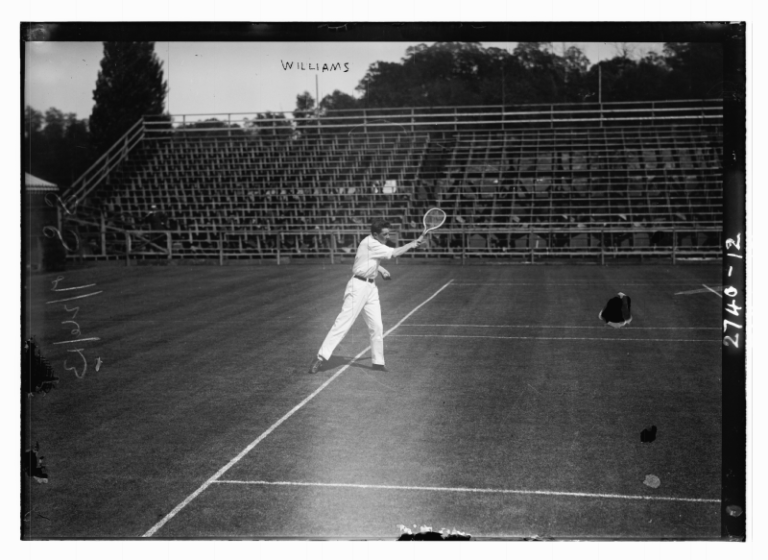
Richard Norris Williams practicing for the Davis Cup, 1913. Courtesy of the Library of Congress.

PUBLIC DOMAIN

Richard enlisted in the US Army to serve in the First World War, and was awarded both the Croix de Guerre and Legion of Honor awards. He was inducted into the Tennis Hall of Fame in 1957.

He was described by his grandson, Quincy, as “a modest man who didn’t like to talk about himself… and loved to garden.”

Richard Norris Williams died in 1968, at the age of 77.

Richard Norris Williams. As published in "Methods and Players of Modern Lawn Tennis," 1915.

PUBLIC DOMAIN

Quincy now owns the silver flask that his great-grandfather, Charles Williams, gave to Richard during the sinking.

Open post

“Very Fond of Playing Patience”: William Harbeck & Henriette Yrois

"Very Fond of Playing Patience": William Harbeck & Henriette Yrois

William Harbeck was ending a season-long tour of Europe when he boarded Titanic as a Second-Class passenger; he was bound for home in Toledo, Ohio.

Ever since 1906, his star had been on the rise, beginning its ascent when he filmed the immediate aftermath of the infamous San Francisco earthquake.

Montgomery Street, San Francisco, 1906. Courtesy of the Edith Irvine Collection, Brigham Young University, Utah.

PUBLIC DOMAIN

He was then hired by the Canadian Pacific Railway and its Department of Colonisation. His goal, it was stated, was “to put Western Canada on the motion picture screen in a scenic, industrial and comic form.”

William produced over a dozen reels for the Railway, and his work was used in promotional material to make Western Canada a destination spot and entice Europeans.

And entice them, his films certainly did—as evidenced by the renewal of his two-year contract. 

The Railway then sent him on a trip to Paris to study with a French filmmaker named Leon Gaumont, who was the apparent master of outdoor, on-location shooting. So he left for Europe at the tail-end of February 1912, visiting London, Berlin, and Brussels. And Paris, of course.

On the first day of April, William wrote back home to his wife, Catherine; he planned to travel from Amsterdam, to London, to Southampton. Then homeward bound on Titanic. 

He already had another project lined up for when he was back in the States: to film the beauty of Alaska and the Yukon.

The aurora borealis over Dawson, in the Yukon territory, photographed by Morte H. Craig between 1902 and 1912. Courtesy of the University of Washington.

PUBLIC DOMAIN

Furthermore, it’s believed that William had also been hired by White Star to film Titanic’s maiden voyage, owing to the claims of “Moving Picture News,” a trade periodical that asserted that he had, had a contract to the tune of $10,000.00.

But when William Harbeck boarded Titanic in Southampton on April 10, he did not do so alone.

He took to Titanic with a young woman on his arm.

She was a French model, 22 years of age, named Henriette Yrois. They had evidently become acquainted in Paris, where she lived.

The Second-Class entrance on Titanic's sister, RMS Olympic, circa 1911. Taken by / courtesy of Bedford Lemere & Co.

PUBLIC DOMAIN

But Henriette was not his wife.

Fellow passengers, however, certainly were under the impression that she was, possibly because William went ahead and told them as much, or maybe just because it was assumed because there was no other reasonable explanation for a May-December couple to be traveling together with no companions.

The sole evidence of a romantic relationship between William and Henriette exists in implication: they boarded jointly, and their sequentially issued tickets (and thus, cabins) neighbored one another. 

Lawrence Beesley wrote in his survivor account that he saw them on board at one point, and he was evidently under the impression that they were married.

In the opposite corner are the young American kinematograph photographer and his young wife, evidently French, very fond of playing patience, which she is doing now, while he sits back in his chair watching the game and interposing from time to time with suggestions.

Excerpt from "The Loss of the S.S. Titanic," by Lawrence Beesley.

Lawrence wrote that he did not encounter them again.

Other than that, there seems to have been very little documented about William and Henriette while on Titanic.

And neither of them survived.

Henriette’s corpse was never recovered. 

William’s body, however, was. It was identified by his “Moving Picture & Projecting Machine Operators Union” membership card.

William was pulled fron the ocean still clutching a lady’s purse, which contained jewelry and a wedding band. It was later confirmed to have belonged to Henriette.

The recovery crew of the MacKay-Bennett listed William H. Harbeck as follows.

NO. 35. - MALE. - ESTIMATED AGE, 40.

CLOTHING - Black coat; grey mixture tweed trousers and vest; red tie; black boots.

EFFECTS - Cheque books; travellers' cheques; lady's bag; gold watch and chain; two lockets; gold time meter; fountain pen; diary; false teeth; pencil; knife; diamond ring; union card. Moving Picture and Projecting Machine operators' union; 15 in gold, £15 6s. in silver, 10s. in purse in lady's bag; wedding ring in bag; pearl and diamond pin.

SECOND CLASS PASSENGER.

NAME - WILLIAM H. HARBECK. 114 24th Avenue, N. Y

When William’s widow, Catherine, arrived in Halifax to claim her late husband’s corpse, she was initially turned away by  theauthorities because “Mrs. Harbeck” had died on Titanic alongside her husband.

But reason eventually won out, and Catherine was permitted to transport William’s body home for burial in Toledo.

There was another mystery, however, that still has yet to be solved.

Catherine Harbeck solicited White Star for the items that had been recovered with William’s corpse, but White Star informed her that they had passed them on to the Provincial Secretary of Halifax because they were valued at over $100.00.

Catherine proceeded to provide the proper documentation to prove that she was the administratrix of her husband’s estate, and the effects were relinquished.

But it turns out that Catherine wasn’t the only person who wanted them back.

Months later, another letter arrived to the Provincial Secretary of Halifax, claiming ownership of the effects of the late Mr. Harbeck. The letter, from Seattle Washington, was signed by “Mrs. Brownie Harbeck."

The Secretary informed Brownie that the effects had already been expressed to Mrs. Catherine Harbeck, to which Brownie replied.

She inquired further about the specific amounts of money found on his body, both in gold and travelers checks. She continued, to much surprise, to claim that she was aware of Henriette's presence on the ship, and that she "knew the lady well."

After that, William’s son, John Harbeck, somehow discovered that the Secretary’s office was offering information about his dead father’s effects, which were legally in his mother’s custody. 

When the Secretary confirmed via letter that communication had occurred in fact between themselves and Brownie, John was irate.

The web of letters, still in the possession of the Nova Scotia Archives, end unceremoniously there.

To date, the identity of Brownie Harbeck remains unknown.

Open post

“Embarcome”: Manuel Uruchurtu Ramirez

"Embarcome": Manuel Uruchurtu Ramirez

Manuel Uruchurtu Ramirez is the only confirmed passenger of Mexican nationality on Titanic.

He was born in late June of 1872, in Sonora, Mexico, into an elite family. As such, he had the privilege of traveling to Mexico City in order to study law.

While there, he met and married another student by the name of Gertrudis, who was from a similarly aristocratic (and therefore affluent) family.

Manuel and Gertrudis settled into life in Mexico City, going on to have a total of seven children. Manuel, in the meanwhile, established his law practice.

By way of his familial connections, education, and friendship with the Vice President of Mexico, Ramon Corral, Manuel became a politician.

But when the dictatorship was overthrown in 1911, and both President Porfirio Diaz and Vice President Corral were banished, Manuel found himself in a precarious situation. He was reportedly considered a member of the “catrines;" that is, an individual who had close personal ties to the now-former government owing to his wealth and/or social standing.

Not great, and certainly unsafe.

And so, Manuel Uruchurtu found himself himself fleeing to Europe in order to reconnect with his fellows.

After conducting a meeting with Vice President Corral on or about March 1, 1912, Manuel booked passage home on the SS City of Paris, which was scheduled to depart on April 10, 1912, from the port of Cherbourg. He was ready to be home, it's reported, and eager to see Gertrudis again.

Shortly before he was set to travel, however, Manuel had a visitor to his hotel in Paris. Guillermo Obregon, who was Vice President Corral’s son-in-law, had arrived to discuss what turned out to be a fateful exchange: that of Manuel’s ticket upon the SS City of Paris with his own on the Titanic.

This writer has not found evidence as to why Obregon was eager to swap tickets with Manuel. Given comparison of the two travel routes, it would seem reasonable to assume that Obregon wanted to get to Mexico as soon as he possibly could, owing to the fact that Titanic was scheduled to arrive very far away in New York City. And Manuel was almost certainly obligated to any member of Corral’s family.

Regardless.

Manuel agreed to the exchange of tickets. He would travel on Titanic, in room PC 17601.

Manuel’s travel plans can’t have been altered much. He was still going to depart from Cherbourg on April 10. As such, he took the train down, and made some new acquaintances along the way, including fellow First-Class passenger Edith Russell.

The trip going down to Cherbourg was marked out distinctly by the acquaintanceship started with several very nice ladies in my (train) compartment, one a Swedish lady, two others Americans, who had been cabled to return to America and were overjoyed that they were sailing on this wonderful boat, and a Mexican gentleman, who informed me that he was a member of Parliament in Mexico. We were a merry little party; the fact that all were going on this exceptional ship seemed to draw us together, as everybody was looking forward to seeing the monster boat.

Courtesy of [source]

From Cherbourg, Manuel sent his last documented communication: a telegram to his brother that read only, “Embarcome.”

Little information pertaining to Manuel Uruchurtu’s actions while on board Titanic are definitive or—more accurately—confirmed to have happened at all.

Because Manuel is more or less exclusively noted today because of his famed Heroic Act.

Unfortunately--like so much of what happened on and within Titanic throughout the sinking--this story of Manuel Uruchurtu, which has been recounted for some time by his indirect descendant, is thus far unsubstantiated.

The story goes that Manuel was offered a seat in Lifeboat 11 owing to his political stature, but when an Englishwoman from Second-Class was not allowed to board that same lifeboat, he acted in chivalry and faith and forfeited his seat to her.

It's reported that in return, Manuel but asked her to visit his family back in Mexico to share his final memory with them, which the woman agreed to do.

And while this narrative is certainly compelling, it is the opinion of this writer that the story is most likely fabricated.

The woman supposedly in question, Elizabeth Rammell Nye, did, in fact, survive the sinking in Lifeboat 11. But she provided multiple accounts as to what occurred that night, and she made no mention of Manuel. Nor did anyone else in the lifeboat.

Moreover, Edith Russell, who was confirmed to have made an acquaintance with Manuel en route to Cherbourg, was also in Lifeboat 11, and yet—despite her many, many accounts about Titanic—she  made no mention of Manuel’s Heroic Act, which surely would not have gone unnoticed by her, had it occurred.

Additionally, supporting documentation has not been produced in an accessible format, despite claims to the contrary.

Multiple people, including Manuel’s own granddaughter and an author who had previously been led to accept the story as truth, have come forward in recent years to discredit it as fantastical.

Butin spite of all of this, the true importance of Manuel Uruchurtu’s experience during the sinking should neither be mistaken nor disregarded: regardless of the veracity of the story about Manuel giving up his seat in Lifeboat 11, the truth of the matter is that he was an actual person who lived and was lost. Lost to his family and his country and to the memory of so many people who never even knew that he was on Titanic.

And he was brave because at some point within that frigid night, amidst trauma and chaos and fear, he confronted his mortality.

Manuel Uruchurtu died on April 15, 1912, in the sinking of the Titanic. His body, if ever recovered, went unidentified.

He was 39 years old.

Open post

“My God, If I Could Only Forget”: Eugene Daly

"My God, If I Could Only Forget": Eugene Daly

Titanic had two stopovers after leaving Southampton: the first in Cherbourg, France, on April 10, and the last in Queenstown, Ireland, on April 11. 

On board the tender America as it marched toward the Titanic, Eugene Daly played “Erin’s Lament” on his uilleann pipes.

Eugene was from Athlone, Co. Westmeath, Ireland, and was 29 years old when he boarded Titanic.

Per census records circa 1911, Eugene was living with his widowed mother and two siblings. Eugene, as the eldest son, was the unmarried head of household, and was noted as a wool “heaver”. In addition, he supplemented his income by taking jobs as a mechanic.

And of course, Eugene also belonged to the Clan Ulseach War Pipers’ Band and the Irish National Foresters Band, as well as hid local chapter of the Gaelic League.

But Eugene decided to break free and try out a new life for himself in the United States.

So he saved for a few years and purchased steerage passage on Titanic. He boarded at Queenstown, in the company of his cousin Maggie and their friend, Bertha. Like all steerage accommodation, he had a shared cabin. Per Eugene’s accounts, he was bunked with two other lads in C-23.

The days in steerage seem to have been pleasant and minimally structured. Lawrence Beesley, a survivor from Second Class, shared his observations. And he seems to have spotted Eugene among the jollity, although he mistook his nationality.

Looking down astern from the boat deck or from the B deck to the steerage quarter, I often noticed how the Third-Class passengers were enjoying every minute of the time; a most uproarious skipping game of the mixed-double type was the great favorite, while ‘in and out and roundabout’ went a Scotchman with his bagpipes playing...

Lawrence Beesley, as written in "The Loss of the S.S. Titanic." © First Mariner Books, 2000.

It appears that Eugene played often for his fellows. Even on the night of the sinking, he played his pipes during a party held in steerage.

When Titanic struck the iceberg later that night, Eugene was nearly thrown out of his bed. He dressed in his trousers and shoes and went out to the gangway, but was assured by a steward that nothing serious had occurred and that he should just go back to bed.

Eugene did just that, if only for a little while.

But commotion made him go back up on deck, where he saw a lot of people panicked and running around. So he rushed down to steerage to retrieve Maggie and Bertha.

They came out with me, but a sailor told us there was no danger. He said the ship would float for hours. He also said to go back, and that if there was any danger he would call us.

The group went to the stern to procure lifejackets, and Eugene reported that he had a “scuffle” with a man for one, which ended up being given to Maggie.

There was a great deal of noise at this time and water was coming in. We knelt down and prayed in the gangway. Then the sailor said there was danger. We went to the deck but there were no boats going off. Then we went to the second cabin deck. A boat was being lowered there. It was being filled with women. Maggie and Bertha got in, and I got in. The officer called me to go back, but I got in. Life was sweet to me and I wanted to save myself. They told me to get out, but I didn’t stir. Then they got hold of me and pulled me out.

As cited in "On Board RMS Titanic," by George Behe. © The History Press, 2012.

After he saw Maggie and Bertha safely off, Eugene went to find another boat that would let him on. And that is when he bore partial witness to one of the Great Mysteries of Titanic: an officer shooting two male passengers, before committing suicide.

In May of 1912, Eugene reported to the Daily Sketch that he saw an officer shoot two passengers who were fighting to break through the crowd to board a lifeboat.

There was a terrible crowd standing about. The officer in charge pointed a revolver and waved his hand and said that if any man tried to get in he would shoot him on the spot… Two men tried to break through and he shot them both. I saw him shoot them. I saw them lying thereafter they were shot. One seemed to be dead. The other was trying to pull himself up at the side of the deck, but he could not… Afterward, there was another shot and I saw the officer himself lying on the deck. They told me he shot himself, but I did not see him.

As cited in "On Board RMS Titanic," by George Behe. © The History Press, 2012.

Unable to find a ready lifeboat and with water rushing the deck, Eugene clamored to a “sort of canvas craft,” which may have been Collapsible lifeboat A or B. He worked frantically with a group of other men to free it from “a wire stay which ran up to the mast.”

But when the canvas lifeboat was washed off the deck, there was no choice for Eugene Daly but to dive into the ocean. And so he did.

Eugene swam for the same lifeboat that he believed he had been attempting to cut loose. The boat he found was Collapsible B, which had floated away upside down as Titanic submerged. Eugene climbed on top of it; he estimated that over a dozen men followed. Together, they watched Titanic groan and vanish.

Eugene Daly survived the night balancing on the back of Collapsible B, alongside many other men, including Second Officer Charles Lightoller, 17-year-old Jack Thayer, Colonel Archibald Gracie, and Junior Marconi Officer Harold Bride. He often credited his survival to the heavy coat he wore, and he held onto his “lucky coat” for the rest of his life.

Eugene's daughter, Marion Joyce, wrote the following about her dad's lucky coat.

On that fateful night aboard the RMS Titanic, he put on his shoes and his trousers and, a heavy block overcoat with an Astrakhan fur collar. He still had it on when picked up by the Carpathia - that coat and his watch and rosary were treasured relics of his survival.

Many a cold night in my childhood in Ireland, that coat would be thrown over us in bed to keep us warm. We called it "the Titanic." It had a greenish tinge to it, maybe from the sea water, but it still had heaviness and warmth in it.

When Eugene was brought on board Carpathia, he blacked out and was carried to the cabin of a passenger named Dr. Frank Blackmarr, who worked to revive Eugene with hot drinks and unspecified “stimulants.” And then Dr. Blackmarr transcribed Eugene’s account, word for word.

[NOTED BY DR. BLACKMARR: Here this man fell back on his pillow crying and sobbing and moaning, saying: ‘My God if I could only forget!’ After a bit, he proceeded.]

My God, if I could only forget those women’s cries. I reached a collapsible boat that was fastened to the deck by two rings. It could not be moved. During that brief time that I worked on cutting one of those ropes, the collapsible was crowded with people hanging upon the edges. The Titanic gave a lurch downwards and we were in the water up to our hips.

She rose again slightly, and I succeeded in cutting the second rope which held her stern. Another lurch threw this boat and myself off and away from the ship into the water. I fell upon one of the oars and fell into a mass of people. Everything I touched seemed to be women’s hair. Children crying, women screaming, and their hair in their face. My God, if I could only forget those hands and faces that I touched!

As I looked over my shoulder, as I was still hanging [on] to this oar, I could see the enormous funnels of the Titanic being submerged in the water. These poor people that covered the water were sucked down in those funnels, each of which was twenty-five feet in diameter, like flies.

Eugene was hospitalized along with other survivors at St. Vincent’s in New York, and from there, he sent the following letter to his mother.

Dear Mother, got here safe. Had a narrow escape but please God, I am all right, also Maggie. I think the disaster caused you to fret, but things could have been worse than what they were.

As cited in "On Board RMS Titanic," by George Behe. © The History Press, 2012.

Soon thereafter, he filed a claim with White Star for the loss of his pipes, and was compensated $50. He was very pleased with the sum, thinking it more than that pipes had been worth.

Eugene was celebrated as a hero, especially back home in Ireland. "The Westmeath Independent" commented that "the courage credited to Eugene Daly in the foregoing will not surprise his fellow townsmen, who knew him as a man of principle and pluck. In the present deplorable disaster, he appears to have upheld the traditions of the Gael."

He went on to become a machinist for the Otis Elevator Company, and that led him to meet his future wife: the sister of his coworker Jimmy, an English woman named Lillian who owned silk mills in the neighboring state of Connecticut. They married in 1917, and the couple appears to have begun life in New York but eventually moved back to Ireland. Quite by accident and due to his trauma, according to Eugene's daughter.

In 1921, they got a cable from home to say that Eugene's mother was dying. So my Mom booked passage right away and they sailed for home.

...As soon as the ship was a few hours out Eugene lost all sense of security. He was in an extreme state of panic. He couldn't eat or sleep. He walked the decks the whole voyage, and my Mom paid a steward to look out for him.

Once they arrived in Ireland, Eugene refused to sail again. He did not return to the United States until he was widowed in 1961--and only then because flight was a travel option.

In his later years, Eugene was noted as a devout parishioner and quite musical, although he was also described as “very loud.” But people seem to have forgiven him this, as he was probably somewhat deafened from years of working in the mills.

Eugene Daly died on Halloween, 1965, in New York City. He was 82 years old.

In recent years, a curious artifact was salvaged from the wreck site: an instrument with undeniable similarities to uilleann pipes.

SOURCE MATERIAL

Behe, George. "On Board RMS Titanic: Memories of the Maiden Voyage." The History Press, 2012.

Beesley, Lawrence. "The Loss of the S.S. Titanic: By One of the Survivors." First Mariner Books edition, 2000. Originally published by Houghton Mifflin Company, 1912.

https://www.encyclopedia-titanica.org/eugene-dalys-account.html

https://www.encyclopedia-titanica.org/eugene-daly-his-daughter.html

https://www.encyclopedia-titanica.org/titanic-survivor/eugene-patrick-daly.html

https://www.irishcentral.com/news/eugene-daly-irish-titanic


Posts navigation

1 2 3 4 5 6
Scroll to top