Open post

“Deep In Desolate Thought”: Masabumi Hosono

“Deep in Desolate Thought”: Masabumi Hosono

Masabumi Hosono was 42 years old when he boarded Titanic as a Second-Class passenger in Southampton.

Hosono was a highly regarded civil servant of the Japanese government. After a brief stint at Mitsubishi, Hosono entered into a career working for the Ministry of Transport.

Having been a graduate of the Russian Department at the Tokyo School of Foerign Languages, Hosono had been sent to Russia in 1910 to study the country's railroad system.

Having done his duty by the beginning of 1912, Hosono elected to head home. He first stopped in London, and then boarded Titanic in Southampton.

Masabumi Hosono.

PUBLIC DOMAIN

Hosono slept through the collision on April 14.

He was awoken by knocking at his door around midnight, when a steward ordered Hosono to put on his lifevest. Hosono immediately made his way up to the boatdeck but was turned away and directed to the lower level--as a Japanese man, he was mistaken for a steerage passenger.

Hosono stated that he succeeded in his third attempt to get up on deck, having evaded the notice of a guard.

Hosono later wrote about the scene on deck.

"flares signalling emergency were being shot into the air ceaselessly, and hideous blue flashes and noises were simply terrifying. Somehow I could in no way dispel the feeling of utter dread and desolation."

Citation courtesy of Encyclopedia Titanica.

Hosono mentally prepared himself to die with the honor befitting his countrymen, but he stated that he still found himself seeking any opportunity for survival.

So when an unnamed officer lowering a nearby lifeboat called out, “Room for two more!” and Hosono witnessed a man jump in, he decided to follow suit.

‘I myself was deep in desolate thought that I would no more be able to see my beloved wife and children, since there was no alternative for me than to share the same destiny as the Titanic. But the example of the first man making a jump led me to take this last chance.'

Citation courtesy of Encyclopedia Titanica.

On board the Carpathia, Masabumi Hosono began to write his survivor account.

He repurposed some Titanic stationary that he had initially intended to use to write a letter to his wife.

Dated April 10, 1912, he crossed out the letter’s original beginning—"My Dearest, I am now on board of the SS Titanic”—and proceeded to recount his daily experiences.

He was bored, he wrote, and wracked with nerves from poor weather conditions—he feared another sinking. The conditions were terribly crowded, as the Carpathia was accommodated hundreds of Titanic passengers alongside their own.

And he was isolated. He was reportedly treated with relentless suspicion. He sought sleep in the Smoking Room when he could manage to find a space, but he tended to avoid it otherwise as he claimed seamen ridiculed him throughout the journey.


’Because they are a good-for-nothing band of seamen, anything I say falls of deaf ears… [on the last day] I talked a little about myself; I showed them a bulldog tenacity and finally gained a bit of respect.’

At first, Masabumi Hosono hardly registered among the hundreds the survivor stories. Once he had arrived in New York City, he found his way to friends to ask for help in making his way home, then went on to San Francisco where he departed at last for Japan.

Back home in Tokyo, he was interviewed by multiple periodicals, one of which included a photograph of Hosono with his family.

Shortly thereafter, disgrace came.

Colonel Archibald Gracie, a blustery, a First-Class American who survived the sinking on the back of Collapsible B, released his harrowing account of the sinking.

In it, he referred to Masabumi Hosono as a "Japanese stowaway."

Archibald Gracie IV, whose account of Masabumi Hosono was negative.

PUBLIC DOMAIN

Furthermore, witness testimony at the American Senate Hearing damned Hosono, even though it was hearsay in which he was never named.

When asked if there were any make passengers in his lifeboat, crewmember Edward Buley testified that he saw none but was later told that there were “a couple of Japanese” men in the boat. “They never got in our boat,” Buley testified, “unless they came in there dressed as women.”

And that was enough to condemn Masabumi Hosono.

To date, stories such as these are entirely unsubstantiated. Unfortunately, they are never the less predictable—there was, and still is, a fervent game of blame about the Titanic disaster. And no surviving White Star employee wanted to invite the shame of letting imperiled women and children die all for the sake of men.

The esteemed and accomplished Masabumi Hosono lost his job in 1913, fired for his grave dishonor in the Titanic disaster.

He was reportedly referenced in textbook as an exemplia grata of shameful behavior, an ethics professor declared him immoral, though said source materials have yet to be located. Periodicals denounced him.

In short, Masabumi Hosono was entirely ostracized. But being so adept in his field, Hosono was eventually rehired by the Ministry of Transport, and he worked there until his death in 1939, at the age of 68.

But the shame of his ignoble escape continued to cast its pall over his descendants.

In 1997, the Hosono family wrote a letter to thank director James Cameron for not further villifying the family name.

Masabumi Hosono’s private account of his experience, written on board the Carpathia, was discovered hidden at the bottom of a drawer by his granddaughter.

It was subsequently published.

With the release of the film and the passage of time, Masabumi Hosono’s family has at last been granted exoneration. His grandson, an orchestral musician named Haruomi Hosono, attested to feeling “extremely relieved. Honor has been restored to the Hosonos.”
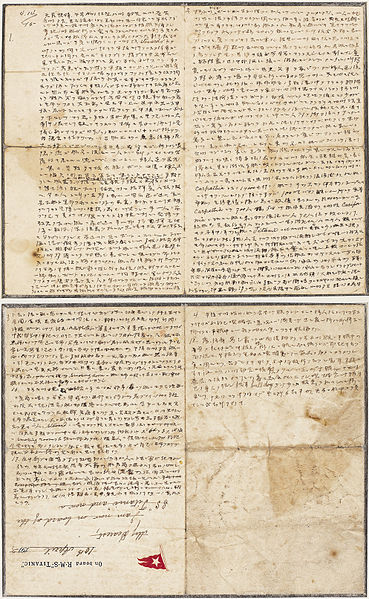
Masabumi Hosono's account of the Titanic disaster.

PUBLIC DOMAIN

Open post

“A Costly Thing, Studded With Diamonds”: John Jacob Astor IV

"A Costly Thing, Studded With Diamonds": Colonel John Jacob Astor IV

John Jacob Astor--who went by Jack--is easily one of Titanic's most notable passengers.

Wildly wealthy, John Jacob Astor and his second wife--who was 19 years old to his 47--were returning from their honeymoon abroad in Egypt and France, which they were ending early because of her unexpected pregnancy.

The Astors boarded Titanic in Cherbourg, France, on the evening of April 10, 1912. They were accompanied by Mrs. Astor's maid and nurse, Col. Astor's valet, and the Astors's dog, an Airedale named Kitty.

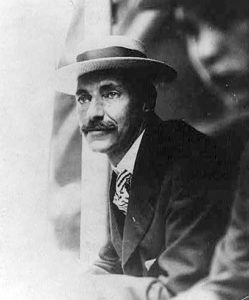
John Jacob Astor IV, circa 1909.

PUBLIC DOMAIN

Many of the American elites had recently come to disdain the Astors because of Jack's hasty remarriage to such a young girl.

One of those who didn't pass judgment, however, was fellow First-Class passenger Margaret Brown. She had in fact  traveled with the happy couple in Europe, and coincidentally also needed to abbreviate her travels and return to the United States on board the Titanic.

The Washington Times, dated August 3, 1911.

PUBLIC DOMAIN

Astor was a Harvard alum; an intelligent man, he was considered eccentric by some.

In addition to the real-estate that comprised his fortune, he had also tried his hand at writing science fiction in the 1890s; he published a novel exploring life on other planets in the faraway year of 2000, called "A Journey in Other Worlds".

He was also fascinated by technological advancements, and was known to invent certain things to make life's little tasks easier--a bicycle brake, for instance--and things to make the world better, such as a more efficient turbine engine.

Jack Astor was also fond of motor cars.

Astor in his motor car, circa 1903. Courtesy of the Library of Congress.

PUBLIC DOMAIN

He had served in the United States Army during the Spanish-American War and had thereafter offered his yacht for commission by the United States Navy.

His service, however, was not entirely appreciated by the American public; despite his minimal involvement in combat, he had been rewarded with an honorary promotion to colonel.

It was never the less his chosen form of address for the rest of his life.

Astor in military uniform.

PUBLIC DOMAIN

Jack reportedly roused Madeleine immediately after the iceberg strike, assuring her the damage was "not serious."

While queuing on the boat deck for a lifeboat, the young Mrs. Astor reportedly offered her shawl to a third-class passenger, to keep her child warm.

Having grown uncomfortable with the cold while waiting on deck, the Astors went into the gymnasium, taking seats on the mechanical horses. It was during this time that Titanic's First-Class Barber Augustus Weikman found Jack and fellow millionaire George Widener watching some other men have a go at the punching bags.

The Colonel was also reportedly witnessed in the gymnasium slicing open a life-jacket with a pen knife to show his nervous wife the contents therein.

Madeleine Force Astor circa 1915. From the George Grantham Bain Collection, courtesy of Library of Congress.

PUBLIC DOMAIN

It was Second Officer Charles Lightoller who refused Jack a seat in Lifeboat 4. Colonel Astor politely indicated that his wife was "in a delicate condition" in an attempt to persuade him otherwise.

But Office Lightoller made no exception.

Colonel Astor reportedly received the refusal with grace, only inquiring as to what lifeboat number it was, in order to reunite with his wife later.

And then, stepping back, the Colonel quietly lit a cigarette with another doomed man.

Conflicting reports persist of Colonel Astor stepping aside, or otherwise giving up his seat to children and selflessly assisting other women into lifeboats. This imagined heroism is a common theme with notable men who died on Titanic; they are, however, often unsubstantiated.

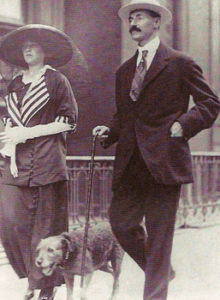
The Astors with their beloved Airedale Terrier, named Kitty.

PUBLIC DOMAIN

Mrs. Astor's maid and nurse both survived.

John Jacob Astor IV, as well as his valet Victor Robins, both perished.

John Jacob Astor's body was recovered by the crew of the Mackay-Bennett on April 22, 1912, one of just over three hundred.

The condition of his corpse remains a source of speculation, as it would likely indicate his precise cause of death: hypothermia, drowning, or--as rumor has dictated--the brute injury of being crushed by a falling funnel.

However he met his end, the Titanic's wealthiest victim was labeled as follows.

NO. 124 – MALE – ESTIMATED AGE 50 – LIGHT HAIR & MOUSTACHE.

CLOTHING – Blue serge suit; blue handkerchief with "A.V."; belt with gold buckle; brown boots with red rubber soles; brown flannel shirt; "J.J.A." on back of collar.

EFFECTS – Gold watch; cuff links, gold with diamond; diamond ring with three stones; £225 in English notes; $2440 in notes; £5 in gold; 7s. in silver; 5 ten franc pieces; gold pencil; pocketbook.

FIRST CLASS. NAME- J.J. ASTOR IV

While a great deal of attention was paid to his dazzling effects, there is no mention of damage to Astor's body.

In fact, Mackay-Bennett crewmember Gerald Ross reported the following in his interview with the Philadelphia Evening Bulletin, further demonstrating that, contrary to popular belief, it would appear that John Jacob Astor had not, in fact, been crushed.

I saw the recovery of Col. Astor’s body. Like the others it was floating buoyed by a lifebelt. Both arms extended upwards. The face was swollen, one jaw was injured. His body was clothed in a business suit and tan shoes. His watch, a costly thing, studded with diamonds, was dangling from his pocket. It had stopped at 3:20. Practically all the other watches on bodies we recovered had stopped at 2:10. His watch chain was of platinum and so were the settings of the rings he wore.

Colonel Astor's fame and societal prominence invited much in the way of tall tales and un-truths that persist even today.

For instance, it's been rumored that Astor himself let all the passenger dogs loose from their kennels, although how he would have managed to go from the boat deck to F-deck and back again--all while in the company of his panicked wife and prominent friends--remains to be reasoned out.

And then there's the myth that he was idle at the bar when Titanic struck the iceberg and decided to quip, "I asked for more ice, but this is ridiculous," which appears to be entirely fictitious.


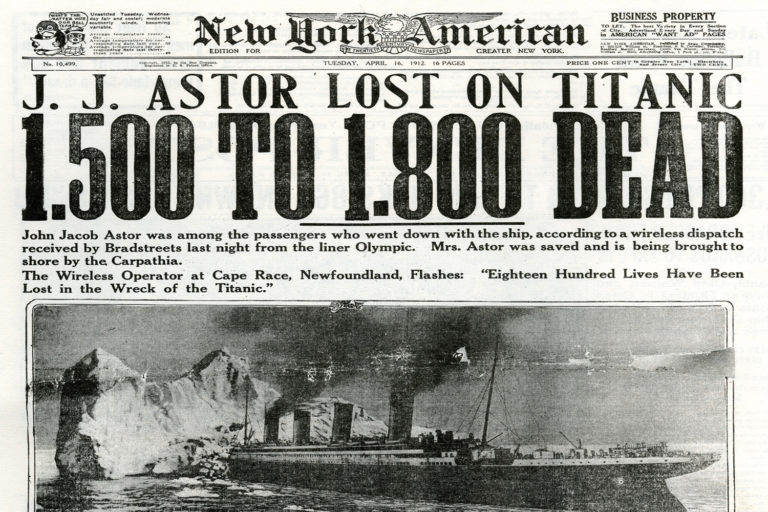
New York American dated April 16, 1912.

PUBLIC DOMAIN

Madeleine Astor, now widowed, gave birth to her son in August of 1912.

Named after his late father, he was nicknamed "Jakey" by his mother, and he was sometimes called "the Titanic Baby" by the press.

Madeleine Astor died in 1940, at the age of 46. Her son died in 1992.

SOURCE MATERIAL

[to be appended]

Open post

Alma Paulsson

PASSENGER PROFILE: Alma Paulsson

Alma Palsson (Americanized: Paulson) was an immigrant from Sweden; she was 29 when she boarded Titanic as a third-class passenger with her four young children.

Alma had been waiting for enough funds for her husband, Nils, to purchase tickets so they might finally join him in Chicago. The children--daughters Torborg and Stina, sons Paul and Gosta--ranged in age from 2 to 8 years old.

Nils had emigrated to America after realizing that he didn't want to be a miner anymore, and that mining was pretty much the only gig around where the Palssons lived in Sweden.

He arrived in Chicago in 1910; after landing a job as a tram conductor, he set to saving up enough money for his family to reunite in their new country. Swedish immigrants were the third-most robust nationality on Titanic, after the British and the Americans.

When Titanic struck the iceberg, Alma apparently struggled to gather and dress her children. By the time they got to the boatdeck from steerage class, it was too late; all the lifeboats had gone.

Another Swede named August Wennerstrom tried to look after the patriarch-less family in their distress. He said that he tried desperately to hold onto two of the Palsson children as the water washed the deck, but they were swept away. Wennerstrom survived.

Little else is known about Alma and her children; she was not seen again until her corpse was recovered by the crew of the Mackay-Bennett. It is thought that she must have presented an eerie and heartbreaking sight when she was found floating on the sea, her fair hair undone around her beautiful face.

She was listed as follows.

No. 206 - FEMALE - ESTIMATED AGE 30 - FAIR HAIR.

Brown Coat; green cardigan; dark shirt; brown skirt under; boots; no stockings

Wedding ring; brass keeper; mouth organ; purse and two coins; a letter; 65 kroner; had four children with her; letter from husband, Neil Paulsson, 94 Townsend St, Chicago.

Memory persists of Alma playing songs on the listed mouth organ (a harmonica) for her frightened children as they waited helplessly for the ship's submersion.

None of the Palsson children, if recovered, were ever identified. For decades, it was assumed that little Gosta was Titanic's famed "Unknown Child," but genetic testing has at last proved otherwise.

An account of Nils Palsson's reaction exists, including his desperate attempts to find out if an orphaned boy was his son. At the White Star Offices in Chicago, Nils begged for information about his family.

He was told they were not listed on the roster of survivors.

In broken English, he hoped out loud that maybe they didn't sail.

Your family was on the boat, but none of them are accounted for.' The man on the other side of the counter was assisted to a seat. His face and hands were bathed in cold water before he became fully conscious.

He was finally assisted to the street by Gust Johnson, a friend who arrived with him. Paulson's grief was the most acute of any who visited the offices of the White Star, but his loss was the greatest. His whole family had been wiped out.

Nils eventually remarried and moved, where he planted 4 trees in his backyard to mourn and honor his lost family. Gosta, only two years old, was born after his father's departure; Nils never met his youngest son.

Posts navigation

1 2 3 4 5 6
Scroll to top