Open post

“I Trust That They Are Better Off”: Rhoda Abbott

"I Trust That They Are Better Off": Rhoda Abbott

Rhoda Abbott had long been an elusive Titanic survivor.

As it turns out, this was because her name, on Titanic's manifest and in contemporary articles, was inaccurately written as Rose or Rosa. Regardless, on her birth, death, and marriage certificates, her name is listed as Rhoda. And with that, a comparative wealth of information has been discovered.

Rhoda about was born in England, and emigrated to Providence, RI, in 1894. There, she met and married a fellow expat named Stanton Abbott, who rose to fame as a middle-weight boxing champion. This fame, however, accelerated the deterioration of their marriage, and in 1911, Rhoda and Stanton separated.

Rhoda returned to England with their two teenaged sons, Rossmore and Eugene, on Titanic's longest-lived sister ship, the RMS Olympic.

They struggled to get by in England. Rhoda worked as a seamstress and Rossmore as a bootmaker, while Gene was still receiving schooling. But Rhoda soon realized that her boys were homesick--she was English, but they were American. So she decided to take them home.

Rhoda Abbott boarded Titanic as a third-class passenger with her two boys. Rossmore was 16 by this point; Gene was 13.

It's been reported that the boys, excited to get stateside and dazzled by Titanic, almost immediately peaced out from their mom to explore the ship. Rhoda spent time conversing at length with fellow English women in adjoining cabins, particularly Amy Stanley and Emily Goldsmith.

As a whole, those in Third Class, being low within the vessel, felt the greatest shudder upon impact with the iceberg. After feeling the collision, the boys wanted to get up to the boat deck to see what had happened. But their mother wanted to wait for instruction from a steward, so she made them stay put and go to bed.

At a quarter past midnight, a steward threw open their door, yelling, "All passengers on deck with life jackets."

Rhoda, Rossmore, and Gene managed their way up to the boat deck with a little maneuvering. As they shuffled in the mass across the stern's deck, the last of the distress signals was launched above them. Eventually, they reached Collapsible C, the boat that some of Rhoda's cabin neighbors, including Amy Stanley and Emily and Frankie Goldsmith, got in. With the assertion of 'Women and Children First' in full effect, Rhoda's sons were too old to be considered children.

At around 2:00 a.m., when Rhoda was frantically offered a place in Collapsible Lifeboat C, she pressed her two boys to her and refused. It was about 2:00 a.m.

Twenty minutes later, Titanic submerged.

Water overtook the boat deck as the officers were desperately trying to launch Collapsible A, which Rhoda and Gene were waiting for--Rossmore, in accordance with Rhoda's worst fear, was put firmly back with the other men.

Rhoda grabbed Gene's hands, but when she surfaced, both Rossmore and Gene had been dragged away underwater.

She never saw her boys again, alive or dead.

Rossmore's corpse was recovered by the Mackay-Bennett and committed to the sea on April 24, 1912. He was listed as follows.

NO. 190 - MALE - ESTIMATED AGE, 22 - VERY FAIR
CLOTHING - Brown overcoat; grey pants; green cardigan; blue jersey; black boots.
EFFECTS - Watch; chain and fob, with medal marked "Rossmore Abbott"; pocket book empty and two knives.
PROBABLY THIRD CLASS - NAME - ROSSMORE ABBOT

Gene's body was never found.

With no sight of her lost sons, Rhoda sank again, but was blown back to the surface by the exploding Titanic boilers, which she believed caused burns to her thighs.

Rhoda managed to make it to Collapsible A--which having been washed away only half-prepped, had taken on a few inches of water--and was pulled aboard. She recounted her experience to the Pawtucket Times.

Soon the raft tilted and all slid off into the water. Many of them managed to get back on it and some did not. I managed somehow to get on it, but I don’t know how. We were forced to stand on the float in lockstep to keep our balance for over six hours. Had it not been for Officer Laws I would have been drowned. I was nearly exhausted when he lifted me into his lifeboat. It would have been impossible for an officer to show more courtesy and many of the criticisms that have been made against this man are very unjust.

"Officer Laws" was, in fact, Fifth Officer Harold Lowe, of Lifeboat 14, the only lifeboat to return for survivors.

Officer Lowe left Collapsible A behind. It was recovered one month later, in May of 1912, with three corpses still within.

Rhoda had been practically unconscious when removed from Collapsible A, and was cared for by a fireman until taken aboard Carpathia. She had no memory of any of it. According to fellow survivor Amy Stanley, once on board Carpathia, Rhoda was mute and shellshocked.

 We were very close since we were on the Titanic together. And her stateroom had been near mine. I was the only one that she could talk to about her sons because I knew them myself. She told me that she would get [sic] in the lifeboat if there hadn't been so many people around. So she and her sons kept together. She was thankful that [the] three of them had stayed with her on that piece of wreckage. The youngest went first then the other son went. She grew numb and cold and couldn't remember when she got on the Carpathia. There was a piece of cork in her hair and I managed to get a comb and it took a long time but finally we got it out.

Meanwhile, Rhoda's ex-husband Stanton had been informed of the loss of his young boys. The New York Times reported it on it, with a distinct lack of sentiment, on May 4, 1912.

Stanton Abbott, an Englishman residing at Providence, R. I., inquired at the White Star Line office yesterday for his two sons, Rosmore Edward, 17 years old, and Eugene Joseph, 13, who were passengers with their mother, Mrs. Rose Abbott, 45 years old, on the Titanic, and were lost. The mother, he said, is in the New York Hospital in a dangerous condition from shock and fever. He was told that the body of the older boy had been recovered, and Mr. Abbott said he would go to Halifax to claim it.

Rhoda's physical recovery was slow, and she was one of the last survivors to be released from care at St. Vincent's Hospital in New York City.

Her grief, however, knew no real end. Rhoda kept in touch with her cabin neighbors after the sinking, and in 1914, she wrote to Emily Goldsmith, and her grief was no less palpable for the passage of time.

I have so envied you with Frankie, and me losing both mine, but I trust that they are Better off out of this hard world...

I read by the papers the terrible weather you are having. I suppose Frank enjoys it. I know my little fellow used to when he was alive. I have his sled now that he used to enjoy so much, bless his little heart. I know he is safe in God’s keeping, but I miss him So Much.


Rhoda Abbott was the only woman to go down with Titanic and somehow survive.

And therefore, Rhoda, thereafter and for so long called "Rosa" or "Rose," was the only woman rescued from the water.

Open post

“Like Locusts on a Midsummer Night”: Jack Thayer

"Like Locusts on a Midsummer Night": Jack Thayer

Jack Thayer boarded Titanic at all of 17 years old, as a First-Class passenger with his parents John and Marian, and Marian's maid Margaret Fleming.

Jack Thayer in his youth.

PUBLIC DOMAIN

On April 14, at 11:40 p.m., Jack was winding his watch and preparing for bed when he felt the breeze coming from his open window stop altogether, and the engines ceased their turnings.

He wrote, "The sudden quiet was startling and disturbing. Like the subdued quiet in a sleeping car, at a stop, after a continuous run."

Throwing on a coat over his pajamas, Jack hollered to his parents he was "going out to see the fun" and went up to the boat deck, but noticed nothing out of the ordinary. He moved toward the bow and, as his vision became accustomed to the night, saw pieces of ice on the well deck.

Jack retrieved his parents. On the way, they all noted that Titanic was listing to port.

The Thayers returned immediately to their stateroom and dressed. Jack, in a fit of clarity, put on two vests and a coat to try to safeguard himself from the cold.

Jack, his parents, and Miss Fleming banded together on boat deck until the Women-And-Children-First decree, when they parted ways with Marian and her maid at the top of the Grand Staircase.

Jack and his father assumed Marian and Margaret were safely off the ship, until a steward informed them otherwise. They chased the ladies down, and while John, Marian, and Margaret wandered off looking for a lifeboat, Jack was left behind.

Jack's mother Marian circa 1900, taken when Jack was 6 or 7 years old.

PUBLIC DOMAIN.

It's possible that Jack was caught up in conversation with Milton Long, an acquaintance he'd only made earlier that same evening over coffee.

Jack and Milton went searching for boats, but the boys were impeded by the melee and missed out. At one point, they paused in between a set of empty lifeboat davits and traced a star's movement as it rose in between the davits, to determine how quickly the ship was going down.

Two collapsible boats were available, but the boys felt uneasy, having seen how precariously the traditional, all-wood lifeboats had been launched.

So they elected to remain on board Titanic instead of seeking placement in any of the collapsible lifeboats.

As Jack and Milton went back and forth on how to proceed, a man came out through a nearby door and staggered by, pounding down an entire bottle of gin as he went. Jack recalled thinking, "If I get out of this, that's one man I'll never see again."

Jack's father, John.

PUBLIC DOMAIN

As the ship's angle grew more drastic, the boys heard "deadened explosions" within. Jack was haunted by the sound of it all.

It was like standing under a steel railway bridge while an express train passes overhead, mingled with the noise of a pressed steel factory and wholesale breakage of china.

Excerpt from "The Sinking of the S.S. Titanic" by Jack Thayer.

Jack wanted to jump in and swim for it as he saw people doing down by the stern, but Milton was reticent as he was not a strong swimmer. Eventually, though, Milton relented.

Milton climbed over the railing, and with his legs dangling down, paused and called back, "You are coming, boy, aren't you?" Jack said he'd be right behind him, and Milton slid down the side of the ship.

Jack never saw him again.

Milton Long's corpse was recovered by the Mackay-Bennett, and listed as follows.

NO. 126. - MALE. - ESTIMATED AGE, 35. - HAIR, DARK.
CLOTHING - Black clothes; flannel vest, and black and white vest; white shirt marked "M. C. L."; handkerchief marked "M. C. L." (monogram), and brown boots.
EFFECTS - Gold wrist watch; gold ring with crest; three gold studs; keys; pocket box; £30.00 in gold; 12s. 1 1/2d. in purse; letter of credit.
FIRST CLASS. - NAME - MILTON C. LONG.

Jack jumped in feet first almost immediately after Milton disappeared in the water. He guessed in his account that Milton was sucked in by the deck, instead of pushed out by the backwash as he himself had been only moments later.

Jack surfaced a fair distance away from the ship, and was transfixed by the sight.

The ship seemed to be surrounded with a glare and stood out of the night as though she were on fire. I watched her. I don’t know why I didn’t keep swimming away. Fascinated, I seemed tied to the spot. Already I was tired out with the cold and struggling, although the life preserver held my head and shoulders above the water.

Excerpt from "The Sinking of the S.S. Titanic" by Jack Thayer.

Jack Thayer's survival is particularly notable because he was one of the minority who insisted that Titanic had broken in half, and never faltered in his assertions.

Suddenly the whole superstructure of the ship appeared to split, well forward to midship, and blow or buckle upwards. The second funnel, large enough for two automobiles to pass through abreast, seemed to be lifted off, emitting a cloud of sparks. It looked as if it would fall on top of me. It missed me by only 20 or 30 feet. The suction of it drew me down and down.

Excerpt from "The Sinking of the S.S. Titanic" by Jack Thayer.

When Jack managed against all odds to resurface, he struck his head on the overturned Collapsible B lifeboat.

Jack was pulled up onto the back of the upside-down "canvas craft," where there were, he guessed, four or five other men already on board.

[Titanic's] deck was turned slightly toward us. We could see groups of the almost 1,500 people still aboard, clinging in clusters or bunches, like swarming bees; only to fall in masses, pairs or singly...

Here it seemed to pause, and just hung, for what felt like minutes. Gradually she turned her deck away from us, as though to hide from our sight the awful spectacle.

We had an oar on our overturned boat. In spite of several men working it, amid our cries and prayers, we were being gradually sucked in toward the great pivoting mass. I looked upwards — we were right underneath the three enormous propellers.

For an instant, I thought they were sure to come right down on top of us. Then, with the deadened noise of the bursting of her last few gallant bulkheads, she slid quietly away from us into the sea...

I don’t remember all the wild talk and calls that were going on on our boat, but there was one concerted sigh or sob as she went from view.

Probably a minute passed with almost dead silence and quiet. Then an individual call for help, from here, from there; gradually swelling into a composite volume of one long continuous wailing chant, from the 1,500 in the water all around us. It sounded like locusts on a midsummer night, in the woods in Pennsylvania.

Excerpt from "The Sinking of the S.S. Titanic" by Jack Thayer.

Jack wrote that, after the sinking, 28 men ended up on the back of Collapsible B.

Every moment was spent desperately trying to keep the upside-down lifeboat from going completely underwater by maintaining a precarious balance on its back.

For hours, all the men on board held utterly still in the oddest and most painful of positions, to keep from slipping into the lethally cold water.

We were standing, sitting, kneeling, lying, in all conceivable positions, in order to get a small hold on the half-inch overlap of the boat’s planking, which was the only means of keeping ourselves from sliding off... I was kneeling. A man was kneeling on my legs with his hands on my shoulders, and in turn somebody was on him. Once we obtained our original position we could not move.

Excerpt from "The Sinking of the S.S. Titanic" by Jack Thayer.

The men prayed.

They sang hymns.

And when daylight finally broke, the Carpathia followed slowly. The men moved to stand, shifting their weights to and fro to the counter the swells as the air pocket that kept the lifeboat afloat continued to diminish. Every moment, more water overtook it.

Finally, hearing the cries from Collapsible B, Lifeboats 4 and 12, which were lashed together, crept over to take the surviving men on board.

Jack's mother was on Lifeboat 4.

He did not notice her. She did not notice him.

The recovery of Collapsible B by the crew of the Mackay-Bennett.

PUBLIC DOMAIN.

When Jack reunited with his mother on Carpathia, she was reported to have embraced him and asked, "Where's daddy?"

Jack told her that he did not know.

John B. Thayer, Sr., did not survive, and his corpse was not recovered. For the remainder of his life, Jack was dogged by shame and remorse about his father. "I only wish I had kept on looking for my father. I should have realized that he would not have taken a boat, leaving me behind."

Jack was loaned pajamas and a bunk, and before crumpling into bed, he took a desperate shot of brandy, only then realizing it was his first encounter with hard liquor.

Once rested and in possession of his full faculties, Jack spoke with Carpathia passenger L.D. Skidmore, who, while listening to Jack's story, sketched his recollections of Titanic's break.

Jack Thayer's account of Titanic breaking, sketched by Carpathia passenger L.D. Skidmore as Jack spoke to him.

PUBLIC DOMAIN

Jack kept a stiff upper lip and by all accounts, persevered to honor Titanic. When Colonel Archibald Gracie--a man whom Jack had shared space with on Collapsible B--passed away in December of 1912, Jack and his mother attended the funeral services.

And when Jack received a letter from the bereaved father of Milton Long, the friend that he had made while on board Titanic, Jack wrote the following reply.

My dear Sir:

I received your letter this morning. Mother and I were very touched by it. Words cannot express how much we sympathise with you and Mrs. Long.

...Your son was perfectly calm all the time and kept his nerve, even to the very end. I wish I had more to tell you, but I hope this will be of some comfort to you. I am sending you my picture, thinking you might like to see who was with him at the end. I would treasure it very much if you could spare me one of his.

With our heartfelt sympathy, believe me,

Sincerely yours, John B. Thayer, Jr.

Jack went on to graduate from UPenn and pursue a banking career, get married, and have six children: three daughters and three sons, although one boy did not survive infancy. Both of Jack's surviving sons, Edward and John, served in the Second World War.

Edward Thayer had signed on as a bomber pilot, and was lost in the conflict when his plane was shot down in the Pacific theater in 1943. His remains were never recovered.

And the following year, on April 14--the anniversary of Titanic's collision with the iceberg--Jack's mother died. Doubly and profoundly bereaved, Jack's depression deepened.

He went missing in September of 1945, when he was 50 years old. He hadn't been seen for days. When he was finally found, he was dead in his car, parked alongside a trolley loop in Philadelphia.

He had slit his wrists, as well as his own throat.

When Jack's belongings were posthumously sorted, a small booklet was discovered; produced in 1940, it was one of 500 copies made for family and friends.

SOURCE MATERIAL
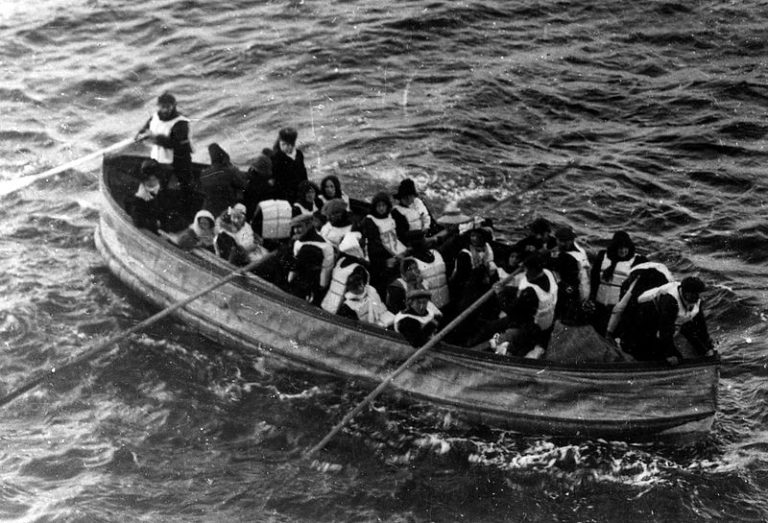
Cornwall, Thomas [compiled & edited by.] "Titanic: The John B. "Jack" Thayer Jr. Chronicles." 2019.

https://www.encyclopedia-titanica.org/titanic-survivor/john-borland-thayer-jr.html

Open post

“My God, Don’t Ask Me Too Much”: Daniel and Mary Marvin

“My God, Don’t Ask Me Too Much”: Daniel Warner Marvin & Mary Farquharson Marvin

Mary Farquharson was born in Edinburgh, Scotland, in 1894. She emigrated to New York with her parents when she was 9 years old.

Mary’s mother Jessie and her Aunt Margaret established a successful modiste business, Farquharson & Wheelock. So successful, in fact, that the Scottish atelier would go on to produce a gown worn by Cornelia Vanderbilt and others displayed in the Metropolitan Museum of Art.

A portrait of Mary, originally published in the Butler Citizen (Pennsylvania) in 1914. Courtesy of Encyclopedia Titanica as provided by Gavin Bell.

PUBLIC DOMAIN (image taken & published prior to 1923)

Daniel Warner Marvin, by contrast, was New York born-and-raised. His daddy Henry was the co-founder of the famed American Mutoscope and Biograph Company. It was the premier motion picture company at the time, founded in part by William Kennedy Dickson, a scientist who had only just left the employ of Thomas Edison, and which innoculated the founders against Edison's notorious litigious approach.

We don't know how Daniel and Mary met. What we do know is that when they fell in love, Daniel was only 18, and Mary was still in school at 17. They wed in a civil ceremony on January 8, 1912, without their parents' knowledge.

Young Mary found herself pregnant almost immediately thereafter. Once found out, Daniel and Mary had a staged do-over wedding in her parents' home on March 12, 1912, which was filmed. It's reported that this ceremony was the first wedding ever "cinematographed".

Mary's wedding gown was designed, of course, by Farquharson & Wheelock, and Mary was featured in Vogue.

Still from Daniel & Mary's "cinematographed" wedding, filmed on March 12, 1912.

PUBLIC DOMAIN (image taken & published prior to 1923)

Daniel and Mary elected to honeymoon in Europe, departing on the Mauretania. And in a twist of cruel, even maniacal fate, they were set to return to New York on the Carpathia--the very ship that rescued Titanic survivors--but were persuaded by Captain Smith, a friend of the family, to take the trip on Titanic with him.

Before they departed, Daniel's father gave him a hand-crank camera.

The young Marvins took to suite D-30. It's reported that they were fairly private during the voyage, and spent a significant amount of time filming around the ship.

After the collision at 11:40 p.m., a steward knocked on the couple's door around 12:25 a.m. He advised that lifeboats were being loaded as a precaution.

Mary dressed in a life-vest and a fur coat, and Daniel led her up to the boat deck. Mary was sent off in Lifeboat 10, which contained a number of very young children, including Titanic's youngest and last-to-die survivor: Millvina Dean, who was only two months old.

We know of Mary and Daniel's last exchange thanks to Mary herself.

"My God, don’t ask me too much," she said [when being asked after by a reporter]. "Tell me, have you any news from Dan? He grabbed me in his arms and knocked down men to get me into the boat. As I was put in the boat he cried: 'It’s all right, little girl; you go ahead, I will stay a while. I’ll put on a life preserver and jump off and follow your boat.' As our boat shoved off he threw a kiss at me, and that is the last I saw of him."

As reported in the New York Times dated April 19, 1912. © Citation: Holman, Hannah. "Titanic Voices: 63 Survivors Tell Their Extraordinary Stories," 2011.

It's been reported that when Mary realized that Daniel was not among the saved, she fainted.

Daniel's body, if recovered, was never identified.

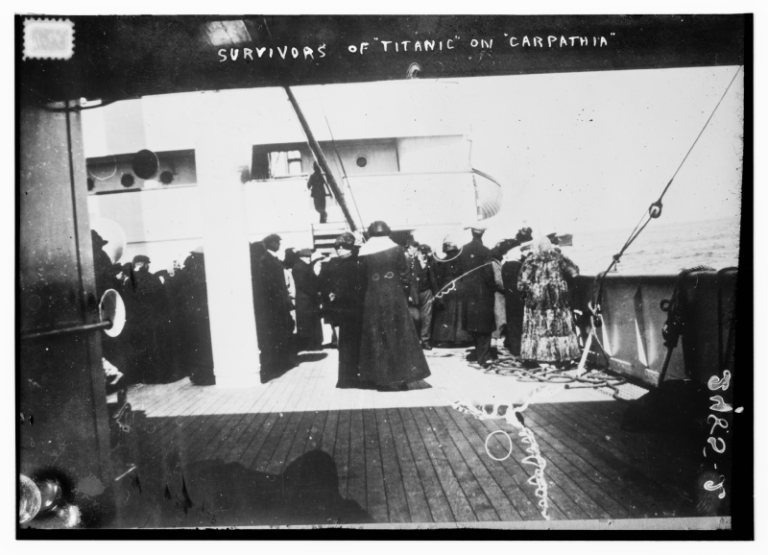
Titanic survivors on board the rescue ship Carpathia. Courtesy of Library of Congress.

PUBLIC DOMAIN

Mary gave birth to Daniel's daughter in October of 1912. On Christmas Day of 1913, Mary married her late husband's best man, Horace de Camp. Together, they had two children, and Horace adopted Daniel's daughter.

Mary spent the remainder of her life in the Adirondacks.

Mary's first daughter disclosed that tensions between Mary's family and the grieving Marvin family were heightened in the wake of Daniel's loss. Specifically, she said that Mary was determined to keep the Marvins from ever learning too much about their son's final days on Titanic. I doubt we'll ever know why.

Mary was reportedly reticent to talk about Titanic, going so far as to decline multiple invitations to survivors' reunions. She did assert, however, that she had seen a man use a revolver to force his way into a lifeboat.

As she progressed in years, Mary relaxed her sense of privacy just enough to confide a small amount of things in her young grandson, Stuart de Camp. According to Stuart, he eventually eased his grandmother into discussing Titanic--he recalls that he was around 9 years old at the time.

Moose River in the Adirondacks, as taken by Anne LaBastille in May 1973 for the Enivronmental Protection Agency.

PUBLIC DOMAIN

Around that time, Mary asked Stuart to row out in a family boat with her to the center of Moose River in upstate New York. She brought with her two items completely unknown to Stuart.

Eventually, Mary instructed Stuart to cease his rowing.

As she waited for the boat to still, she revealed the mystery items one by one.

The first was the film reel of her wedding to Daniel Marvin; that is, the staged version her parents had arranged after discovering their elopement.

The second, said Stuart, was the reel Daniel had filmed while he and Mary sailed on Titanic—that same reel that young Mr. Marvin had thrown down into the lifeboat, for his beloved wife to safeguard.

And then, before the eyes of her bewildered grandson, Mary threw both reels into the river.

Open post

“In Death They Were Not Divided”: Isidor & Ida Straus

“In Death, They Were Not Divided”: Isidor & Ida Straus

Isidor Straus was nine years old when he first set foot on American soil in 1854.

He, along with his three younger siblings, had been brought to New York by their mother. They then set forth to reunite with Isidor’s father Lazarus, who had already settled in Georgia two years prior to establish his mercantile business, which thrived—partly due to Lazarus’s pre-existing connections with wholesale merchants in Philadelphia, and partly due to the prosperity of local cotton plantations.

Reportedly, the Strauses were the sole Jewish family in their new hometown of Talbotton.

In 1861, sixteen-year-old Isidor was ultimately turned away from the Confederate Army of the United States; he was simply too young, he was told.

So, in 1863, after becoming the secretary to a Confederate agent, young Isidor Straus elected to become an international spy.

He hopped a ship from Charleston to Liverpool, which ran the union blockade. Isidor hid himself away—his life savings of $1200.00 in gold was sewn into his undershirt.

And after a layover of some months, staying with relatives in his birthplace of Otterberg, Bavaria, Isidor settled in London. He worked as an aide in financial deals for the Confederacy, and at all of nineteen years old, he even took on a mission to Cuba.

Isidor returned to Georgia in 1865, once the Civil War had ended. He found his family’s business destroyed, and so he convinced his family to reconsider their planned relocation to Philadelphia, in favor of New York City.

So Isidor arrived in New York broke, because he insisted on paying all of his debts prior to his departure, in spite of the fact that Confederate money had been rendered worthless.

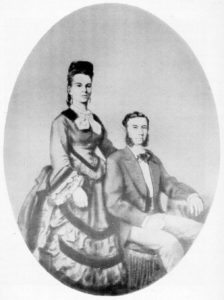
In 1871, Isidor married Rosalie Ida Blun, whom he had met in 1863 while traveling to England.

They would go on to have seven children.

Isidor & Ida Straus's marriage portrait, 1871.

PUBLIC DOMAIN

By 1871, Isidor had already been in business with his father for five years. Isidor’s brother Nathan and their brother-in-law joined in by 1873, thereby creating L. Straus & Sons, purveyors of crockery and fine china.

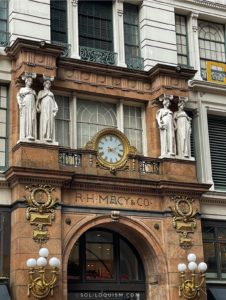
In 1874, L. Straus & Sons entered into an agreement with Rowland Hussey Macy, founder of Macy’s Department Store, to open a glassware department in the basement.

L. Straus & Sons became internationally successful. In 1888, Isidor and Nathan were invited into official partnership at Macy’s, which at the time boasted just over 2,000 employees.

And by 1896, Isidor and Nathan owned Macy’s outright.

Entrance to Macy’s Department Stire on 34th Street, Manhattan, circa 2022.

© soliloquism, 2022.

Isidor and Ida were reportedly a shining example of love throughout their lives.

They traveled together constantly and were rarely apart. Even when Isidor served in the United States Congress from January 1894 through March 1895, he and Ida exchanged daily correspondence.

Perhaps out of love as well as pragmatism, Isidor declined to seek reelection.

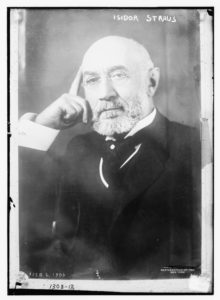
Congressman Isidor Strauss, taken on February 6, 1906. From the George Grantham Bain Collection, courtesy of the Library of Congress.

PUBLIC DOMAIN

They had wintered together in Europe in 1911 through 1912, spending most of their holiday at Cape Martin in southern France.

The Strauses had not planned to travel on Titanic. Like many other passengers, however, they found themselves with no other option due to the ongoing coal miners' strike.

Their daughter had been holidaying with them, but she did not board Titanic with her parents.

The Strauses’ time on board was evidently pleasant. Thanks to the account of Colonel Archibald Gracie, we are privy to an insight as to how Isidor and Ida spent the day of Sunday, April 14.

During this day I saw much of Mr. and Mrs. Isidor Straus. In fact, from the very beginning to the end of our trip on the Titanic, we had been together several times each day. I was with them on the deck the day we left Southampton...

During our daily talks thereafter, he related much of special interest concerning incidents in his remarkable career, beginning with his early manhood in Georgia when, with the Confederate Government Commissioners, as an agent for the purchase of supplies, he ran the blockade of Europe. His friendship with President Cleveland, and how the latter had honored him, were among the topics of daily conversation that interested me most.

On this Sunday, our last day aboard ship, he finished the reading of a book I had loaned him, in which he expressed intense interest. This book was 'The Truth About Chickamauga,' of which I am the author...

I recall how Mr. and Mrs. Straus were particularly happy about noon time on this same day in anticipation of communicating by wireless telegraphy with their son and his wife on their way to Europe on board the passing ship America. Some time before six o'clock, full of contentment, they told me of the message of greeting received in reply. This last good-bye to their loved ones must have been a consoling thought when the end came a few hours later.

Excerpt from "Titanic: A Survivor's Story," by Archibald Gracie, 1912 (reprinted by Sutton Publishing, 2008.)

On the night of the collision, Isidor and Ida found themselves at Lifeboat 8--the same lifeboat where Victor Penasco was desperately trying to get his sobbing bride, Pepita, to leave him and save herself.

Ida Straus stepped in, she expected Isidor to sit next to her; instead, thinking his wife out of harm's way, he stepped back on deck.

Ida immediately removed herself from the lifeboat and refused to reenter without her husband. Other First-Class passengers tried to secure a spot for Isidor aside Ida, but he refused.

Archibald Gracie described the scene as he witnessed it.

The self-abnegation of Mr. and Mrs. Isidor Straus here shone forth heroically when she promptly and empathically exclaimed: 'No! I will not be separated from my husband; as we have lived, so will we die together;' and when he, too, declined the assistance proffered on my earnest solicitation that, because of his age and helplessness, exception should be made and he be allowed to accompany his wife in the boat. 'No!' he said, 'I do not wish any distinction in my favor which is not granted to others.' As near as I can recall them these were the words which they addressed to me. They expressed themselves as fully prepared to die, and calmly sat down in steamer chairs on the glass-enclosed Deck A, prepared to meet their fate.

Excerpt from "Titanic: A Survivor's Story," by Archibald Gracie, 1912 (reprinted by Sutton Publishing, 2008.)

First-Class passenger Hugh Woolner was another survivor who witnessed this, and testified to as much during the Senate Inquiry.

She would not get in. I tried to get her to do so and she refused altogether to leave Mr. Straus. The second time we went up to Mr. Straus, and I said to him: "I am sure nobody would object to an old gentleman like you getting in. There seems to be room in this boat." He said: "I will not go before the other men."

Then, when Idisor tried in desperation to persuade Ida to get back in her seat, she again refused.

She was overheard by several witnesses, including steward Alfred Crawford, who testified at the Senate Inquiry, as stating, "We have lived together for many years; where you go, I go."

It is likewise reported that Ida Straus said, "I will not be separated from my husband. So we have lived, so we will die--together," but witness accounts do not seem to support this very particular word choice.

Archibald Gracie IV.

PUBLIC DOMAIN

In any case, Ida gave her chambermaid, Ellen Bird, her fur coat to keep warm in the lifeboat. Ida simply told Ellen that she would no longer need it.

And Lifeboat 8 was lowered away without the Strauses.

Miss Ellen Bird, maid to Ida Straus.

PUBLIC DOMAIN

Some say Isidor and Ida were last seen holding each other on deck, weeping. Others insisted that they were sitting on deck chairs, holding hands until a wave washed them into the sea. Others still attested only to the couple, arm-in-arm, on deck.

Isidor & Ida Straus.

PUBLIC DOMAIN

Isidor's corpse was the 96th body recovered by the Mackay-Bennett. It was listed as follows.

NO. 96 - MALE - ESTIMATED AGE, 65 - FRONT GOLD TOOTH (Partly) - GREY HAIR AND MOUSTACHE
CLOTHING - Fur-lined overcoat; grey trousers, coat and vest; soft striped shirt; brown boots; black silk socks.
EFFECTS - Pocketbook; gold watch; platinum and pearl chain; gold pencil case; silver flask; silver salts bottle; £40 in notes; £4 2s 3d in silver.
FIRST CLASS - NAME - ISADOR STRAUSS

Ida's corpse was never found.

The last devotion of Isidor and Ida was a tale immediately and widely told, and it galvanized an outpouring of public sentiment and admiration.

Forty thousand people attended the memorial at Carnegie Hall in New York City, which could hold a mere fraction of the mourners.

Isidor was posthumously lauded by the New York Times as “a representative of humanity in its best form.”

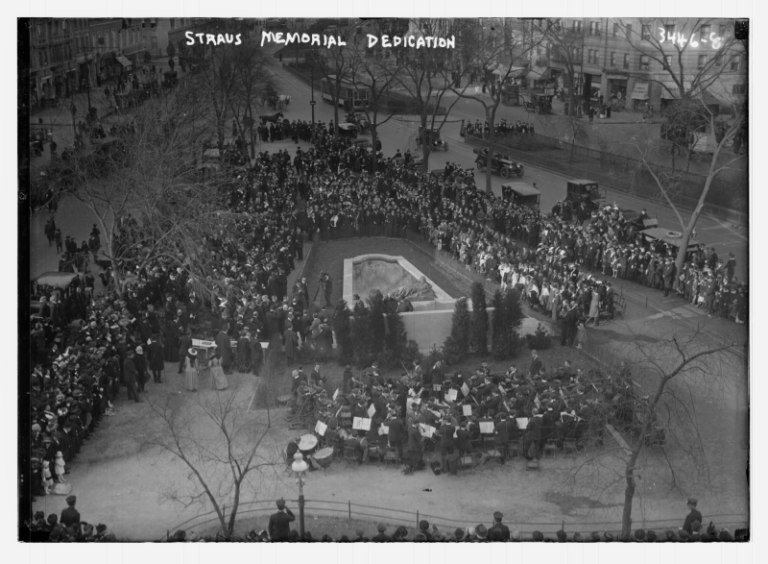
A small memorial was erected in Manhattan, located off of 106th Street. The landscaped plot, aptly christened Straus Park, bears a bronze statue of a water nymph that once gazed upon a reflecting pool. This water feature was transformed into a flower bed in the 1990s with the consent of the Straus family.

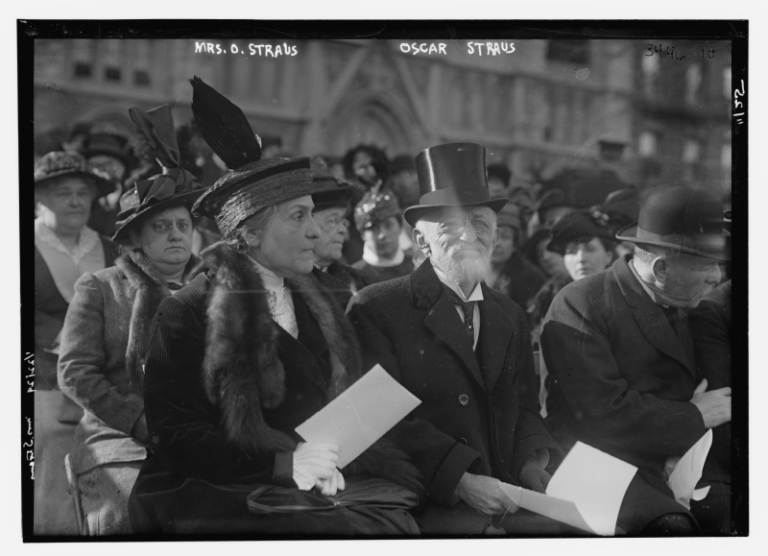
Straus Park was dedicated on April 15, 1915, exactly three years to the date of the Titanic disaster. Isidor’s younger brother, Oscar, was one of many in attendance.

Dedication of Memorial to Isidor & Ida Straus on April 15, 1915. Courtesy of Library of Congress.

PUBLIC DOMAIN

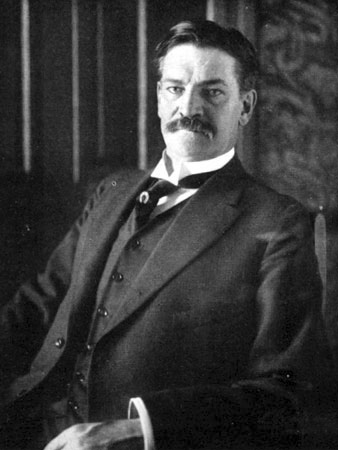
Isidor's brother, Oscar Straus, at the dedication to the memorial of Isidor & Ida Straus on April 15, 1915. Courtesy of Library of Congress.

PUBLIC DOMAIN

Isidor Straus was laid to rest in the couple’s mausoleum in the Bronx. Because Ida’s remains were not recovered, the Strauses collected ocean water from the wreck site in an urn and interred it beside Isidor.

The Straus mausoleum is thusly engraved.

Many waters cannot quench love -- neither can the floods drown it.

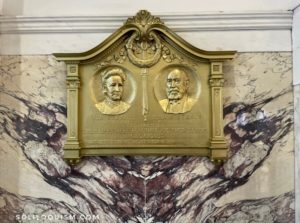
In 1913, approximately 5,000 Macy's employees donated their meager wages toward a memorial plaque for the Strauses, who were much beloved, particularly Isidor.

It's been reported that "'Mr. Isidor,' as he was known, regularly walked the shop floor, a pink carnation boutonnière stuck in the lapel of his dark suit jacket as he greeted workers by name."

The memorial plaque was re-dedicated in 2014 at the so-named "Memorial Entrance" on 34th.

It reads, "Their lives were beautiful and their deaths glorious."

Memorial plaque at Macy's 34th Street Entrance.

© soliloquism, 2022

Open post

“So That We Might All Live Happily Together”: Michel Navratil & ‘The Titanic Orphans’

"So That We Might All Live Happily Together": Michel Navratil & 'The Titanic Orphans'

Michel Navartil, 32, was a Slovakian tailor who had been living in Nice, France, when he married Marcelle Caretto in 1907. They had two sons, Michel Jr. and Edmond, nicknamed Lolo and Momon by their parents.

Michael Navratil, taken prior to his voyage on Titanic in 1912.

PUBLIC DOMAIN (Photo taken prior to 1923)

By 1912, Michel's business was struggling, and he suspected Marcelle, 21, of cheating on him, so they separated. Even though the boys, 4 and 2 years old, were in the custody of Marcelle, she let Michel take them for the Easter break.

Thing is, Michel had no intention of returning them.

After a stopover in Monte Carlo, he brought them to England, where he bought three second-class tickets on Titanic. He registered himself as Louis M. Hoffman--the name of a friend who helped him accomplish the abduction--and registered his boys as "Louis" and "Lola". They boarded at Southampton.

Titanic departing Southampton on April 10, 1912. Courtesy of the National Maritime Museum, Greenwich, UK.

PUBLIC DOMAIN

When asked, "Mr. Hoffman" told other passengers that he was a widower, and aside from a cardgame during which he let a Swiss girl babysit them, he never let them stray from his side. He wrote back to his mother in Hungary, hoping that his sister and brother-in-law would help take care of the boys if they were not permitted or able to stay in America.

Michel, Jr., had no notion of any wrogdoing on his father's part. He recalled that Titanic was

A magnificent ship! ...I remember looking down the length of the hull... My brother and I played on the forward deck and were thrilled to be there. One morning, my father, my brother, and I were eating eggs in the second-class dining room. The sea was stunning. My feeling was one of total and utter well-being.

On April 14, upon learning of the collision, a still unidentified passenger helped Michel dress the boys and bring them up on deck.

Michel, Jr., said of his father and the stranger carrying them up on deck, "When I think of it now, I am very moved. They knew they were going to die."

The only lifeboats left were the 4 collapsibles, and the only one secure and ready to go was Collapsible D, presided over by Second Officer Charles Lightoller.

Collapsible D, which contained the Navratil boys, as taken from on board Carpathia on April 15, 1912.

PUBLIC DOMAIN

Officer Lightoller was gravely serious about the "Women and Children" order. Due to the maddened crush of third-class passengers--most of them men--Lightoller had ordered a locked-arm circle around the lifeboat, so only women and children could board.

Michel passed his little sons through to be minded in the boat.

Even in his later years, Michel, Jr., recalled his father's last words to him.

"My child, when your mother comes for you, as she surely will, tell her that I loved her dearly and still do. Tell her I expected her to follow us, so that we might all live happily together in the peace and freedom of the New World."

We know a little bit about Michel's and Edmond's night in Collapsible D not from Michel's recollections, but from First-Class passenger Hugh Woolner. Hugh and another passenger had taken their chances together and jumped down into Collapsible D when they noticed room in the bow portion of the lifeboat.

Hugh testified in the American Inquiry, and he recalled how distraught young Michel was.

A sailor offered some biscuits, which I was using for feeding a small child who had waked up and was crying. It was one of those little children for whose parents everybody was looking; the larger of those two... I should think it was about 5, as nearly as I can judge... It looked like a French child; but it kept shouting for its doll, and I could not make out what it said before that. It kept saying it over and over again.

Michel Navratil, Sr., did not survive to be reunited with his sons. His body was recovered and listed as follows.

NO. 15 - MALE - ESTIMATED AGE 36 - HAIR & MOUSTACHE, BLACK
CLOTHING - Grey overcoat with green lining; brown suit.
EFFECTS - Pocket book; 1 gold watch and chain; silver sov. purse containing £6; receipt from Thos. Cook & Co. for notes exchanged; ticket; pipe in case; revolver (loaded); coins; keys, etc; bill for Charing Cross Hotel (Room 126, April 1912).
SECOND CLASS NAME - LOUIS M. HOFFMAN.

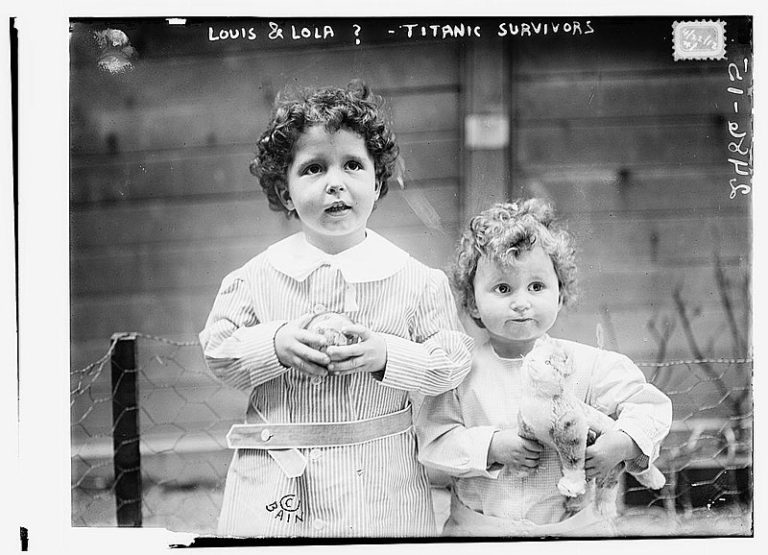
"Louis" and "Lola" were the only orphaned survivors of Titanic. And like other young children, they were hauled on board in burlap bags.

On board Carpathia, it was realized that they only spoke French. Survivor Margaret Hays was concerned that the brothers would be separated, so she offered to take them under her care in New York City. The boys spent most of their time playing with Lady, Hays' little Pomeranian, which was one of only three dogs to survive the sinking.

Michel (left) and little Edmond with his toy cat. From the George Grantham Bain Collection, courtesy of Library of Congress.

PUBLIC DOMAIN

In New York, the boys were motherless for some time. According to contemporary newspaper articles, they only answered "oui" to inquiries from Consul representatives, and as little children are prone, they were much more interested in playing with their new toy boats.

The following was reported in "No Light on the Mystery Hiding the Identity of Two Waifs of the Sea," an article published in the Evening World dated April 22, 1912.

Under the shadow of a giant azalea they sat yesterday afternoon, each with a brand-new boat in hand with which they entertained themselves while the French Consul to New York strove vainly to extract some enlightening word from the elder boy, whose age has been given as three and a half.

To every question the little curly haired chap replied with a polite and baffling "Oui" and said nothing more.

   "Do you like to play with your boat?" asked the Consul, taking the little fello [sic] on his knee.
   "Oui," came the monotonous reply.
   "What city do you come from?"
   "Oui."
   "Do you remember the big boat that brought you away from France?"
   "Oui."

Yet the children are by no means stupid. They are sweet, well-mannered, gentle little fellows, and my only hope for them is that having survived the perils of the iceberg and the open sea they may not be adopted by some American family which was born with a gold knife in its mouth.

For what it's worth, the author of this particular article also found the gifts of little toy boats a bit untoward, writing, "Probably I am the only person to whom it seemed in the least incongruous that these two babies should be playing with brand new tin boats."

Edmond (left) and Michel with their toys.

PUBLIC DOMAIN

Many photos were taken of "Louis" and "Lola" to be circulated worldwide. But in addition to their inability to speak English, the boys had been given fake names by their late father, so tracking down their mother was proving impossible.

When asked if the orphans could be traced via their father's tickets, Margaret Hays' father illustrated the fatal class divide perfectly in his response. "I have never travelled second cabin or steerage," he said, "so I don’t know anything about such matters."

Michel, Jr., recounted coming to the realization that, had they not been in Second Class, he and his brother would surely have died.

Michel (left) and Edmond. Courtesy of the National museum of the U.S. Navy.

PUBLIC DOMAIN

Meanwhile, in France, their mother Marcelle was desperately, frantically searching for her sons with no leads. She was entirely unaware that they had even left the country, let alone sailed on the Titanic.

Marcelle knew nothing of the so-called 'Titanic Orphans' until she saw their photos in a newspaper. Marcelle sailed to New York City courtesy of the White Star Line, and was reunited with her boys on May 16, 1912.

Permitted to meet them alone, she found Michel reading an alphabet book on a window seat, and Edmond on the floor, playing with puzzle pieces.

Growing wonder spread over the face of the bigger boy, while the smaller one stared in amazement at the figure in the doorway. He let out one long-drawn and lusty wail and ran blubbering into the outstretched arms of his mother. The mother was trembling with sobs and her eyes were dim with tears as she ran forward and seized both youngsters.

She reportedly was asked if she would talk to them about Titanic, and said, "I do not want them to think about that," she said. "They must only be happy from now on—only happy; no more distress."

Michel and Edmond reunited with their mother. Courtesy of the Library of Congress.

PUBLIC DOMAIN

Edmond died in 1953, after having served in the French Army in WWII.

Michel, Jr., accomplished a doctorate in philosophy, and was a professor. He was one of the longest-lived survivors, and the last-living male survivor. He died in 2001, having said throughout his life that since four years old, he had "been a fare-dodger of life. A gleaner of time."

Because of the fake surname he used when boarding, Michel Navratil Sr. was interred in the Halifax cemetery that was designated for Jewish victims. The headstone has since been replaced to reflect his true identity.

Open post

“Just Like Little Canaries”: Victor & Maria Josefa Penasco

“Just Like Little Canaries”: Victor & Maria Josefa Penasco

Victor Peñasco y Castellana, born October 24, 1887, was just 24 years old and newly wed when he boarded the RMS Titanic at Cherbourg.

Young Victor was kind and athletic. He was also spectacularly wealthy, and family to the minister of the King of Spain.

And on December 8, 1910, Victor married Maria Josefa Perez de Soto y Vallejo, an heiress who was two years his junior and affectionately called Pepita. Their combined affluence ballooned to obscene proportions.

By all accounts, the newlyweds were carefree, pretty, and very much in love.

Victor and Pepita spent almost two years on their honeymoon, leaving a trail of receipts for precious gemstones throughout Europe. Because Pepita loved herself some fancy jewelry.

While whiling away in Paris, they happened upon a flyer for Titanic's maiden voyage. They longed to extend their honeymoon a little further by going to New York, but Victor's mother, Purificacion, had forbidden ocean travel--it was a truth universally acknowledged that it was very bad luck on one's honeymoon.

So the Penascos had their butler, Eulogio, stay behind in Paris, and left him with a collection of pre-written postcards to be sent intermittently to Victor's superstitious mother, boasting of trips to Notre Dame Cathedral, the Palace of Versailles, and the opera.

Victor and Pepita then absconded to have some fun in New York and return in secret. Purificacion would be none the wiser.

Victor Penasco y Castellana.

PUBLIC DOMAIN

The Penascos boarded Titanic with Pepita's maid, Fermina, on the evening of April 10, 1912. The party occupied stateroom C-65.

They were not the only Spanish passengers, but they were the only ones in First Class.

Reports vary as to the Penascos' fluency in English, but multiple sources say they spent most of their time speaking with their fellow Spanish-speaking passengers. And there would have been a number, particularly from Argentina and Mexico.

Victor at the very least must have been proficient in the English language, but historical accounts reflect that Pepita was not.

Regardless of any language barrier, Victor and Pepita were apparently the darlings of any First Class coterie that beheld them.

Survivor Helen Bishop said of them, "[Pepita] and her husband were just like little canaries... …They were so loving… and were having such a happy honeymoon that everyone on the Titanic became interested in them."

On the night of the collision, Victor and Pepita were readying themselves for bed. Fermina, Pepita’s maid, had stayed awake because Victor and Pepita were late returning from dinner. Working to mend a corset while waiting to tend to the couple, Fermina felt a jolt and a shudder.

She immediately alerted Victor and Pepita. Later, Pepita would attest that the impact was so faintly felt that not a drop had spilled from a bedside glass of milk.

Victor dressed himself and left to seem information from officers. Met with the grim news, he hurried to collect Pepita and Fermina.

Victor outfitted his wife and Fermina with lifebelts and hurried to escort them to the boat deck.

Victor the ladies into the care of Second Officer Charles Lightoller, who was preparing to lower in Lifeboat 8.

It became a vessel well-known as the site of multiple lovelorn declarations that occurred that night--in particular, that of Isidor and Ida Straus.

Isidor & Ida Straus, who lost their lives in the Titanic disaster and remain its most famous love story.

PUBLIC DOMAIN

Rumor has it that Victor dashed back below deck for his wife's famed jewels. When he returned, he implored Pepita to get into the lifeboat, but in tears, she refused.

Speaking Spanish, in the midst of heartbreak and chaos, no one understood the exact words of their desperate exchange.

But the Countess of Rothes did try.

The Countess's cousin, Gladys Cherry, recalled the Penascos parting as a "terrible scene."

As patience in the waiting lifeboat wore thin, the Countess gently interceded in French, which she recalled in her letter to Walter Lord, the author of "A Night to Remember."

Pepita was no less inconsolable for the Countess’s polite intervention. Finally, according to Gladys, Victor "threw [Pepita] in our arms and asked us to take care of her."

There is the occasional report that Victor was last spotted on the boat deck, taking to his knees in prayer.

But he was never seen again.

Pepita wailed and wailed for him as the boat descended and pushed away from Titanic.

The Countess of Rothes described her time with Pepita in heartrending detail in the April 21, 1912,  issue of the New York Herald.

Then Signora de Satode Penasco began to scream for her husband. It was too horrible. I left the tiller to my cousin and slipped down beside her to be of what comfort I could. Poor woman! Her sobs tore our hearts and her moans were unspeakable in their sadness.

As the darkness bore down and the women rowed Lifeboat 8, the Countess of Rothes continued to try to comfort Pepita, who was beside herself with grief.

When the awful end came, I tried my best to keep the Spanish woman from hearing the agonizing sound of distress. They seemed to continue forever, although it could not have been more than ten minutes until the silence of a lonely sea dropped down. The indescribable loneliness, the ghastliness of our feelings never can be told.

When the rescue ship Carpathia deposited the survivors in New York, Victor's mother had no idea her son and daughter-in-law had sailed, let alone that her son had died.

It's said she found out via a Madrid newspaper, and was as baffled as she was heartbroken. How could it be true, when she'd been receiving her son's postcards from Paris all along?

A suit owned by Victor Penasco y Castellana. Courtesy of Titanic: The Exhibition, New York City, 2022.

© soliloquism

Soon, the bereft family of Victor Penasco was soon faced with financial dilemma on top of the tragedy of his loss.

Contemporary Spanish law dictated that even though Pepita was legally widowed, she could not inherit Victor's fortune.

This was because without a body as proof of death, Victor could not be declared deceased for 20 years.

So unless Victor’s remains were found, their combined downries eould remain bound and untouchable in a savings account.

Figuratively cornered by the law, the family made an unusual choice: they bribed someone.

According to descendants, Victor’s family supposedly bought an unnamed victim's corpse, Fermina then identified it as Victor, which was substance enough to issue the death certificate.

However it happened, the result was the same: Pepita, though grieving, was that much wealthier.

Pepita married again about 6 years later and had three children; Fermina continued to work for her through retirement.

Pepita died at the age of 83.

Open post

“Lead, Kindly Light”: Noel Leslie, the Countess of Rothes

"Lead, Kindly Light": Noel Leslie, The Countess of Rothes

The Countess of Rothes, whose name was Noel Lucy Martha Leslie, was reknowned for her beauty, her gracefulness on the dance floor, her lifelong philanthropy. But when it comes to Titanic, she is famed for her relentless optimism and being the fiercest woman on the sea.

Noel was 33 when she boarded Titanic with her parents, cousin-in-law Gladys Cherry, and maid Roberta Maioni, at Southampton. Before setting sail, she was interviewed and stated that she was going to America to see her husband, and that they hoped to purchase a pretty little orange grove.

When the reporters derisively asked her if she looking forward to leaving the glamour of London society for a "California fruit farm," she replied, "I am full of joyful expectation."

The Countess's parents disembarked at Cherbourg, and the others carried on.

On April 14, the crash woke the ladies in their suite, and they sought out Captain Smith, who insisted they immediately find lifevests and head for lifeboats. The three were put into Lifeboat 8 around 1am, which was launched off the port side.

Captain Smith put approximately 4 men with experience at sea in Lifeboat 8; unfortunately, they were experienced stewards and the like, not sailors. After they had lowered, and were attempting to push themselves out from Titanic, the ladies on board were critical of their ineptitude, and it certainly didn't help.

Doing their damnedest, stressed, scared, and frustrated, it was reported by a Mrs. White at the Senate Inquiry that one crewman said to another, "If you don’t stop talking through that hole in your face, there’ll be one less in this boat."

The person this vitriol was directly at was Thomas Jones, the lone seaman in Lifeboat 8, only 32 years old, who had been assigned to it by Captain Smith at the last minute. But it was the Countess who immediately took charge.

Jones famously said of the Countess that, because he had to row, "she had a lot to say, so I put her to steering the boat."

And she damn well did, stopping only briefly after an hour so she could take to comforting a fellow passenger, an almost-teenaged newlywed, who was distraught about leaving her husband.

The Countess said "the most awful thing was seeing the rows of portholes vanishing one by one" beneath the water, and later, the sounds of the dying, and the eventual absence of sound from the dead.

She, Tom Jones, and some others wanted to row back for more people, but were overruled for fear of the boat being overturned. Tom Jones is remembered as having said, "Ladies, if any of us are saved, remember, I wanted to go back. I would rather drown with them than leave them."

Tom's comment about the Countess having "a lot to say" has been intepreted in recent memory as snide, or some sort of punishment for a woman daring to speak out of turn, but he meant it in earnest. He said, "I heard the quiet, determined way she spoke to the others, and I knew she was more of a man than any we had on board.”

According the the Countess herself, "We were lowered quietly to the water, and when we had pushed off from the Titanic's side I asked the seaman if he would care to have me take the tiller, as I knew something about boats. He said, 'Certainly, lady.'"

At the subsequent inquiries, the Countess also made sure to emphasize that Thomas had wanted to turn the boat back.

If that isn't sufficient to refute the impression that Jones was being vindictive, the Countess bestowed an engraved silver pocket watch upon Thomas Jones in gratitude for his saving their lives. In reciprocation, he sent her the plaque from Lifeboat 8. They remained friends for the rest of their lives, writing to one another every Christmas; the Countess's letter was always sent with a pound enclosed, according to Jones's daughter. The plaque and pocketwatch now both belong to the Countess's family.

The Countess of Badass rowed, alternating with other women, through the night. When the rescue vessel Carpathia was finally sighted, the boat began singing "Pull for the Shore" and "Lead, Kindly Light."

Once on board Carpathia, the Countess was intent on helping steerage survivors, in translating, acquiring medicine, and making clothes. The London periodical Daily Sketch reported, "Her Ladyship helped to make clothes for the babies and became known amongst the crew as the 'plucky little countess.'"

According to her great-granddaughter, Angela Young, The Countess wrote a letter to her own parents, detailing her many busy hours on board Carpathia. In that letter, Noel wrote that she worked closely with the doctors to help feed the children on board so their mothers might recuperate. She was also sought out by the doctors to aid in calming a "hysterical" French woman who they feared might commit suicide; in addition, the young widow Pepita Penasco, who the Countess had comforted in the lifeboat, clung to her "like a baby" as she spoke no English and knew not a soul but one in America.

It further reported that a stewardess had lauded the Countess, telling her, "You have made yourself famous by rowing the boat."

Noel Leslie, Countess of Rothes, replied, "I hope not. I have done nothing."

Open post

“Surrounded by Mothballs and Memories”: Quigg Baxter & Berthe Mayne

"Surrounded by Mothballs and Memories": Quigg Baxter & Berthe Mayne

The Baxters--matriarch Helene, her daughter Zette, and her son, Quigg--were an affluent family from Montreal. They had been traveling Europe through 1911, after Helene had sold her property in Montreal to absolve herself of her late husband's embezzling. I guess that's what you get when you marry yourself a man nicknamed "Diamond Jim."

Zette, 27, was married, and defied her husband's wishes by traveling with her family.

Quigg was 24, and had been a lauded football and hockey player back in his school days, until he was blinded by a stick to the eye in 1907. He continued to coach, though, and even set up one of the first international hockey tournaments in Paris.

Whiling away in a cafe in Brussels, Quigg met a young cabaret performer named Bella Vielly. Her real name was Berthe Antonine Mayne, and she was "well known in Brussels in circles of pleasure."

Quigg was mad about her, and they quickly fell into a secret affair. When he learned his family was returning stateside, he pleaded with Berthe to come back with him. She relented, and he purchased a ticket separate from and unknown to his family, installing his lover in a first-class cabin on C-Deck under the name Mme. De Villiers, a throwback to a prior lover of hers named Fernand de Villiers, a soldier in the French foreign legion who was eventually sent off to the Belgian Congo.

Helene Baxter had spent most of the journey on Titanic laid up with seasickness and nausea, and suffered weakness as a result.

When Titanic struck the iceberg, Quigg sought to discover what happened, and in so doing came across Captain Smith and Bruce Ismay in the hall. Captain Smith told him everything was just fine; Ismay, on the other hand, demanded that Quigg get his mother and sister to the lifeboats.

Helene had an anxiety attack when Titanic ceased moving, having taken comfort in the constant turning of the engine. Quigg carried his mother in his arms to the boat deck, and loaded her and his sister into Lifeboat 6.

He then went to fetch Berthe, and in what must have been the world's worst time to meet your future mother-in-law, Berthe was introduced to the Baxter women.

She did not want to get into the lifeboat, but Molly Brown helped persuade her. Quigg asked his mother and sister to be good to Berthe, and handed his mother his silver brandy flask. Now, the Baxter children had been raised to speak English to their father, and French to their mother, but it's reported that when he gave Helene the flask to keep warm with, she started in on him,wishing he wouldn't drink so much. But Quigg cut her off to ask if she was alright, and then bid everyone fare well.

Quigg Baxter died in the sinking. His body, if recovered, was never identified.

Helene Baxter never fully recovered from Titanic, and died in 1923. Zette moved to California, and according to her nephew, lived "surrounded by mothballs and memories" until her death on the last day of 1954.

And Berthe, the benefactor of the family's last promise to dear Quigg, stayed with the Baxters in Montreal for some time before returning to performance in Paris. She never married.

As an elderly woman, she told fanciful, ridiculous stories about having sailed on Titanic with a tragic Canadian millionaire, which no one in their right mind would believe. Until after her death in 1962, when her nephew discovered a curious shoebox among her effects.

SOURCE MATERIAL
[ital]

Open post

“See You Soon, Darling”: Joseph & Juliette Laroche

"See You Soon, Darling": Joseph & Juliette Laroche

Joseph Phillipe Lemercier Laroche was a gifted engineer from Cap Haiten, Haiti.

He was the only known black passenger on Titanic.

Joseph was 25 years old when he boarded Titanic in Cherbourg, France. He traveled with his two young daughters, Simone and Louise, and his wife Juliette, who was pregnant with their third child.

Joseph Laroche was born in Haiti in 1886. His mother, Euzelie, was 24 years old and a wildly successful business woman who made her substantial wages in trade. She was also a single mother.

Joseph was Euzelie's only child, and she prioritized her son's education. When she was absent and he was not in school, he attended cockfights and won handily in games of marbles with his friends. He was remembered as good-natured, but not particularly talkative.

Time wore on, and Joseph had been sent to study in France at just 15 years old with his teacher, Monsignor Kersuzan, Lord Bishop of Haiti.

And in the course of his studies in France, Joseph made a fateful connection. During an outing to the Parisian suburb of Villejuif, Joseph made friends with another young man named Maurice LeFargue. After a chat, Maurice invited Joseph back to his father's house for some food and drink.

Joseph certainly enjoyed the meal, but took even more pleasure in meeting the person who had prepared it: Maurice's sister, Juliette.

Within minutes, Joseph and Juliette were evidently besotted, and by the end of the meal, they had promised to write each other while he continued his studies a distance away. Soon enough, he was spending weekends with the LeFargues.

Joseph married Juliette on March 18, 1908, when he was 22 years old and she, 19. The ceremony was held at the local church in Villejeuf. At the reception, Joseph led his bride in a dance, and even showed his skills dancing the merengue.

Now a married man, Joseph immediately undertook an intense job hunt. His application was at last accepted by the company Nord-Sud, a company that possessed a contract for the "underground electric railway" being drawn up for Paris.

The Laroche family.

PUBLIC DOMAIN

Joseph's first daughter, Simone, was born in 1909, to her parents' joy.

Louise, the younger of their girls, was born in 1910.

Joseph sought higher paying positions to help cover incurred expenses, but despite his familial pedigree, connections, and remarkable resume, he was refused time and again because he was black.

In 1995, Joseph's daughter Louise spoke candidly about her father's experience.

In the only interview she gave in 1995, in which she briefly mentioned the subject, Louise Laroche explained that her father faced "racial prejudice" at that time. "Joseph would find small jobs, but his employers always claimed that he was young and inexperienced, so they could pay him low wages."

From "Black Man on the Titanic: The Story of Joseph Laroche," by Serge Bile. © 2019.

Low on options, Joseph and Juliette decided to move for their fiscal well-being, and were set to return to Haiti in late 1912 or early 1913.

But the timeline became urgent when Juliette found herself pregnant again.

With a job as a math instructor secured for Joseph by his eminent uncle Cincinnatus LeConte, the then-President of Haiti, the LaRoches were gifted tickets on the SS France by Joseph's mother, who was ecstatic that her son and his babies were at last coming home. She had never met her daughter-in-law or her grandchildren.

Joseph and Juliette soon found out, however, that vessel France had strict on-board rules about not allowing children to dine with their parents. The Laroches found this policy unfeasible for their situation--not to mention cold and unnecessary--so they exchanged their tickets for second-class passage on Titanic.

The family would travel from Paris to the port of Cherbourg by a luxury train called the New York Express.

April 10th was a bright day in France, and little Simone Laroche was all aflutter with excitement for the travel ahead.

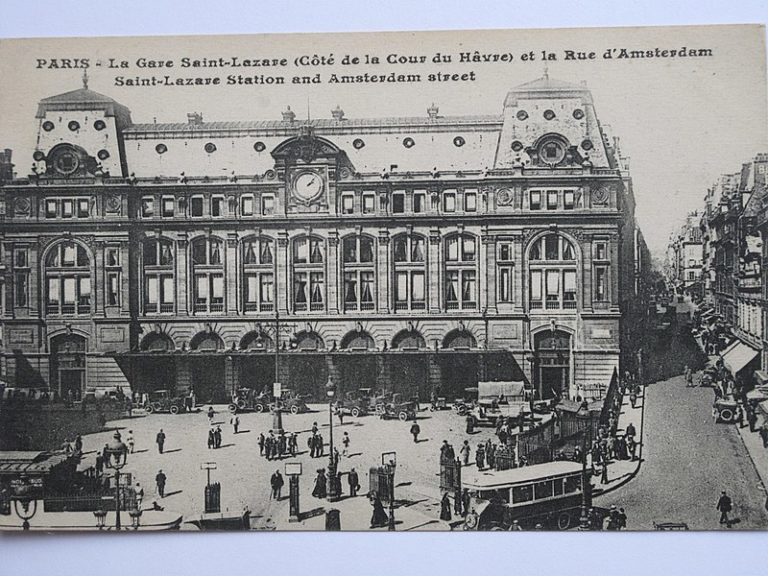
After breakfast that morning, it is reported that Joseph and Juliette hired two taxicabs--both Renaults AG1s--for transportation to Gare Saint-Lazare, which was less than an hour from their home. Joseph and Simone took the first cab, while Juliette and Louise followed in the second.

Simone was giddy with anticipation upon her family's arrival at the train station, and while her father paid the taxi fare, the elder Laroche daughter ran ahead. Joseph called out and scolded her in Haitian Creole, as was his custom when his children were not behaving. Though Simone did not fully understand the language, she immediately obeyed her father.

At the station, a family friend named Monsieur Renard arrived to see off the Laroches. He brought with him a gift of two balloons--one for Simone, and one for Louise. Although Louise lost hers shaking the string, Monsieur Renard gallantly purchased a replacement.

La Gare Saint-Lazare circa 1910.

PUBLIC DOMAIN

The New York Express, exclusively designated for the transport of First- and Second-Class passengers of Titanic, departed at 9:45am.

Once settled on the train, Joseph and Juliette struck up a friendship with a young couple from Canada.

Albert Mallet was an importer of cognac for a liquor firm, and he traveled to Paris often for work; he, his wife Antonine, and their toddler Andre were traveling back to Quebec after a short visit with family. Joseph and Albert chatted the whole way as their wives did the same, and their children played.

The Mallets, as it turned out, had likewise exchanged their tickets on the SS France for passage on Titanic, and for the very same reason that had compelled the Laroches: it simply was not feasible to dine without their children.

And with that, the voyage appeared to have started well. Bound for a ship on which most people would speak only English, the Laroche family had made fast friends with another French-speaking family of similar age.

Juliette wrote a letter to her papa while on board Titanic, which was postmarked from Queenstown, Ireland, on April 11th. It reflected a pleasant time, and Juliette wrote of the ongoing kindnesses of fellow passengers.

The girls ate well last evening. They slept in one stretch the whole night and were awoken by the bells announcing breakfast; those made Louise laugh.

Right now, they are walking on the covered deck with Joseph. Louise is in her small car, and Simone is pushing her. They have already made acquaintances: since Paris, we have traveled with a gentleman and lady and their little boy, who is the same age as Louise. I believe they are the only French on board. So, we sit at the same table and like this we can chat.

Simone amused me earlier; she was playing with an English girl who had lent her a doll. My Simone was having great conversation, but the little girl could not understand anything. People are very nice on board. Yesterday, they were both running after a gentleman who had given them chocolate.

From "Black Man on the Titanic: The Story of Joseph Laroche," by Serge Bile. © 2019.

The couple to whom Juliette referred in her letter were, of course, the Mallets.

It is worth noting that there is little in the way discoverable first-hand accounts regarding racial treatment of the Laroche family while they were on board Titanic.

As a young interracial couple, it is assumed that they must have endured racism to an unquantified degree; their marriage, so full of devotion and strength, was neither commonplace nor socially acceptable by the standards of the era.

And yet, Joseph and Juliette paid this no mind. Their love, and their loving family, were all that mattered to them both. By all accounts, their company was warm, jovial, and accepting, and other passengers delighted in the presence of their sweet little girls.

Simone and Louise Laroche are mentioned, though not by name, in a letter written by fellow Second-Class passenger Kate Buss. "There are two of the finest little Jap[anese] baby girls, about three or four years old, who look like dolls running about."

The racism is there, even in a private letter. The Laroche daughters were not Japanese, but this was not a mistaken assumption on the account of Ms. Buss; it was a generic term of disparagement. At the time, people with not-white complexions were often called "Japanese" or "Italian".

By all accounts, Simone and Louise seemed to be having a gleeful time, but they missed their grandfather. Juliette also wrote the following to her papa.

I am going to stop [writing] because I think we will stop over soon, and I would not like to miss the mail service. Thank you, again, dear Papa, for all your kindness. Please receive the best kisses from your daughter who loves you. Little Simone and Louise send big kisses to their good grandfather. After getting dressed this morning, they wanted to see you.

From "Black Man on the Titanic: The Story of Joseph Laroche," by Serge Bile. © 2019.

April 14th was a Sunday, and the Laroches attended religious services presided over by Father Thomas Byles, a fellow passenger and Roman Catholic priest.

That night, Joseph answered his cabin door to find a steward demanding the family don their life vests and get up on deck with urgency. Joseph woke his wife, and she exited the cabin with Simone in her arms.

Joseph snatched his coat, and stuffed its pockets with their money, jewelry, and paperwork. Then he swaddled tiny Louise inside it, and chased after his wife.

On deck, Joseph gripped Louise in one arm, and clung to an unnamed sailor who was holding men back from entering the lifeboat with the women and children. Joseph, who was fluent in both English and French, somehow managed to secure a spot in for his bewildered wife and their children amidst the chaos.

Some accounts claim that Juliette entered Lifeboat 14. Others believe that it was Lifeboat 8, because Juliette recalled that a countess was in the boat with them, which many suspect was Noel Leslie, the Countess of Rothes.

Juliette recounted the memory with desperate pain.

When the collision happened, there was terrible panic. People were pushing, in a hurry to get off the boat. Suddenly, I felt that they were pulling my older daughter away from me, my little Simone... I saw her thrown to a lifeboat suspended above the abyss. "My child," I yelled. "My child! It is my child that was taken away!"

But right at that instant, I felt someone grabbing me as well. A pair of hands took me, and threw me into emptiness. I found myself in the lifeboat, next to my little Simone, and up there, on the deck, in the middle of the scramble, I glimpsed my husband. Arms extended above the crowd, he was holding our younger girl, whom he was trying to protect against the push. He was struggling against the sailors, showing them the little girl and trying to make them understand that she was separated from me, her mother. At last someone grabbed our little Louise from my husband's hands, and soon she was in my arms.

Then the lifeboat was once and for all lowered onto the sea. I hardly had time to bid my husband a final farewell. I heard his voice, above the rumble, yelling: "See you soon, darling! There will be space for everyone, don't worry, in the lifeboats... Take care of our girls! See you soon!"

From "Black Man on the Titanic: The Story of Joseph Laroche," by Serge Bile. © 2019.

There is no record of Joseph Laroche's last moments.

His body was never recovered.

Survivors on board the rescue ship Carpathia, courtesy of the Library of Congress.

PUBLIC DOMAIN

When the Carpathia arrived on scene, the little Laroche girls were hoisted aboard in burlap bags.

Juliette, already surmising Joseph had died, did her best to remain level for the sake of her daughters. For instance, diapers were predictably absent on Carpathia. Juliette discreetly hoarded cloth napkins by sitting on them during mealtime, in order to use them later as makeshift diapers.

The coat that had kept Louise warm--and which Joseph had been present enough to stock with the family's valuables--is reported to have been stolen on board the Carpathia.

The rescue ship Carpathia docked at Pier 54 in New York City, April 18, 1912. George Grantham Bain collection, courtesy of the Library of Congress.

PUBLIC DOMAIN

After the Carpathia docked in New York City, Juliette was transported to St. Vincent's Hospital and treated for her frostbitten feet.

Once she had recovered, Juliette and the girls returned home to France via liner on the morning of May 2, 1912.

According to "Le Matin," the local newspaper, Juliette's father, "an old man in mourning clothes," waited anxiously at the dock for the disembarkment of his bereaved daughter and grandchildren.

When they found each other, Juliette withered in her papa's arms, sobbing.

When Mrs. Laroche and her two daughters appeared on the gangway, the old man ran to them and father and daughter hugged for a long time, teary-eyed. Mrs. Laroche then recounted that at the time of the catastrophe, she and her two little girls had been forced to leave her husband behind. He'd tried to reassure her, affirming that he would be rescued just like her--only a little later. Crying, the poor woman repeated several times: "I believed him! I believed him! Otherwise, I would have never agreed to leave him!"

From "Black Man on the Titanic: The Story of Joseph Laroche," by Serge Bile. © 2019.

On May 24, 1912, Juliette held a memorial service for Joseph in Villejuif. To every mourner, she distributed a card, which had Joseph's photo on it surrounded by a black band.

It read only, "Please pray for the repose of the soul of Joseph Laroche, who passed away on April 15, 1912, in the sinking of the Titanic."

Joseph would have turned 26 only two days later, on May 26.

Juliette gave birth to a boy around Christmastime, 1912; he was named after his late father.

Destitute, heartbroken, and tragically widowed with three children all under the age of 5, Juliette Laroche sued the White Star Line for damages, and was awarded 150,000 francs in 1918--approximately $250,000 today. Juliette used the funds to open a dry-cleaning business operating out of her father's house.

Joseph's mother traveled to France in 1920 to meet her grandchildren at last. Sadly, Juliette never traveled to her late husband's home in Haiti.

Juliette reportedly never spoke of Titanic with anyone except  fellow survivors Antonine Mallet and Edith Russell, the latter of whom she had met in Paris. For a number of years thereafter, Juliette received a small gift from Edith every April 15th, on the anniversary of the sinking.

Edith Russell, fellow Titanic survivor and friend to Juliette LaRoche.

PUBLIC DOMAIN

Juliette Laroche never remarried.

She died in 1980 at the age of 90.

SOURCE MATERIAL

Bile, Serge. "Black Man on the Titanic: The Story of Joseph Laroche." Mango Publishing, 2019.

https://www.wellesley.edu/news/2020/stories/node/175636

https://titanichistoricalsociety.org/miss-louise-laroche/

Open post

“I Can Look Back and See Every Detail”: Lawrence Beesley

“I Can Look Back and See Every Detail”: Lawrence Beesley

Lawrence Beesley was an accomplished science teacher, having graduated from Cambridge with honors in 1902. And while doing his post-grad at his first assignment at a grammar school, he discovered a rare algae that was named after him, called Ulvella Beesleyi.

Lawrence then went on to take a job at Dulwich College in London, where one of his students was future novelist Raymond Chandler.

Lawrence Beesley and his students.

PUBLIC DOMAIN (photo taken & published prior to 1923)

Lawrence's wife passed away at only 37 years old. They had one child, Alec, who would grow up to marry Dodie Smith, the author of "101 Dalmatians".

So in 1912, after two years of grief and personal upheaval, Lawrence decided to take a long-overdue holiday to see his brother in Toronto.

Second-Class entrance on R.M.S. Olympic, circa 1911. Courtesy of Bedford Lemere & Co.

PUBLIC DOMAIN

Beesley boarded the Titanic as a second-class passenger on April 10, 1912, in Southampton.

His accommodations were ideally suited to his tastes. He wrote, “I had been fortunate enough to secure a two-berth cabin to myself, - D56, quite close to the saloon and most convenient in every way for getting about the ship."

Like any true academic would, Beesley mused extensively in his memoir of the disaster--the very first published--about the Second-Class library, which he visited on the afternoon of April 14, 1912.

I can look back and see every detail...the beautifully furnished room, with lounges, armchairs, and small writing or card tables scattered about, writing bureaus round the walls of the room, and the library in glass-cased shelves flanking one side—the whole finished in mahogany relieved with white fluted wooden columns that supported the deck above.

Excerpt from "The Loss of the S.S. Titanic" by Lawrence Beesley, published in 1912.

Beesley was reading in his room when the collision happened. Being on D Deck and above the point of impact, and with Titanic being so large, he felt it as nothing more than "an extra heave of the engines" and thought maybe the ship has sped up.

It wasn't until the incessant white noise of the engines stopped entirely, and Beesley noticed that the top of his mattress was no longer vibrating with their churning, that he knew something was wrong.

The Second-Class Library on R.M.S. Olympic, which was identical to Titanic's.

PUBLIC DOMAIN

Beesley stopped a steward in the hall and was assured that there was no cause for concern. Beesley dressed and went up to the boat deck, and was summarily dismissed.

On his way downstairs, Lawrence noted that even though the stairs appeared level, his footfall was out of balance, and he knew the ship was sinking. So he went to his room, dressed warmly, stuffed some books in his pockets, and returned to the boat deck.

This time, with no women and children in the vicinity, Lawrence Beesley was instructed by an officer to jump into Lifeboat 13.

Beesley not only survived the sinking itself, but also had a near miss when Lifeboat 13 drifted under Lifeboat 15 as it was being lowered, threatening to crush the occupants of Lifeboat 13. It was thanks to Lead Fireman Frederick Barrett that no one was harmed. Barrett managed to cut the ropes in time under great duress, saving seventy lives.

"Leaving the Sinking Liner" by Charles Dixon for The Graphic, published April 27, 1912, depicting lifeboats 13 & 15's near-calamity.

PUBLIC DOMAIN

BeeLawrence sley later described the sinking in poignant detail, making note of the ship's unnerving stillness and "the slow, insensible way she sank lower and lower into the sea, like a stricken animal" whose will to live had been lost.

In the dark after the sinking, he tried to calm a crying baby in the lifeboat by tucking a blanket about its toes, and in the course of conversation with the woman holding the baby, found out they had some mutual friends back in Ireland.

Lawrence Beesley went on to write his memoir, The Loss of the S.S. Titanic, while he was in America; it was published less than eight months after the disaster.

Its contents have proved invaluable to researchers seeking answers to questions about weather conditions, life and accommodations on board, and the last moments of the dead. For instance, Lawrence Beesley was adamant upon the issue of giving special recognition to the doomed bandmembers for their valor.

Many brave things were done that night, but no more brave than by those few men playing minute after minute as the ship settled quietly lower and lower in the sea.

Excerpt from "The Loss of the S.S. Titanic" by Lawrence Beesley.

Lawrence returned to England on a Cunard liner--reportedly because the White Star Line was the competitor--and never traveled or went to sea again.

He eventually remarried and had three more children. His daughter recalled a single family outing to the beach, and said that her father kept his back to the ocean the whole time.

He also became a notable writer and golfer, and he notoriously crashed the set of the 1958 film "A Night to Remember," in hopes of having a renewed chance to go down with the ship. The director ultimately had him removed.

Lawrence Beesley died in 1967 when he was almost 90 years old.

SOURCE MATERIAL

Beesley, Lawrence. "The Loss of the S.S. Titanic." Houghton Mifflin Company, 1912. Rpt. by Mariner Books, 2000.

Posts navigation

1 2 3 4 5 6
Scroll to top